Blog

  • MEXT Scholarship 2027 (Best Fully Funded Japan)

    MEXT Scholarship 2027 (Best Fully Funded Japan)

    The MEXT Scholarship 2027 is a fully funded scholarship offered by the Japanese government for international students who want to study in Japan at the undergraduate, master’s, or PhD level.

    At first glance, it looks like a standard scholarship.

    It isn’t.

    MEXT does not operate as a single, centralized application where you simply apply online and wait for results. Instead, it follows a two-track system, and most applicants misunderstand this from the start.

    There are two main ways to apply:

    • through the Japanese embassy in your country (Embassy Recommendation)
    • through a Japanese university (University Recommendation)

    For most applicants, the embassy track is the primary route—and it involves written exams, document screening, and interviews.

    That changes everything.

    Unlike scholarships such as Chevening, MEXT is not purely profile-based. Your academic ability is tested directly through exams, and your selection depends on how well you perform in each stage of the process.

    This page is designed to guide you through the complete system:

    • how MEXT Scholarship 2027 actually works
    • which application track you should choose
    • what the real selection process looks like
    • how to apply correctly based on your country

    If you understand the structure early, you avoid the most common mistake applicants make:

    → treating MEXT Scholarship 2027 like a simple online scholarship

    When in reality, it is a structured, exam-based selection system managed by the Government of Japan.

    Explore more options: Fully Funded Scholarships 2026

    Find currently open opportunities: Scholarships Still Open 2026

    MEXT Scholarship 2027

    MEXT Scholarship 2027 – Current Status

    Current Status (Updated 2026):

    • Status: Open / Opening (country-dependent)
    • Application Track: Embassy Recommendation (primary) + University Recommendation
    • Typical Opening Period: April – May 2026
    • Typical Deadline: May – June 2026 (varies by country)
    • Level: Undergraduate, Master’s, PhD
    • Funding: Fully funded
    • Country: Japan
    • Provider: Government of Japan (MEXT Scholarship 2027)

    Important Note (Critical for Accuracy)

    MEXT does not have a single global deadline.

    • Each country’s Japanese embassy sets its own timeline
    • Deadlines can differ by weeks or even months

    Example: In Pakistan, applications typically close between May and June, but you must always confirm with your local embassy.


    What You Should Do Now

    • Check your local Japanese embassy website
    • Download official application guidelines
    • Start preparing documents immediately

    Waiting for a “global deadline” will cause you to miss your chance.

    What is the MEXT Scholarship 2027?

    The Ministry of Education, Culture, Sports, Science and Technology (Japan) offers the MEXT Scholarship 2027, a fully funded program that allows international students to study in Japan at the undergraduate, master’s, or PhD level.

    This is a government-funded scholarship, not a private or university-only program.


    Core Characteristics of MEXT Scholarship 2027

    • Funded by the Government of Japan (MEXT)
    • Available for multiple levels:
      • Undergraduate
      • Master’s
      • PhD
    • Covers study at Japanese national and selected universities
    • Focuses on academic ability and structured selection

    Important Clarification

    MEXT is not a single application system.

    It operates through two separate pathways:

    • Embassy Recommendation (main route)
    • University Recommendation (secondary route)

    Each pathway has:

    • different procedures
    • different timelines
    • different selection methods

    What Makes MEXT Different

    Unlike many scholarships:

    • MEXT involves written exams (especially embassy track)
    • selection is not based only on profile or essays
    • academic performance is directly tested

    This makes it a structured, exam-based scholarship system, not just an application review process.


    Key Insight OF MEXT Scholarship 2027

    If you approach MEXT like a simple online scholarship, your chances drop.

    You must understand:

    → which track you are applying through
    → how selection is conducted
    → what each stage requires

    What Does the MEXT Scholarship 2027 Cover?

    The Ministry of Education, Culture, Sports, Science and Technology (Japan) provides a fully funded MEXT Scholarship 2027 designed to cover the essential costs of studying in Japan.


    What Is Included

    MEXT typically covers:

    • Full tuition fees
      Paid directly to the university
    • Monthly stipend
      Covers basic living expenses such as accommodation, food, and transportation
    • Round-trip airfare
      Economy-class ticket between your home country and Japan
    • Entrance and examination fees
      Required academic fees are covered

    Important Clarification

    “Fully funded” means your core academic and living costs are covered.

    It does not mean unlimited financial support.


    What Is Not Covered in MEXT Scholarship 2027

    You should not expect coverage for:

    • personal or luxury expenses
    • travel beyond the official route
    • expenses for dependents or family members

    What This Means for You

    The MEXT Scholarship allows you to:

    → study in Japan without tuition burden
    → live with financial stability
    → focus on academics and research

    However, you are still expected to manage your spending responsibly within the provided stipend.

    How the MEXT Scholarship 2027 Application Works

    The Ministry of Education, Culture, Sports, Science and Technology (Japan) does not use a single, centralized application.

    Instead, it operates through two distinct tracks. Choosing the correct track is the most important decision you will make.


    Track 1 — Embassy Recommendation (Primary Route)

    This is the main and most common pathway.

    How it works:

    1. Apply through your local Japanese embassy
    2. Submit required documents
    3. Sit for written examinations
    4. Attend an interview
    5. If selected → recommended to MEXT for final approval

    Key Features

    • Includes written tests (usually English + subject)
    • Managed by your country’s embassy
    • Structured and competitive
    • Does not require prior university acceptance

    👉 This is the route most applicants should follow.


    Track 2 — University Recommendation (Secondary Route)

    This is less common and more selective.

    How it works:

    1. Apply directly to a Japanese university
    2. Contact a professor (for research programs)
    3. Secure university nomination
    4. University recommends you to MEXT

    Key Features

    • No embassy exams
    • Requires strong academic profile
    • Often needs prior research alignment
    • Limited availability

    👉 This route is suitable for advanced applicants (especially research degrees).


    Critical Difference Between Tracks

    FactorEmbassy TrackUniversity Track
    Application RouteEmbassyUniversity
    ExamsYesNo
    InterviewYesYes
    DifficultyModerateHigh
    Common ChoiceYesNo

    Common Mistake

    Most applicants fail because they:

    • do not understand the difference between tracks
    • choose the wrong application route
    • prepare incorrectly for exams

    Practical Rule

    If you are unsure:

    Apply through the Embassy Recommendation track

    It is:

    • more structured
    • more accessible
    • more widely available

    MEXT Scholarship 2027 Selection Process

    The Ministry of Education, Culture, Sports, Science and Technology (Japan) uses a multi-stage selection system. If you’re applying through the embassy track (most applicants), your performance in exams and interviews is decisive.


    Stage 1 — Document Screening

    • Your application is checked for eligibility and completeness
    • Academic records, field relevance, and basic requirements are reviewed
    • Incomplete or ineligible applications are rejected early

    Stage 2 — Written Examination (Embassy Track)

    Most applicants must sit for written tests, typically:

    • English test (common for all)
    • Subject test (depends on your field)

    👉 This stage filters a large portion of applicants.


    Stage 3 — Interview

    Shortlisted candidates are invited for an interview:

    • conducted by embassy or official panel
    • evaluates:
      • academic intent
      • clarity of research/study plan
      • communication ability

    Stage 4 — Embassy Recommendation

    Candidates who pass the interview are:

    • recommended by the embassy
    • forwarded to MEXT in Japan for final review

    Stage 5 — Final Selection & Placement

    • MEXT makes the final decision
    • candidates are matched with universities
    • final confirmation is issued

    Key Insight

    The written exam + interview combination is the most important part of selection.

    Unlike many scholarships:

    → your performance is tested directly
    → not just evaluated on profile


    Common Reasons for Rejection

    • poor performance in written exams
    • weak or unclear study plan
    • lack of preparation for interview
    • mismatch between field and background

    Practical Rule

    Prepare for MEXT like an academic selection process, not just an application.

    • study for exams
    • refine your study plan
    • practice interviews

    MEXT Scholarship 2027 Timeline (Embassy Track)

    The Ministry of Education, Culture, Sports, Science and Technology (Japan) follows a country-based timeline, not a single global schedule. Exact dates vary by embassy, but the overall flow is consistent.


    Phase 1 — Application Opening (April – May 2026)

    • Japanese embassies announce applications
    • guidelines and forms are released
    • applicants submit required documents

    👉 This is when most countries (including Pakistan) open applications.


    Phase 2 — Screening & Exams (May – July 2026)

    • document screening
    • written examinations (English + subject)
    • interview stage

    👉 This is the most competitive phase.


    Phase 3 — Embassy Recommendation (Mid 2026)

    • selected candidates are recommended to MEXT
    • documents are forwarded to Japan

    Phase 4 — Final Selection & Placement (Late 2026)

    • MEXT reviews recommended candidates
    • applicants are matched with universities
    • final results are announced

    Phase 5 — Arrival in Japan (2027)

    • selected scholars travel to Japan
    • academic programs begin

    Important Clarification

    • Dates vary by country
    • Some embassies may open earlier or later
    • You must follow your local embassy timeline

    Key Insight

    MEXT is not a “single deadline” scholarship.

    It is a multi-stage process spread across months.

    Missing the initial embassy deadline means missing the entire cycle.


    Practical Rule

    Start preparation before April, not after.

    Applicants who wait for deadlines often miss:

    → document preparation
    → exam readiness
    → proper planning

    MEXT Scholarship 2027 Requirements

    To apply for the Ministry of Education, Culture, Sports, Science and Technology (Japan), you must meet academic, age, and nationality requirements. These vary slightly by program level, but the core criteria remain consistent.


    Basic Eligibility for MEXT Scholarship 2027

    You must:

    • be a citizen of a country that has diplomatic relations with Japan
    • be in good physical and mental health
    • be willing to study in Japan for the full duration of the program

    Academic Requirements for MEXT Scholarship 2027

    • For undergraduate: completion of high school
    • For master’s: bachelor’s degree
    • For PhD: master’s degree

    Your academic background must align with your chosen field of study.


    Age Limits (Important)

    Age limits vary by program:

    • Undergraduate: typically under 25
    • Research (Master’s/PhD): typically under 35

    Exact limits are defined in official embassy guidelines.


    Language Requirements

    • English or Japanese proficiency may be required
    • Depends on:
      • your chosen program
      • the university

    IELTS is not always mandatory
    (Some applicants apply without it if their program allows)


    Field of Study Requirement

    • You must apply in a field related to your previous studies
    • Switching to an unrelated field is usually not allowed

    Important Clarifications

    • You do not need prior admission to a university (for embassy track)
    • You must meet both academic and program-specific criteria
    • Requirements may vary slightly by country

    Key Insight

    Meeting the minimum requirements does not guarantee selection.

    You must also demonstrate:

    • strong academic ability
    • clear study plan
    • readiness for exams and interviews

    How to Apply for MEXT Scholarship 2027

    For most applicants, the Ministry of Education, Culture, Sports, Science and Technology (Japan) application is done through the Embassy Recommendation track. This is a structured, step-based process—not a single online form.


    Step-by-Step Application Process (Embassy Track)

    Step 1: Find Your Local Japanese Embassy

    • Visit your country’s official Japanese embassy website
    • Download the MEXT Scholarship 2027 guidelines and forms

    Step 2: Prepare Required Documents

    Typical documents include:

    • application form
    • academic transcripts
    • degree certificates
    • study or research plan
    • recommendation letters
    • medical certificate

    Requirements vary slightly by country.


    Step 3: Submit Application to Embassy

    • Submit documents according to embassy instructions
    • Ensure everything is complete and formatted correctly

    Step 4: Sit for Written Examinations

    Most applicants must take:

    • English test
    • subject-specific test (depending on field)

    This is a major filtering stage.


    Step 5: Attend Interview

    If you pass exams:

    • you will be invited for an interview
    • questions focus on:
      • your study plan
      • academic goals
      • motivation

    Step 6: Embassy Recommendation

    • successful candidates are recommended to MEXT
    • forwarded to Japan for final review

    Step 7: Final Selection

    • MEXT confirms final selection
    • candidates are assigned to universities

    Important Application Rules

    • There is no single global application portal
    • You must apply through your local embassy
    • Missing embassy deadlines means missing the entire cycle
    • Documents must be accurate and complete

    Alternative Route (University Track)

    Some applicants apply through:

    • Japanese universities
    • direct professor contact (for research programs)

    This route is more competitive and less common.


    Practical Advice

    Treat this as a multi-stage process, not a form submission.

    Focus on:

    → correct documents
    → exam preparation
    → strong study plan

    MEXT Scholarship 2027 Deadline

    The Ministry of Education, Culture, Sports, Science and Technology (Japan) does not have a single global deadline.

    Deadlines are set by each country’s Japanese embassy, which means the exact closing date varies depending on where you apply.


    Typical Deadline Range

    For most countries, including Pakistan:

    • Application Opening: April – May 2026
    • Deadline: May – June 2026

    👉 You must confirm the exact date through your local embassy.


    Important Deadline Rules

    • Applications must be submitted before your embassy’s deadline
    • Late submissions are not accepted
    • Missing the deadline means waiting for the next yearly cycle

    What You Should Do Now

    • check your local Japanese embassy website immediately
    • download the latest application guidelines
    • start preparing documents and exam material

    Waiting for a “final date” announcement often leads to missed deadlines.


    Key Insight

    MEXT is not a last-minute application.

    Because it includes:

    • document preparation
    • written exams
    • interviews

    You must start early to complete all stages successfully.

    How Competitive Is the MEXT Scholarship 2027?

    The Ministry of Education, Culture, Sports, Science and Technology (Japan) is competitive—but in a different way from scholarships like Chevening.

    It is not purely profile-based.
    It is performance-based.


    What Actually Determines Selection

    Your chances depend mainly on:

    • performance in written exams
    • clarity of your study or research plan
    • performance in the interview stage
    • academic consistency

    Key Difference

    Many scholarships select based on:

    → essays
    → profile

    MEXT adds:

    → objective testing (exams)

    This makes it more structured and predictable.


    Where Most Applicants Fail

    Common reasons for rejection:

    • weak performance in written exams
    • lack of preparation for interview
    • unclear or unrealistic study plan
    • mismatch between academic background and chosen field

    Important Clarification

    MEXT Scholarship 2027 is not impossible.

    Compared to some global scholarships:

    • competition is moderate
    • selection is more transparent
    • strong preparation gives a clear advantage

    Practical Insight

    Applicants who succeed typically:

    • prepare specifically for exam format
    • understand their subject fundamentals
    • present a clear and realistic study plan

    Key Rule

    Treat MEXT like an academic selection process, not just a scholarship application.

    Prepare for:

    → exams
    → interview
    → academic alignment

    Who Should Apply for the MEXT Scholarship 2027

    Apply for the Ministry of Education, Culture, Sports, Science and Technology (Japan) if your profile fits an exam-based, academically focused selection system.

    You are a strong candidate if you:

    • have a solid academic foundation in your field
    • are comfortable preparing for written exams
    • can present a clear study or research plan
    • have consistent academic performance
    • are willing to study and adapt to life in Japan

    Applicants who prepare specifically for exams and interviews tend to perform better.


    Who Should Not Apply

    This scholarship is not suitable if you:

    • are not prepared for written examinations
    • want a profile-only selection process
    • have an unclear or unrelated field of study
    • are applying without a defined academic direction
    • are not willing to follow a structured, multi-stage process

    Applying without preparation usually leads to early rejection.


    Important Clarification

    MEXT is not about:

    • applying broadly
    • relying on luck
    • submitting generic applications

    It requires:

    • preparation
    • subject knowledge
    • clarity of purpose

    Final Decision Rule

    Apply only if you are ready to:

    → prepare academically
    → take exams seriously
    → present a clear and realistic study plan

    If you meet these conditions, your chances improve significantly.

    What Should You Do Next?

    The Ministry of Education, Culture, Sports, Science and Technology (Japan) follows a fixed yearly cycle, and timing is critical.


    If Applications Are Currently Open (Most Countries)

    • download official forms from your embassy
    • prepare and submit your documents immediately
    • start preparing for written exams

    👉 Delaying at this stage reduces your chances significantly.


    If Applications Are About to Open

    • check your local embassy website regularly
    • prepare your documents in advance
    • review past exam formats

    👉 Early preparation gives a strong advantage.


    If You Miss This Cycle

    • start preparing for the next intake
    • improve your academic foundation
    • refine your study or research plan

    👉 MEXT runs annually, so you can apply again.


    Final Action Rule

    Do not treat MEXT like a simple application.

    Treat it as a structured academic process that requires:

    → preparation
    → exam readiness
    → clear planning


    Frequently Asked Questions

    When to apply for MEXT Scholarship 2027?

    Applications usually open between April and May 2026, depending on your country’s embassy.


    What GPA is required for MEXT Scholarship 2027 ?

    There is no fixed GPA requirement, but a strong academic record is expected.


    How do I apply for MEXT Scholarship 2027?

    Most applicants apply through the Japanese embassy in their country by submitting documents, taking exams, and attending an interview.


    Can I apply for MEXT without IELTS?

    Yes, in many cases IELTS is not required, depending on the university or program.


    What is the MEXT Scholarship 2027 deadline?

    Deadlines vary by country but typically fall between May and June 2026.


    Is MEXT Scholarship fully funded?

    Yes, it covers tuition, stipend, and travel costs.


    Official Sources

    Use official resources for accurate updates:

  • Chevening Scholarship 2027 (Fully Funded) Apply Now

    Chevening Scholarship 2027 (Fully Funded) Apply Now

    Chevening Scholarship 2027 (Fully Funded)

    The Chevening Scholarship 2027 is a fully funded UK government scholarship for international students who want to pursue a one-year master’s degree in the United Kingdom. It is one of the most competitive global scholarships, designed for individuals with leadership potential and a clear career direction.

    At the time of writing, applications for the previous cycle are closed, and the next Chevening Scholarship 2027 cycle is expected to open around August–September 2026. This means you are currently in the preparation phase, not the application phase.

    That distinction matters.

    Most applicants start preparing too late—after the application opens. By that point, they are already behind. Chevening is not a scholarship you apply to casually. It requires:

    • a strong academic background
    • at least two years of work or leadership experience
    • well-structured essays
    • a clear study and career plan

    This page is designed to help you approach Chevening correctly at every stage:

    • Before applications open → how to prepare and position your profile
    • During the application window → how to apply without mistakes
    • After the deadline → what happens next and how selection works

    If you understand how the Chevening Scholarship 2027 system works early, your chances of applying correctly—and competitively—improve significantly.

    Explore more options: Fully Funded Scholarships 2026

    Find currently open opportunities: Scholarships Still Open 2026

    Chevening Scholarship 2027 – Current Status

    Current Status (Updated 2026):

    • Status: Not open yet
    • Expected Opening: August – September 2026
    • Expected Deadline: November 2026
    • Level: Master’s (1-year UK degree)
    • Funding: Fully funded
    • Country: United Kingdom

    Applications for the previous cycle are closed. The next Chevening Scholarship 2027 cycle is expected to follow the standard timeline, so early preparation is essential.

    Chevening Scholarship 2027 – Current Status

    What is the Chevening Scholarship 2027?

    The Chevening Scholarship is a fully funded international scholarship funded by the UK government. It supports students from eligible countries to pursue a one-year master’s degree in the United Kingdom.

    This is not just an academic scholarship.

    Chevening is designed for individuals who demonstrate:

    • leadership potential
    • professional experience
    • a clear plan to contribute to their home country

    Key Characteristics of Chevening Scholarship 2027

    • Funded by the UK government (FCDO)
    • Covers study at top UK universities
    • Focuses on future leaders and decision-makers
    • Requires scholars to return to their home country for at least 2 years after completion

    Important Clarification before applying to Chevening Scholarship 2027

    Chevening is not awarded based on grades alone.

    Academic performance matters, but selection depends heavily on:

    • leadership profile
    • work experience
    • career vision

    This makes it different from most fully funded scholarships.

    What Does Chevening Scholarship 2027 Fully Fund?

    The Chevening Scholarship 2027 is considered a fully funded scholarship, meaning it covers the essential costs required to study and live in the UK during your master’s degree.


    What Is Included

    Chevening typically provides:

    • Tuition fees
      Full coverage of your selected UK master’s programme
    • Monthly stipend
      Support for accommodation, food, and daily living expenses
    • Travel costs
      Return airfare to and from the United Kingdom
    • Visa costs
      UK student visa application fees
    • Arrival and departure allowances
      Basic support for settling in and leaving the UK

    Important Clarification

    “Fully funded” does not mean unlimited funding.

    The scholarship is structured to cover essential academic and living costs, not luxury or personal expenses.


    What Is Not Covered in Chevening Scholarship 2027

    You should not expect coverage for:

    • personal or luxury spending
    • additional travel beyond the funded route
    • expenses for dependents or family

    What This Means for You

    Chevening allows you to:

    → focus on your studies
    → live comfortably within a structured budget
    → avoid major financial pressure

    But you are still expected to manage your expenses responsibly.

    How the Chevening Scholarship 2027 Application Works

    The Chevening Scholarship does not follow a typical university-first model.

    Most applicants get this wrong.


    Key Principle

    You apply to Chevening first, not to universities.

    This is different from many other scholarships where admission comes first.


    The Actual Flow of Chevening Scholarship 2027 application

    Here is how the process works:

    1. You apply through the official Chevening application portal
    2. You select three UK master’s courses
    3. Your application is evaluated based on:
      • essays
      • leadership profile
      • experience
    4. If shortlisted, you move to the interview stage
    5. You must later secure offers from UK universities

    Important Clarification

    You are not applying to a “general scholarship pool.”

    Your application is tied to:

    • your chosen courses
    • your career goals
    • your leadership profile

    Where Most Applicants Fail

    Common mistakes:

    • applying without clear course selection
    • weak or generic essays
    • misunderstanding the process order

    These mistakes often lead to rejection before the interview stage.


    Practical Rule

    Treat Chevening as a structured selection system, not a simple application.

    Follow the correct order:

    → Chevening application first
    → university offers after

    If you reverse this, your application strategy becomes inefficient.

    Chevening Scholarship 2027 Selection Process Explained

    The Chevening Scholarship follows a multi-stage selection process. Understanding this pipeline helps you know where you stand at each stage.


    Selection Stages

    1. Application Submission

    • You submit your Chevening application online
    • Includes essays, course choices, and background details

    2. Initial Screening

    • Applications are checked for eligibility and completeness
    • Incomplete or ineligible applications are removed early

    3. Longlisting

    • Strong applications are shortlisted for further review
    • Focus is on leadership, experience, and alignment

    4. Interview Stage

    • Selected candidates are invited for interviews
    • Conducted by panels (often at embassies or virtually)
    • This is the most critical stage

    5. Final Selection

    • Final decisions are made after interviews
    • Conditional offers may be given
    • Candidates must meet all requirements (including university offers)

    What This Means for You

    • Reaching the interview stage is already competitive
    • Final selection depends on overall profile, not just academics
    • Each stage filters candidates progressively

    Practical Insight for Chevening Scholarship 2027 applicants

    Most rejections happen before the interview stage, often due to:

    • weak essays
    • unclear leadership profile
    • poor alignment with chosen courses

    Chevening Scholarship 2027 Timeline (Complete Cycle)

    The Chevening Scholarship follows a structured annual cycle. Understanding this timeline helps you prepare, apply, and track your application correctly.


    Phase 1 — Preparation (Now)

    This is the most important phase, and most applicants underestimate it.

    During this stage, you should:

    • shortlist relevant UK master’s courses
    • research universities and entry requirements
    • prepare your Chevening essays
    • build or highlight leadership experience

    👉 If you wait until applications open, you are already behind.


    Phase 2 — Application (August – November 2026)

    This is when the Chevening Scholarship 2027 application is expected to open.

    During this phase:

    • submit your Chevening application
    • select your three course choices
    • upload required information and documents

    👉 Deadline is expected around November 2026 (exact date announced officially)


    Phase 3 — Post-Deadline (After November 2026)

    After applications close, the selection process begins.

    Typical stages:

    • application review and longlisting
    • interview invitations (usually Feb–April)
    • final selection decisions (around June)
    • course start in the UK (September–October)

    Key Insight

    Each phase requires a different approach:

    • Preparation phase → build a strong profile
    • Application phase → submit a complete and focused application
    • Post phase → understand selection and next steps

    Practical Rule

    Treat Chevening as a year-long process, not a single deadline.

    Applicants who prepare early have a significant advantage over those who start late.

    What Happens After You Apply for Chevening Scholarship 2027?

    Once you submit your application for the Chevening Scholarship, the process does not end. In fact, the most important evaluation stages begin after the deadline.


    What to Expect After Submission of Chevening Scholarship 2027 Application

    After applications close, your application goes through:

    • detailed review and longlisting
    • shortlisting for interviews
    • final evaluation after interviews

    👉 This phase can take several months.


    Interview Stage (Critical Step)

    If you are shortlisted:

    • you will be invited for an interview (usually Feb–April)
    • interviews are conducted by official panels
    • focus is on:
      • leadership
      • career plans
      • motivation

    This stage has a major impact on final selection.


    Final Results of Chevening Scholarship 2027 guide

    • final decisions are typically announced around June
    • selected candidates receive conditional offers
    • you must then meet all final requirements (including university offers)

    If You Are Not Selected in Chevening Scholarship 2027

    Rejection is common, even for strong candidates.

    Most common reasons:

    • weak or generic essays
    • unclear leadership experience
    • poor alignment with chosen courses

    What You Should Do Next

    If not selected:

    • improve your profile (experience, leadership, clarity)
    • refine your essays
    • apply again in the next cycle

    Chevening allows reapplication, and many successful candidates are selected after multiple attempts.


    Key Insight

    The post-application phase is not passive.

    Understanding what happens here helps you:

    → prepare better for interviews
    → improve your chances in future cycles

    Chevening Scholarship 2027 Requirements

    To apply for the Chevening Scholarship, you must meet both academic and professional criteria. This is not an entry-level scholarship—it targets candidates with proven potential.


    Basic Eligibility Requirements for Chevening Scholarship 2027

    You must:

    • be a citizen of an eligible Chevening country
    • hold an undergraduate degree (equivalent to a UK bachelor’s)
    • be able to meet UK university admission requirements
    • return to your home country for at least 2 years after completing your studies

    Work Experience Requirement

    Chevening requires:

    • at least 2 years of work experience (around 2,800 hours)

    This can include:

    • full-time jobs
    • part-time roles
    • internships
    • volunteer work

    👉 This is one of the most important requirements.


    Academic Requirement (CGPA Clarification)

    There is no fixed CGPA requirement.

    However:

    • you must meet the requirements of your chosen universities
    • a strong academic record is expected

    👉 Academic performance alone is not enough.


    English Language Requirement

    • You may need to provide proof of English proficiency
    • Requirements depend on the universities you apply to

    👉 Some applicants can apply without IELTS if universities allow alternatives.


    Programme Restriction

    Chevening only supports:

    • full-time master’s degrees
    • typically 1-year programmes in the UK

    Important Clarifications

    • You cannot apply for undergraduate or PhD through Chevening
    • You must apply to three eligible UK courses
    • You must meet both scholarship and university requirements

    Key Insight

    Meeting the minimum requirements does not guarantee selection.

    Your profile must also demonstrate:

    • leadership
    • career direction
    • impact potential

    How to Apply for Chevening Scholarship 2027

    Applying for the Chevening Scholarship requires following a specific sequence. This is not a one-click application—you must complete each step correctly.


    Step-by-Step Application Process

    Step 1: Choose Your Courses

    Select three eligible UK master’s programmes.

    Make sure:

    • they align with your academic background
    • they support your career goals

    Step 2: Prepare Your Application Content

    Before applying, prepare:

    • Chevening essays (leadership, networking, career goals, study plan)
    • details of your work experience
    • references (if required later)

    Step 3: Submit Chevening Application

    Apply through the official Chevening online portal.

    • complete all sections carefully
    • submit before the deadline
    • incomplete applications are not accepted

    Step 4: Apply to UK Universities

    After submitting your Chevening application:

    • apply separately to your selected universities
    • secure at least one unconditional offer (as required)

    Step 5: Attend Interview (If Shortlisted)

    If selected:

    • attend the interview stage
    • demonstrate leadership and clarity

    Important Application Rules

    • You must apply to Chevening first
    • You must also apply to universities separately
    • You must meet both scholarship and university requirements
    • Late or incomplete applications are rejected

    Practical Advice

    Do not rush the application.

    Focus on:

    → strong essays
    → clear career goals
    → proper course selection

    These factors matter more than simply submitting early.

    Chevening Scholarship 2027 Deadline

    The Chevening Scholarship follows a fixed annual cycle, but exact dates are announced each year.

    For the Chevening Scholarship 2027 cycle, the expected timeline is:

    • Opening: August – September 2026
    • Deadline: Around November 2026

    Important Deadline Rules

    • Applications must be submitted before the official closing date
    • Late submissions are not accepted
    • All sections of the application must be fully completed

    What You Should Do Now

    Since the scholarship is not open yet:

    • start preparing your essays
    • shortlist your courses
    • gather required information

    Waiting until the application opens reduces your chances of submitting a strong application.


    Key Insight

    The deadline is only one part of the process.

    Your preparation before the deadline has a bigger impact on your success.

    Reality Check: How Competitive Is the Chevening Scholarship?

    The Chevening Scholarship is a selective, profile-based scholarship.

    Meeting the minimum requirements is not enough.


    What Selection Actually Focuses On

    Chevening evaluates candidates based on:

    • leadership potential
    • professional experience
    • clarity of career goals
    • alignment with chosen courses

    Academic performance is important, but it is not the deciding factor.


    Where Most Applicants Fall Short

    Applications often do not progress because:

    • essays are generic or poorly structured
    • leadership experience is not clearly demonstrated
    • course choices do not align with career goals
    • application strategy is weak

    These issues usually result in rejection before the interview stage.


    Important Clarification

    Being academically qualified does not guarantee selection.

    Chevening is not a merit-only scholarship.

    It is a holistic selection system.


    Practical Insight

    Strong candidates typically:

    • present clear leadership evidence
    • show consistent career direction
    • connect their study plan to long-term impact

    Unfocused applications rarely succeed.


    Key Rule

    Do not apply just because the scholarship is fully funded.

    Apply only if your profile aligns with:

    → leadership
    → experience
    → clear purpose

    Who Should Apply for the Chevening Scholarship 2027

    Apply for the Chevening Scholarship if your profile aligns with how the programme is designed.

    This scholarship is best suited for applicants who:

    • have at least 2 years of work or leadership experience
    • demonstrate clear leadership potential
    • have a defined career path and goals
    • want to pursue a one-year master’s degree in the UK
    • are prepared to return and contribute to their home country

    Applicants with a structured profile and clear direction are more likely to progress.


    Who Should Not Apply

    This scholarship is not suitable for applicants who:

    • have no work or leadership experience
    • are applying without a clear academic or career plan
    • are looking for any fully funded scholarship without alignment
    • do not meet basic eligibility requirements
    • are not prepared to return to their home country

    Applying without alignment usually results in rejection.


    Important Clarification

    You must apply with:

    • a specific course plan
    • a clear career objective
    • a demonstrated leadership profile

    Without these, your application will not be competitive.


    Final Decision Rule

    Do not apply broadly.

    Apply only if your profile clearly matches:

    → the scholarship requirements
    → your chosen courses
    → your long-term goals

    A focused application has a realistic chance.
    A misaligned application usually does not progress.

    What Should You Do Next?

    The Chevening Scholarship follows a yearly cycle. Your next step depends on where you are in that cycle.


    If Applications Are Not Open Yet (Current Phase)

    • shortlist your UK courses
    • start drafting your essays
    • review eligibility requirements

    👉 Early preparation gives you a measurable advantage.


    When Applications Open (Aug–Nov 2026)

    • complete your Chevening application
    • submit before the deadline
    • apply to your selected universities

    👉 Do not delay once the application window opens.


    After the Deadline

    • prepare for interviews if shortlisted
    • track updates and communications
    • plan for the next cycle if not selected

    👉 The process continues beyond submission.


    Final Action Rule

    Do not treat Chevening as a last-minute application.

    Treat it as a structured process that starts months before the deadline

    Frequently Asked Questions

    What is the 2-year rule for Chevening?

    Scholars are required to return to their home country for at least two years after completing their studies in the UK.


    What is the Chevening Scholarship 2026–2027?

    It is a fully funded UK government scholarship that supports international students to pursue a one-year master’s degree in the United Kingdom.


    What CGPA do you need for Chevening Scholarship?

    There is no fixed CGPA requirement, but you must meet the academic criteria of your chosen UK universities.


    Is Chevening only 1 year?

    Yes. Chevening funds one-year master’s programmes in the UK.


    When does Chevening Scholarship 2027 open?

    The next cycle is expected to open around August–September 2026.


    How to apply for Chevening Scholarship 2027?

    Applications are submitted through the official Chevening online portal. You must also apply separately to UK universities.


    Can I apply without IELTS?

    In some cases, yes—if your selected universities accept alternative proof of English proficiency.

    Official Source

    For accurate and updated information, refer to the official pages:

    1. Main Scholarship Page

    https://www.chevening.org/scholarships


    2. Country-Specific Page (Example: Pakistan)

    https://www.chevening.org/apply


    3. Application Portal

    https://www.chevening.org/scholarship/pakistan


    4. UK Government / British Council Page

    https://study-uk.britishcouncil.org/scholarships-funding/chevening-scholarships

  • University of Pretoria Scholarship 2026 Apply Now

    University of Pretoria Scholarship 2026 Apply Now

    Last verified: October 30, 2026

    Scholarship: Mastercard Foundation Scholars Program

    Host institution: University of Pretoria, South Africa

    Funding: Fully funded under the programme’s conditions

    2027 undergraduate scholarship deadline: August 31, 2026 — Closed

    2027 postgraduate scholarship deadline: September 30, 2026 — Closed

    Study levels: Undergraduate, Honours and Master’s, subject to programme eligibility

    The University of Pretoria Scholarship 2027 offers financial support to academically talented students from African countries who face significant economic and social barriers to higher education.

    The scholarship is administered through the Mastercard Foundation Scholars Program, a partnership that supports students pursuing eligible degrees at the University of Pretoria in South Africa.

    Successful candidates receive comprehensive financial assistance, including tuition fees, accommodation, meals, a monthly stipend, medical aid and specified travel support.

    However, students need to understand one important rule before applying: you must apply to the University of Pretoria before submitting the Mastercard Foundation scholarship application.

    University admission and scholarship selection are separate decisions.

    For students who applied for the 2027 intake, the scholarship application deadlines have already passed. This guide therefore explains the verified eligibility rules, application process, required documents, funding benefits and how to follow up on selection results.

    University of Pretoria Scholarship 2027: Quick Overview

    DetailInformation
    Scholarship nameMastercard Foundation Scholars Program
    UniversityUniversity of Pretoria
    CountrySouth Africa
    Scholarship providerMastercard Foundation, in partnership with the university
    Eligible applicantsAcademically talented African students facing financial and social barriers
    Degree levelsEligible undergraduate, Honours and Master’s programmes
    FundingComprehensive, fully funded support
    Academic requirementAt least 70% in the published 2027 application forms
    Study modeFull-time
    Undergraduate scholarship deadlineAugust 31, 2026
    Postgraduate scholarship deadlineSeptember 30, 2026
    Funding start2027 academic intake
    SelectionAdmission, application assessment and interview
    Application methodUniversity admission followed by a separate scholarship form
    Scholarship contactmcfsp@up.ac.za
    Official websiteUniversity of Pretoria Mastercard Foundation Scholars Program

    The 2027 deadlines occurred in 2026 because the application process takes place before the academic year begins.

    Is the University of Pretoria Scholarship 2027 Still Open?

    No. The published scholarship deadlines for the 2027 intake have passed.

    The University of Pretoria’s official scholarship instructions list:

    Application stageDeadline for the 2027 intake
    Veterinary Science undergraduate admissionMay 31, 2026
    Most other undergraduate university admissionsJune 30, 2026
    Mastercard Foundation undergraduate scholarshipAugust 31, 2026
    Mastercard Foundation postgraduate scholarshipSeptember 30, 2026

    The distinction matters because the scholarship and university admission processes are not the same.

    An applicant who submitted a university admission form by June 30 still needed to complete the separate scholarship process by its applicable closing date.

    Likewise, submitting a scholarship form did not guarantee admission.

    Why does the university mention June 30, August 31 and September 30?

    The official scholarship website contains several dates in different sections.

    The University of Pretoria’s general 2027 admissions information confirms June 30 as the deadline for most undergraduate degree applications.

    The dedicated 2027 Mastercard Foundation undergraduate and postgraduate forms specify August 31 and September 30 respectively for the scholarship documentation.

    Applicants should follow the instructions applicable to the relevant stage rather than treating all three dates as one scholarship deadline.

    For any future intake, verify the newly published forms and deadlines.

    Official Mastercard Foundation application process

    What Is the Mastercard Foundation Scholars Program at the University of Pretoria?

    The programme supports academically capable young Africans who face financial or social obstacles to accessing higher education.

    The University of Pretoria has partnered with the Mastercard Foundation since 2014.

    The partnership entered a new phase in 2024, continuing its focus on higher education, leadership, entrepreneurship and community development.

    It is not simply a tuition-fee discount.

    The programme is designed to help Scholars complete their studies and develop the knowledge, professional capabilities and leadership experience needed to contribute to their communities.

    Students are expected to participate in relevant leadership and community engagement activities.

    The University of Pretoria also emphasizes the importance of Scholars contributing to their home countries and communities after completing their studies.

    What Does the University of Pretoria Scholarship Cover?

    The scholarship provides comprehensive financial and academic support.

    According to the university’s official programme information, successful Scholars may receive:

    BenefitOfficial coverage
    Tuition feesFull tuition support for the approved programme
    AccommodationUniversity residence or approved accommodation
    MealsIncluded through the programme’s residential support
    Monthly stipendModest living allowance
    Books and suppliesAcademic material support
    Medical aidStudent health cover under programme conditions
    Visa expensesSpecified visa-related costs
    TravelReasonable travel to and from home
    Academic supportAdvising, tutoring and mentoring
    Leadership developmentCourses, seminars and activities
    Community engagementService and volunteer opportunities
    InternshipOne approved Africa-based summer internship under programme conditions

    Is the University of Pretoria Mastercard Scholarship fully funded?

    Yes, the programme is described by the university as fully funded.

    However, fully funded does not mean every possible expense is covered.

    The university publishes specific exclusions.

    These include certain passport and qualification-verification costs, personal conference expenses, some medical and dental costs, late fees and lost personal belongings.

    Applicants should plan for any expenses not included in their award.

    How much is the monthly stipend?

    The University of Pretoria confirms that Scholars receive a monthly stipend, but its general programme information does not publish one universal amount for every recipient.

    Do not assume a fixed stipend figure based on unrelated scholarship websites.

    If selected, confirm the amount and payment schedule in your actual award agreement.

    How long does the scholarship last?

    The university’s funding guidance sets ordinary support limits of:

    • Up to eight semesters for undergraduate students.
    • Up to two years for graduate students.

    Funding remains subject to the programme’s academic progress and other conditions.

    The scholarship does not automatically extend indefinitely if a student takes longer to complete a degree.

    Who Can Apply for the University of Pretoria Mastercard Scholarship?

    The programme targets eligible students from across Africa.

    Applicants should meet the main criteria below.

    African citizenship

    Candidates must be citizens of African countries.

    The programme is not a general worldwide scholarship for students from every nationality.

    Financial need

    Applicants must demonstrate that they face economic barriers to pursuing higher education.

    The scholarship is intended for students who cannot afford the full cost of their studies without financial assistance.

    Family income and other financial circumstances form part of the application.

    Academic achievement

    The published 2027 undergraduate and postgraduate forms specify an academic performance requirement of at least 70%.

    This is not a guarantee of selection.

    Applicants must also meet the entry requirements of their chosen University of Pretoria programme.

    Leadership and community contribution

    The programme looks for applicants who demonstrate leadership potential and a willingness to contribute to others.

    Relevant experience may come from:

    • School or university initiatives.
    • Community development activities.
    • Volunteering.
    • Student organizations.
    • Youth leadership programmes.
    • Other meaningful service activities.

    Applicants should provide truthful examples of their contributions.

    Social and economic barriers

    The programme particularly recognizes applicants facing significant social and economic challenges.

    Its stated target groups include refugees, internally displaced persons and persons with disabilities.

    Applicants in these circumstances should provide the supporting documentation specified in the relevant application form, where applicable.

    University of Pretoria Undergraduate Scholarship 2027 Requirements

    The undergraduate route has specific conditions.

    Applicants must:

    • Be eligible African students.
    • Meet the 70% academic threshold stated in the 2027 form.
    • Be applying for eligible full-time undergraduate study.
    • Start their first year in 2027.
    • Not already hold an undergraduate degree.
    • Apply to the University of Pretoria first.
    • Obtain the required student number and admission documentation.
    • Submit financial and other supporting evidence.
    • Apply for university residence accommodation.

    Which faculties are eligible?

    The 2027 undergraduate application form lists:

    • Economic and Management Sciences.
    • Natural and Agricultural Sciences.
    • Engineering, Built Environment and Information Technology.
    • Humanities.
    • Law, with a restriction to eligible SADC applicants.
    • Education.

    The Faculty of Law is restricted to applicants from the Southern African Development Community (SADC) under the undergraduate form’s conditions.

    Applicants from other African countries should not assume that every faculty is available to them.

    Check the faculty and programme list in the actual 2027 scholarship form.

    Can someone who already has a bachelor’s degree apply?

    The 2027 undergraduate form says applicants should not already possess an undergraduate qualification.

    A student who already holds a bachelor’s degree should not assume they can use this award to fund a second undergraduate degree.

    For a future application year, recheck the relevant official form.

    University of Pretoria Master’s Scholarship 2027 Requirements

    The 2027 postgraduate application form includes additional conditions.

    First master’s degree

    The form is specifically directed at students beginning their first master’s degree.

    Applicants who already hold a master’s qualification are excluded under the published requirements.

    Minimum academic performance

    The form specifies a grade average of at least 70%.

    Applicants with different grading systems must also meet the University of Pretoria’s assessment and equivalency requirements.

    Do not automatically equate a particular foreign CGPA with 70% without an acceptable assessment.

    Eligible full-time study

    Applicants must be starting their first year of eligible study in 2027.

    Extended and non-degree programmes are excluded under the form’s instructions.

    Eligible faculties

    The 2027 postgraduate application form lists study areas within:

    • Economic and Management Sciences.
    • Natural and Agricultural Sciences.
    • Engineering, Built Environment and Information Technology.
    • Humanities, excluding Psychology degrees.
    • Law.
    • Education.

    Eligibility depends on the specific course and university admission.

    Can PhD students apply?

    The general 2027 scholarship forms reviewed here focus on undergraduate and first-master’s study, while the programme website also discusses Honours.

    They do not establish a general PhD scholarship route for every doctoral applicant.

    PhD candidates should check separately for doctoral funding rather than assuming this scholarship covers their degree.

    Official University of Pretoria postgraduate study information

    How to Apply for the University of Pretoria Mastercard Foundation Scholarship

    The process has two distinct stages.

    Step 1: Apply for university admission

    Choose an eligible programme at the University of Pretoria.

    Check the degree’s academic and language requirements.

    Submit your application through the university’s official admissions process.

    University of Pretoria Online Application

    Step 2: Obtain your student number and admission information

    After submitting the university application, you receive a university student number.

    Scholarship applicants need this number to complete their Mastercard Foundation form.

    The scholarship instructions require university admission or provisional admission, so applicants should follow the status requirements in their relevant form.

    Step 3: Download the correct scholarship form

    The university provides separate 2027 forms for undergraduate and postgraduate applicants.

    Do not use an old form from a different academic year.

    The official application page links to the current forms.

    Download forms from the official scholarship application page

    Step 4: Complete your scholarship application

    The form requests information about your academic background, intended degree, financial situation, family circumstances, leadership activities and other relevant matters.

    Complete the requested sections accurately.

    Step 5: Prepare your documents

    The 2027 forms require supporting documents to be submitted in English as a single combined PDF with the scholarship application.

    The exact checklist depends on your study level.

    Step 6: Submit by email

    The university instructs applicants to email the completed scholarship form and required supporting documents to:

    mcfsp@up.ac.za

    Use the subject and submission instructions provided by the university where specified.

    Step 7: Complete any interview requirements

    The university states that eligible candidates are interviewed before final selection into the programme.

    An interview is part of the assessment process and does not guarantee that a scholarship will be awarded.

    Step 8: Receive the final decision

    The programme reviews scholarship applications and communicates outcomes under its selection process.

    Applicants should not confuse an academic admission offer with a scholarship award.

    Required Documents for the University of Pretoria Scholarship

    The 2027 application forms provide a detailed document checklist.

    Depending on the applicant’s circumstances, documents may include:

    DocumentPurpose
    University admission or provisional admission letterConfirms your study application status
    University student numberLinks the scholarship to your admission
    Academic transcripts or school resultsDemonstrates academic eligibility
    Identity document or passportIdentification
    Parent or guardian identificationFamily information
    Financial statements or payslipsEvidence of financial need
    AffidavitsExplanation of income or family circumstances
    Parent or guardian marital-status evidenceWhere required
    Death certificates or guardianship recordsWhere applicable
    Refugee documentationWhere applicable
    Disability documentationWhere applicable
    Proof relating to siblings’ educationWhere requested

    Financial documentation is especially important

    The programme is designed for applicants who cannot afford to finance their studies.

    The forms ask for supporting evidence of income and household circumstances.

    This can include payslips, bank statements, pension information, maintenance payments or other relevant records.

    Applicants who do not have conventional proof of income may be required to supply an affidavit explaining their circumstances.

    Submit truthful and complete financial information.

    The university warns that false statements can lead to disqualification.

    Is passport or qualification verification free?

    Not necessarily.

    The 2027 undergraduate form states that the programme does not cover USAf verification and passport application expenses.

    The postgraduate form similarly excludes costs associated with SAQA verification and passport applications.

    These distinctions matter for international students budgeting before enrollment.

    SAQA and USAf: What International Applicants Should Know

    International applicants may need their previous academic qualifications assessed for South African university admission.

    The requirements differ depending on the type of qualification.

    Master’s applicants: SAQA

    The postgraduate 2027 application form refers to the South African Qualifications Authority (SAQA) for relevant international qualifications.

    Applicants should follow the university’s actual academic equivalency instructions.

    Official SAQA website

    Undergraduate applicants: USAf

    The 2027 undergraduate application form directs certain international candidates to Universities South Africa (USAf) for the relevant qualification requirements.

    Official USAf website

    Do not pay an unofficial agent who guarantees admission or scholarship selection through document verification.

    Qualification assessment and scholarship selection are separate processes.

    Do Applicants Have to Apply for University Residence?

    Yes. The published 2027 scholarship forms instruct applicants to apply for University of Pretoria residence accommodation.

    This is an important step missing from many scholarship summaries.

    Students should not assume that receiving a scholarship application number automatically creates a residence application.

    Use the university’s official student accommodation information and follow the requirements in your study-level application form.

    Official University of Pretoria Student Accommodation

    University of Pretoria Scholarship Results 2027: When Will Applicants Hear Back?

    The university’s official application process explains that applications are reviewed and eligible candidates undergo interviews before selection.

    However, the published guidance reviewed for this article does not provide one guaranteed calendar date for all 2027 scholarship results.

    It would therefore be misleading to promise that every applicant will receive a decision in a particular month.

    How does selection work?

    The programme considers:

    • University admission eligibility.
    • Academic achievement.
    • Financial need.
    • Leadership potential.
    • Community service and social impact.
    • The overall applicant profile.
    • Interview performance, where applicable.

    The university’s application instructions say that candidates will be notified of the outcome.

    They also indicate that applicants who do not hear back should assume they were unsuccessful, but do not publish a precise universal date when that conclusion applies.

    Does receiving university admission mean I won?

    No.

    University admission confirms that you meet the academic requirements for an offered course.

    The Mastercard Foundation scholarship is a separate competitive funding decision.

    I was invited for an interview. Have I been selected?

    Not necessarily.

    An interview means that your application has reached another stage of assessment.

    Wait for official scholarship confirmation before assuming you have been awarded funding.

    I submitted an application but have not received an update

    First, check whether the university has issued any requests for missing documents or further information.

    Review the email account used for your application.

    If you need clarification about whether your application was received, contact the scholarship office.

    You can provide your student number and scholarship application details.

    Contact: mcfsp@up.ac.za

    Telephone: +27 (0)12 420 4297

    Avoid sending sensitive financial or identification documents to anyone other than the university’s authorized application channels.

    Common Application Problems and How to Avoid Them

    I submitted the scholarship form but had not applied for admission

    The scholarship requires an eligible University of Pretoria admission process.

    You cannot replace that step by submitting only the funding form.

    Follow the admission-first process described by the university.

    My degree is not listed among the eligible faculties

    The programme is restricted to specific academic categories.

    Check the list in the relevant annual application form.

    An undergraduate law applicant, for example, must pay attention to the SADC restriction.

    I have strong grades but limited financial need

    The scholarship specifically targets students who face barriers to financing their education.

    Academic excellence alone does not establish scholarship eligibility.

    I already have a master’s degree

    The 2027 first-master’s application form excludes candidates who already possess a master’s qualification.

    Consider alternative scholarships rather than submitting an application contrary to the rules.

    My documents are not all in English

    The 2027 scholarship forms require the supporting documents to be submitted in English.

    Follow the university’s accepted translation and certification instructions.

    I received another bursary

    The forms state that recipients generally cannot hold another bursary simultaneously, with an exception for specified University of Pretoria achievement awards.

    Disclose your other funding and confirm the applicable conditions with the programme.

    How to Demonstrate Leadership and Community Impact

    The Mastercard Foundation programme is interested in more than academic scores.

    Your application should explain how you have contributed to others and how your education may help you create further positive change.

    A useful response can focus on a genuine experience.

    For example, an applicant might describe helping organize an educational programme, participating in a community initiative or supporting a project addressing a local challenge.

    Explain what you personally contributed.

    Then connect that experience with your proposed degree and your future goals.

    Avoid vague claims that you will transform an entire country without a realistic plan.

    The programme seeks applicants with a demonstrated commitment to their communities, not exaggerated promises.

    Can You Apply From Outside Africa?

    The University of Pretoria programme is specifically targeted at citizens of African countries.

    It is not open to every international applicant.

    For example, an applicant holding only Pakistani or Indian citizenship would not ordinarily meet the published African-citizenship criterion.

    Students who are not eligible should explore scholarships that accept their nationality rather than paying for an application they cannot qualify for.

    Browse international scholarships

    Other Scholarships at the University of Pretoria

    The Mastercard Foundation Scholars Program is not the only funding opportunity associated with the University of Pretoria.

    The university also publishes bursaries, research funding opportunities and other financial assistance.

    Different awards have their own rules concerning nationality, programme type and eligibility.

    Students seeking PhD funding or other specialised postgraduate support should review the university’s funding information rather than assuming every opportunity belongs to the Mastercard Foundation programme.

    University of Pretoria official website

    You can also explore more opportunities through Scholarships Central’s country directory and fully funded scholarships.

    Frequently Asked Questions

    Is the University of Pretoria Mastercard Foundation Scholarship fully funded?

    Yes. The programme provides comprehensive support, including tuition, accommodation, meals, a stipend and other specified benefits. However, it does not cover every personal or administrative expense.

    Is the University of Pretoria Scholarship 2027 still open?

    No. The published 2027 scholarship deadlines were August 31, 2026 for undergraduate applicants and September 30, 2026 for postgraduate applicants.

    Why were the scholarship deadlines in 2026?

    Because applications for the 2027 academic intake were processed during the preceding calendar year.

    What is the minimum academic percentage?

    The 2027 undergraduate and postgraduate forms specify at least 70%, alongside the university’s applicable admission requirements.

    Can Nigerian, Kenyan, Ghanaian or Ethiopian students apply?

    Potentially, yes. Eligible applicants from African countries may apply if they meet the academic, financial and other scholarship requirements.

    Can Pakistani students apply?

    The programme requires African citizenship. Applicants who do not meet that nationality requirement are not eligible under the published rules.

    Does the scholarship support bachelor’s students?

    Yes. The university published a specific undergraduate form for the 2027 intake.

    Does it support master’s students?

    Yes, subject to the first-master’s requirement and other eligibility rules.

    Can students who already have a master’s degree apply?

    The 2027 postgraduate form excludes applicants who already hold a master’s qualification.

    Can PhD students apply?

    The reviewed 2027 forms do not establish an ordinary PhD scholarship route. Doctoral applicants should seek specific confirmation or use other doctoral funding programmes.

    Is an admission letter required?

    University admission or provisional admission is required under the programme’s application instructions.

    Are interviews required?

    The university says eligible candidates undergo an interview as part of selection.

    Does the scholarship cover SAQA and USAf verification?

    No. The relevant 2027 application forms state that these costs are not covered for international applicants.

    Does the scholarship cover passport fees?

    No. Passport application expenses are excluded under the published 2027 forms.

    When will 2027 scholarship results be announced?

    The university has not published one confirmed results date for every applicant in the reviewed guidance.

    Can I combine it with another scholarship?

    The published forms generally prohibit holding another bursary at the same time, except for specified University of Pretoria achievement awards.

    What email should I use for scholarship enquiries?

    The official scholarship contact is mcfsp@up.ac.za.

    Final Advice for Applicants

    The University of Pretoria Mastercard Foundation Scholars Program is a major funding opportunity for talented young Africans who face economic barriers to completing higher education.

    Its benefits are substantial, but the selection process is specific.

    Applicants must meet university admission requirements, follow the correct scholarship application route, demonstrate genuine financial need and provide evidence of academic achievement and leadership.

    For the 2027 intake, applications are closed.

    Students who have already applied should monitor the university’s official communications and respond to any requests for supporting information or interview participation.

    Students preparing for a later intake should monitor the new application forms rather than reuse expired 2027 deadlines.

    The most important rule remains: apply to an eligible University of Pretoria degree first, then complete the Mastercard Foundation scholarship process using the correct form and official instructions.

    For other opportunities, visit the Scholarships Central directory.

    Official Sources

    Editorial verification: October 30, 2026. This guide distinguishes university admission deadlines from Mastercard Foundation scholarship deadlines. The 2027 application forms contain additional degree-specific conditions. Check the university’s official instructions for any later intake before applying.

  • Queen Elizabeth Commonwealth Scholarship 2026 Apply Now

    Queen Elizabeth Commonwealth Scholarship 2026 Apply Now

    Queen Elizabeth Commonwealth Scholarships 2026 fully funded program for international students

    Queen Elizabeth Commonwealth Scholarship 2026 is a fully funded master’s scholarship programme for international students from Commonwealth countries—but it is not a single, centralized award as many applicants assume.

    Instead, QECS works as a multi-country system. You apply to a specific university and course under the scholarship, not to one general pool. This means you are not just applying for funding—you are choosing a country, an institution, and a programme within the Queen Elizabeth Commonwealth Scholarship 2026 fully funded scheme.

    This distinction is important.

    Many applicants approach QECS incorrectly because they expect a single application process or a UK-based scholarship. In reality, QECS opportunities are offered across selected Commonwealth countries, and each cycle includes different universities and courses.

    This page is designed for applicants who want clarity before applying, especially those exploring United Kingdom and other Commonwealth study options.

    This is for:

    • students targeting a fully funded master’s degree through the Queen Elizabeth scholarship for international students pathway
    • applicants ready to choose a specific country and university
    • candidates who want to understand how QECS actually works before applying

    This is not for:

    • applicants looking for undergraduate funding (QECS does not support undergraduate programmes)
    • users expecting a general list of global scholarships
    • candidates who want a one-click application without selecting a course and institution

    If you approach QECS as a system rather than a single scholarship, your chances of applying correctly—and successfully—improve significantly.

    Quick Overview of Queen Elizabeth Commonwealth Scholarship 2026

    • Scholarship Type: Fully funded
    • Study Level: Master’s degree only
    • Eligible Applicants: Citizens of Commonwealth countries (international students)
    • Host Countries: Selected low and middle income Commonwealth countries (varies by cycle)
    • Coverage: Tuition fees, monthly stipend, return airfare, arrival allowance
    • Application Method: Apply to a specific university and course through the QECS platform
    • Deadline (Cycle 2): 3 June 2026 (15:00 UTC)
    • Official Website: https://www.acu.ac.uk/funding-opportunities/for-students/scholarships/queen-elizabeth-commonwealth-scholarships/

    Queen Elizabeth Commonwealth Scholarship 2026 fully funded opportunities are structured differently from most scholarships. You are applying to a specific course and university under QECS, not to a single centralized program.

    You can explore Fully Funded Scholarships 2026 here!

    What Queen Elizabeth Commonwealth Scholarship Actually Is

    Queen Elizabeth Commonwealth Scholarship 2026 is not a single scholarship that you apply to directly.

    It is a structured funding framework managed by the Association of Commonwealth Universities (ACU), where multiple universities across different Commonwealth countries offer fully funded master’s programmes under one shared system.

    This means there is no single “QECS university” or one fixed list that stays the same every year.

    Instead, each application cycle includes:

    • a specific set of countries
    • selected universities within those countries
    • defined master’s programmes eligible under QECS

    So when applicants search for the Queen Elizabeth Commonwealth scholarship universities list, what they are actually looking for is the list of universities available in the current cycle—not a permanent global list.Also you can apply to other United Kingdom Scholarships 2026 and other destination-specific pages.

    This is where most applicants misunderstand the process.

    You are not applying to QECS in isolation.

    You are applying to:

    • a specific country
    • a specific university
    • a specific master’s course

    …and that application is then considered under the QECS funding framework.

    That is why two applicants applying under QECS can be applying to completely different universities in different countries.

    Understanding this structure is what separates correct applications from wasted ones.

    If you treat QECS like a general scholarship pool, you will likely apply incorrectly. If you treat it as a system where your choice of country, university, and course determines everything, your application becomes targeted and realistic.

    How Queen Elizabeth Commonwealth Scholarship Works

    Understanding QECS becomes much easier when you break it into a simple decision process.

    You are not applying randomly—you are following a structured path.

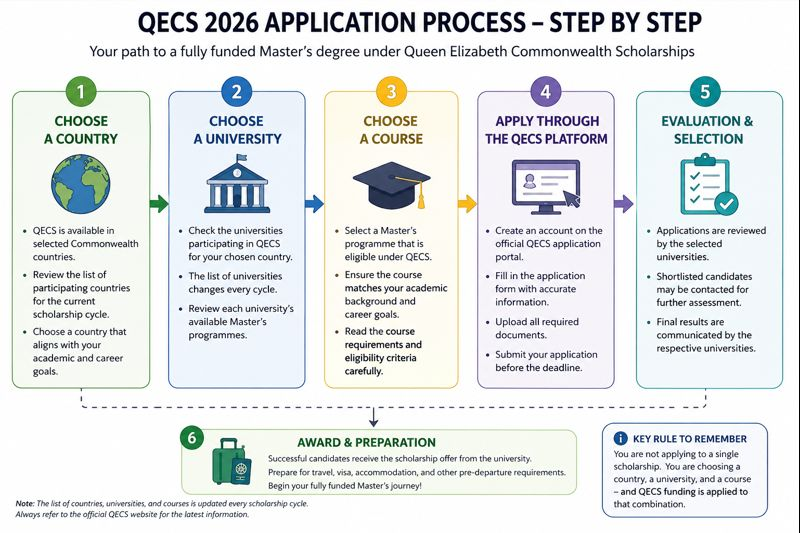
    Step 1: Choose a Country

    QECS scholarships are hosted in selected Commonwealth countries, usually in low and middle income regions.

    Your first decision is not “Which scholarship should I apply for?”
    It is:

    → Which country offers programmes that match my academic and career goals?

    Each country offers different universities and courses, so your options depend heavily on this choice similar to how country-level opportunities are explored under Europe Scholarships 2026.


    Step 2: Choose a University

    Once you select a country, the next step is to review the universities participating in that specific QECS cycle.

    This is where many applicants search for the Queen Elizabeth Commonwealth scholarship universities list, but it is important to understand:

    • the list changes every cycle
    • not all universities participate every year
    • each university offers specific eligible programmes

    So instead of looking for a static list, you should focus on the current cycle’s official university list.


    Step 3: Choose a Course

    After selecting a university, you must choose a master’s programme that is eligible under QECS.

    This is not optional.

    You cannot apply to QECS without selecting a specific course.

    Your course choice must:

    • match your academic background
    • align with your future goals
    • fit the eligibility criteria of the university

    Step 4: Apply Through the QECS Platform

    Once you have chosen your country, university, and course, you apply through the official QECS application system.

    Your application is evaluated based on:

    • your academic profile
    • your chosen programme
    • your overall fit for the opportunity

    This is why two applicants applying under QECS can have completely different application paths.

    Queen Elizabeth Commonwealth Scholarships application process choosing country university and course

    Key Rule

    You are not choosing “a scholarship.”

    You are choosing:

    → a country
    → a university
    → a course

    …and QECS funding is applied to that combination.

    If you understand this process clearly, your application becomes focused and structured instead of random.

    Queen Elizabeth Commonwealth Scholarship Universities List (2026)

    Queen Elizabeth Commonwealth Scholarships countries and universities distribution map

    The Queen Elizabeth Commonwealth scholarship universities list for 2026 is limited and changes every application cycle.

    For the 2026 cycle, QECS includes only a small number of host countries and universities.

    Confirmed QECS Universities (2026 Cycle)

    Papua New Guinea

    • Papua New Guinea University of Technology (Lae)

    South Africa

    • Stellenbosch University (Stellenbosch)
    • Tshwane University of Technology (Pretoria)

    Each of these universities offers specific master’s programmes only, not all courses.


    Important: The List Changes Every Cycle

    QECS does not have a permanent university list.

    Each cycle:

    • new universities may be added
    • some universities may be removed
    • available courses may change

    This is why you should always check the official QECS portal before applying.


    What This Means for Applicants

    You cannot apply broadly.

    You must choose:

    → one country
    → one university
    → one eligible master’s programme

    If your chosen university or course is not listed in the current QECS cycle, you cannot apply for funding through QECS. you can also explore country-level options through Fully Funded Scholarships 2026.


    Why the List Is Limited in Queen Elizabeth Commonwealth Scholarship

    QECS focuses on:

    • low and middle income Commonwealth countries
    • specific academic partnerships
    • selected programmes aligned with development goals

    This is why countries like:

    • UK
    • Canada
    • Australia

    are not included.


    What You Should Do Next

    Instead of searching for a general list:

    • check the current QECS cycle
    • review participating universities
    • shortlist eligible programmes
    • apply only to relevant options

    This approach is far more effective than relying on outdated lists.

    What Queen Elizabeth Commonwealth Scholarship Covers (2026)

    The Queen Elizabeth Commonwealth Scholarship 2026 fully funded package covers the essential costs of a master’s degree—but it is important to understand what “fully funded” actually means in practice.

    QECS is designed to support your core study expenses, not every possible cost.

    Queen Elizabeth Commonwealth Scholarship funding breakdown tuition stipend travel

    What Is Covered

    QECS provides a structured funding package that includes:

    • Tuition fees
      Your full tuition is covered through a combination of QECS funding and host university support.
    • Monthly living stipend
      A regular stipend is provided to cover basic living expenses such as accommodation, food, and transport.
    • Return airfare
      One economy-class return ticket from your home country to the host country.
    • Arrival allowance
      A one-time grant to help with initial costs after arrival.
    • Research support (limited)
      In some cases, additional funding may be available for thesis or research-related expenses.

    Queen Elizabeth Commonwealth Scholarship Stipend Amount

    The Queen Elizabeth Commonwealth Scholarship stipend amount is not fixed globally.

    Instead:

    • each host university sets its own monthly rate
    • the amount depends on the country’s cost of living

    This means:

    • in some countries, the stipend comfortably covers expenses
    • in others, you may need to budget carefully

    The goal is to cover basic living needs, not luxury or savings.


    What “Fully Funded” Does NOT Cover

    This is where many applicants misunderstand QECS.

    The scholarship does not cover:

    • accommodation directly (you pay rent from your stipend)
    • family or dependent expenses
    • personal or luxury spending
    • additional travel beyond the provided ticket
    • miscellaneous costs like visa fees or extra materials

    QECS is a functional funding model—it removes major financial barriers, but it does not eliminate all costs.


    What This Means for You

    Before applying, you should:

    • compare the stipend with the cost of living in your chosen country
    • check accommodation options near your university
    • plan for additional expenses not covered by QECS
    • choose your country and university based on both academic and financial fit

    Understanding this early helps you avoid unrealistic expectations and make better decisions.

    Queen Elizabeth Commonwealth Scholarship 2026 Deadline

    The Queen Elizabeth Commonwealth Scholarship 2026 deadline (Cycle 2) is:

    → 3 June 2026 (15:00 UTC)

    All applications must be submitted before this time through the official QECS platform. Late applications are not accepted.


    QECS Application Cycles Explained

    QECS runs two application cycles each year, and each cycle includes different countries, universities, and programmes.

    Cycle 2 (2026–2027 Intake)

    • Opens: April 2026
    • Deadline: 3 June 2026
    • Study start: Late 2026 or early 2027

    Cycle 1 (Expected)

    • Opens: November–December 2026
    • Deadline: January 2027 (approximate)
    • Study start: Mid–late 2027

    Each cycle is separate, and available universities change every time.You can also explore currently open opportunities through Scholarships Still Open 2026.


    Important Rules You Must Know

    • You must apply before the deadline — there are no extensions
    • You must apply for a specific university and course
    • You may also need to apply separately to the university
    • Missing either deadline can make your application invalid

    What You Should Do Now

    If you are targeting QECS 2026:

    • check available universities immediately
    • shortlist your course early
    • prepare documents in advance
    • submit your application before the final week

    QECS is competitive, and late preparation significantly reduces your chances.

    Queen Elizabeth Commonwealth Scholarship Eligibility Criteria (2026)

    To apply for the Queen Elizabeth scholarship for international students, you must meet strict eligibility requirements.

    QECS is not a general scholarship. It is designed for applicants who clearly match the criteria.


    Basic Requirements

    You must:

    • be a citizen of a Commonwealth country (or hold refugee status)
    • apply to study in a different Commonwealth country (not your own)
    • hold a bachelor’s degree with strong results (minimum 2:1 or equivalent)
    • apply for a full-time, on-campus master’s programme
    • meet the admission requirements of your chosen university

    Important Restrictions

    QECS does not support:

    • undergraduate programmes
    • PhD or doctoral programmes
    • part-time or online courses
    • study in high-income countries such as the UK, Canada, Australia, or New Zealand

    If you are searching for a Queen Elizabeth Commonwealth Scholarship for undergraduate, this programme is not suitable.


    What Strong Applicants Look Like

    Meeting the minimum criteria is not enough.

    Successful applicants usually have:

    • a clear academic background related to their chosen course
    • a defined study or career direction
    • a strong reason for choosing a specific country and university

    QECS selection is based on profile fit, not just eligibility.


    Key Rule

    Do not apply broadly.

    Apply where your profile clearly matches:

    → the country
    → the university
    → the programme

    If your profile does not align, your chances are extremely low.

    How to Apply for Queen Elizabeth Commonwealth Scholarship 2026

    Applying for the Queen Elizabeth Commonwealth Scholarship 2026 fully funded programme is a structured process.

    You are not applying to a general scholarship pool—you are applying to a specific country, university, and master’s course.


    Step-by-Step Application Process

    Step 1: Choose a Country

    Review the countries available in the current QECS cycle.

    Choose a country that:

    • offers programmes in your field
    • matches your academic background
    • aligns with your long-term goals

    Step 2: Select a University and Course

    Once you choose a country:

    • review participating universities
    • check eligible master’s programmes
    • select one specific course

    Only listed courses are eligible for QECS.


    Step 3: Check Eligibility

    Before applying:

    • confirm you meet QECS requirements
    • check university entry criteria
    • review academic and language requirements

    Do not apply if you do not meet the criteria.


    Step 4: Prepare Your Documents

    You will need:

    • academic transcripts
    • degree certificates
    • references
    • personal statement

    Prepare everything before starting your application.


    Step 5: Apply Through the QECS Portal

    Submit your application through the official QECS platform.

    Complete all sections and upload required documents.
    Incomplete applications are rejected.


    Step 6: Apply to the University (If Required)

    Some universities require a separate application.

    If required:

    • apply directly to the university
    • follow their deadlines
    • include all necessary documents

    Important Application Rules

    • You must apply before the deadline — no extensions
    • You must apply for a specific course and university
    • Missing documents will result in rejection
    • Only one QECS award can be granted

    What Makes a Strong Application

    Strong applications are:

    • focused on one clear study path
    • aligned with the chosen course
    • realistic and well-prepared

    Applying randomly reduces your chances.


    Final Advice

    Do not treat QECS like a mass application.

    Choose carefully:

    → the right country
    → the right university
    → the right programme

    Then build a focused application around that choice.

    Reality Check: How Competitive Is QECS 2026?

    The Queen Elizabeth Commonwealth Scholarship 2026 is a selective, course-specific master’s scholarship.

    It is only available for listed universities and courses in low- or middle-income Commonwealth countries, and your application is assessed based on how well it fits your chosen course, institution, and programme goals.


    Why Many Applications Fail

    According to official QECS guidance, many applications do not progress because:

    • applicants do not follow the instructions correctly
    • applications are not aligned with the selected course or university
    • candidates apply without clearly matching the programme requirements

    QECS is not evaluated as a general scholarship.

    It is evaluated based on fit.


    What This Means in Practice

    Even if you meet the eligibility criteria:

    • you are not guaranteed selection
    • you are competing with applicants who also meet the requirements
    • your application must clearly match your chosen course and institution

    This is why generic or unfocused applications fail.


    Important Clarification

    QECS requires you to apply to a specific university and course.

    You may apply again in another cycle or to another country, but each application must be:

    • separate
    • targeted
    • aligned with the selected option

    The Practical Rule

    Do not treat QECS like a general scholarship.

    Treat it as a course-specific opportunity where:

    → your selection determines your chances

    A well-aligned application has a realistic chance.
    A misaligned application usually does not progress.

    Who Should Apply for Queen Elizabeth Commonwealth Scholarship 2026

    Apply for the Queen Elizabeth Commonwealth Scholarship 2026 fully funded programme if your profile clearly matches the structure of the scholarship.

    This programme is best suited for applicants who:

    • are citizens of a Commonwealth country (or hold refugee status)
    • are applying to study in a different Commonwealth country
    • want a full-time, on-campus master’s programme
    • meet the minimum academic requirement (2:1 or equivalent)
    • are ready to choose a specific country, university, and course from the current QECS cycle
    • can prepare a clear study plan explaining their course, university, and country choice

    QECS works best for applicants who already have a defined academic direction.


    Who Should Not Apply to Queen Elizabeth Commonwealth Scholarship

    Do not apply if your approach does not match how QECS works.

    This programme is not suitable for applicants who:

    • are looking for undergraduate or PhD funding
    • are targeting part-time or online programmes
    • want to apply without selecting a specific course and university
    • are applying only because it is “fully funded” without a clear academic fit
    • do not meet the minimum eligibility requirements

    If your situation matches the above, your application is unlikely to progress.


    Important Clarification before applying to Queen Elizabeth Commonwealth Scholarship

    QECS requires you to apply to a specific university and course.

    • You can submit more than one application
    • But each application must be for a different country or university
    • You can submit only one application per host university

    Each application must be separate and fully aligned with the selected option.


    Final Decision Rule

    QECS is not about applying broadly.

    It is about applying where your profile clearly matches:

    → the course
    → the university
    → the country

    A well-aligned application has a realistic chance.
    A misaligned application usually does not progress.

    What Should You Do Next?

    If you are serious about applying for the Queen Elizabeth Commonwealth Scholarship 2026 fully funded programme, the next step is simple:

    Do not stay in research mode.

    Move to action.


    FAQs – Queen Elizabeth Commonwealth Scholarship 2026

    Is Queen Elizabeth Commonwealth Scholarship fully funded?
    Yes, it covers tuition, stipend, airfare, and basic living costs.

    Can I apply to multiple universities under QECS?
    Yes, but each application must be for a different country or university.

    What is the QECS 2026 deadline?
    The deadline for Cycle 2 is 3 June 2026 (15:00 UTC).

    Is QECS available for undergraduate students?
    No, it is only for master’s programmes.

    Can I study in the UK under QECS?
    No, QECS is only available in low and middle income Commonwealth countries.

    Your Next Steps

    Start with this sequence:

    1. Check the current QECS university list
      Confirm which countries, universities, and courses are available in this cycle
    2. Select one strong option
      Choose a course that matches your academic background and goals
    3. Review requirements carefully
      Make sure you meet both QECS and university criteria
    4. Prepare your documents early
      Transcripts, references, and personal statement
    5. Submit before the deadline
      Do not wait until the last week

    If QECS Is Not the Right Fit

    QECS is highly specific.

    If it does not match your profile, you should not force it.

    Instead, explore broader opportunities:

    • fully funded scholarships across multiple countries
    • scholarships still open for 2026
    • country-specific scholarship options

    Final Rule

    Do not apply blindly.

    Choose one direction, build a strong application, and execute it properly.

    That approach gives you a far better chance than applying randomly.

    Official Source

    For latest updates and application details:

    https://www.acu.ac.uk/funding-opportunities/for-students/scholarships/queen-elizabeth-commonwealth-scholarships

  • Fully Funded Scholarships in Germany 2026

    INTRO

    Germany operates on a fundamentally different funding model compared to the UK and the US. In high-tuition systems, scholarships often remove large fees. In Germany, tuition is already low or free in many public universities, so funding is built around living support rather than fee coverage.

    That means “fully funded” in Germany does not mean what most applicants think.

    If you are targeting fully funded scholarships in Germany 2026, the real decision is:

    → Which funding route actually fits your profile—and will it realistically support your stay?

    This page is for:

    • Master’s and PhD applicants targeting serious funding routes
    • Applicants ready to choose between DAAD, research grants, and structured programs
    • Students who want to move toward real applications, not exploration

    This page is not for:

    • Students looking for partial scholarships
    • Applicants expecting automatic full funding
    • Users browsing general “Europe scholarship lists”

    QUICK SUMMARY

    • Germany offers structured funding systems, not random scholarships
    • DAAD is the primary funding route
    • Research-based funding is a major pathway
    • Most opportunities target Master’s and PhD levels
    • Selection depends on profile alignment, not number of applications

    WHAT “FULLY FUNDED” MEANS IN GERMANY

    In Germany, fully funded usually means:

    • Monthly stipend
    • Health insurance
    • Travel support (in some cases)

    It does NOT always mean:

    • Complete financial coverage like UK/US scholarships
    • One package covering every cost without conditions

    Key clarifications:

    • Tuition-free ≠ fully funded
    • Germany’s model = living support system

    This is why many applicants misunderstand Germany and apply incorrectly.

    What Is Actually Covered vs What Is Not

    Even within fully funded routes, coverage is not identical across all programs.

    Typical coverage includes:

    • monthly stipend sufficient for basic living
    • health insurance support
    • partial or full travel support in some programs

    But this does not always include:

    • full housing guarantees
    • family support (in most cases)
    • complete cost coverage without budgeting

    This means “fully funded” in Germany is functional, not excessive. It allows you to study without financial instability, but it does not remove the need for basic financial planning.


    MAIN FULLY FUNDED ROUTES

    DAAD Scholarships

    DAAD is the most structured and reliable funding system in Germany.

    Core programs:

    • DAAD EPOS → development-focused Master’s funding
    • DAAD Research Grants → academic/research path
    • DAAD Postgraduate Scholarships → broader structured funding

    Example detailed routes:

    Why DAAD works:

    • Structured categories
    • Clear eligibility
    • Government-backed system

    If your goal is a predictable funding path, DAAD is your starting point.


    Research-Based and International Routes

    Germany also connects to broader funded systems such as:

    This route is:

    • highly competitive
    • multi-country
    • fully funded in many cases

    Best suited for:

    • strong academic profiles
    • international mobility

    Why Germany Is a Strong Fully Funded Destination

    Germany stands out because funding is built into the system rather than added as an exception.

    Key advantages:

    • Public universities reduce or eliminate tuition costs
    • Government-backed programs like DAAD provide structured funding
    • Foundations support long-term academic and social development
    • Strong research infrastructure supports funded academic pathways

    Unlike countries where funding is limited to a few highly competitive scholarships, Germany offers multiple structured routes — but each route has its own strict logic.

    WHICH ROUTE SHOULD YOU CHOOSE

    Use this decision filter:

    • Choose DAAD if:
      • you want structured, reliable funding
      • your program aligns with defined categories

    How DAAD Selection Works

    DAAD does not operate as a random selection pool.

    Selection is based on:

    • academic performance
    • relevance of your chosen program
    • clarity of your study or research plan
    • professional or academic trajectory

    Strong applicants usually show:

    • a clear reason for choosing Germany
    • a defined academic or professional direction
    • alignment with the specific DAAD program

    This means applying without a focused plan is one of the most common reasons for rejection.

    • Choose research grants if:
      • you are PhD-focused
      • your path depends on supervision
    • Choose Erasmus-type programs if:
      • you want international exposure
      • you meet high academic standards

    Practical rule:

    • Do NOT apply everywhere
    • Choose one route → build a strong application

    Common Mistakes Applicants Make

    Many applicants fail not because funding is unavailable, but because they misunderstand how Germany works.

    Common mistakes include:

    • applying to multiple unrelated routes without strategy
    • treating tuition-free admission as full funding
    • ignoring language or profile requirements
    • choosing scholarships based on name rather than fit

    Germany rewards structured applications. Random application strategies usually fail.

    COMMON MISCONCEPTIONS

    • “Germany is fully funded for everyone” → False
    • “No tuition means no expenses” → False
    • “DAAD is easy” → False

    Most applicants fail because they misunderstand the system—not because funding doesn’t exist.


    REALITY CHECK

    • Not all Germany scholarships are fully funded
    • DAAD is competitive
    • Research routes require strong profiles
    • Most applicants will not qualify for every option

    Assume:

    → If your profile does not match the route, your chances are very low


    NAVIGATION

    If you want to understand the broader Germany system:

    → https://www.scholarshipscentral.com/countries/germany

    If your focus is only fully funded opportunities globally:

    → https://www.scholarshipscentral.com/fully-funded-scholarships-2026

    If you are still exploring alternatives:

    → https://www.scholarshipscentral.com/scholarships-still-open-2026

    For direct scholarship paths, start with:

    • DAAD EPOS
    • DAAD postgraduate scholarships
    • Erasmus Mundus

    Official Sources

    The information on this page is based on the official funding bodies and scholarship providers in Germany. You should always verify details directly from these sources before applying:

    NEXT STEP

    Move from reading to execution with a clear plan:

    1. Identify your route (DAAD, research, or foundation)
    2. Check the exact eligibility and deadline for that route
    3. Open the specific scholarship page and understand requirements
    4. Prepare core documents early:
    • CV
    • academic transcripts
    • motivation letter
    • references
    • language proof
    • work or research evidence (if required)
    1. Build one strong application before considering additional routes

    Germany is not a volume-based system. It is a fit-based system.

    One well-prepared application aligned with the correct route is significantly stronger than multiple unfocused attempts.


    FINAL NOTE

    This page is not designed to list scholarships.

    It is designed to help you:

    → choose the correct route
    → avoid wasted applications
    → move toward real funding

    If you align your profile early, Germany becomes one of the most realistic fully funded destinations.

    If you don’t, it becomes noise.

  • University of Sheffield International Scholarship 2026

    This is a partial, university-level tuition discount for self-funded international undergraduate students starting at Sheffield in September 2026.

    This scholarship is for applicants who:

    • are classified as overseas fee payers
    • are applying to an eligible undergraduate programme
    • can financially cover most of the cost themselves

    This is not for:

    • students needing full funding
    • postgraduate applicants
    • applicants without a clear Sheffield commitment before the deadline

    If you are comparing broader UK options, start with:

    This scholarship is not comparable to major UK funding routes like Chevening or Commonwealth. It is structurally different and significantly narrower in financial scope.


    QUICK SUMMARY

    Scholarship: University of Sheffield International Undergraduate Scholarship 2026
    Institution: University of Sheffield
    Type: Partial (tuition fee discount)
    Study level: Undergraduate
    Deadline: 3 June 2026, 4pm UK time
    Result date: Not confirmed
    Coverage: £2,500 per year tuition discount (up to £10,000 for four-year programmes)
    Who can apply: Self-funded overseas students starting an eligible undergraduate degree in September 2026
    Key requirement: Must choose Sheffield as firm or insurance choice before deadline


    OVERVIEW

    This scholarship exists to reduce part of the tuition burden for international undergraduate students who commit to Sheffield within a defined timeline. It is not designed as a competitive, fully funded scholarship, and it does not attempt to cover total study costs.

    This distinguishes it clearly from major UK scholarships that are:

    • postgraduate-focused
    • leadership-driven
    • fully funded

    The naming can cause confusion. This is not a general Sheffield funding scheme, and it is not interchangeable with postgraduate or externally funded scholarships. It is a specific undergraduate tuition discount tied to admission and commitment timing.


    WHAT IT COVERS

    Confirmed:

    • £2,500 per year tuition fee reduction
    • Up to £10,000 total for four-year programmes
    • Renewal subject to:
      • minimum 60% weighted average
      • at least 120 credits per academic year

    Not provided (confirmed absent):

    • living stipend
    • travel funding
    • accommodation support
    • visa-related costs
    • health surcharge

    This is strictly a tuition discount only.


    REALITY CHECK

    Most applicants will not benefit meaningfully from this scholarship.

    This is not a broad or fallback scholarship. It does not solve the financial challenge of studying in the UK. If you do not already have a viable funding plan, this award does not change your situation.

    If you do not match the eligibility structure exactly or cannot cover remaining costs independently, your effective chance of using this scholarship is close to zero.


    ELIGIBILITY

    Strict requirements:

    • must start an undergraduate degree at Sheffield in September 2026
    • must choose Sheffield as firm or insurance choice before 3 June 2026 (4pm UK time)
    • must be self-funded
    • must be classified as an overseas fee-paying student
    • must study full-time

    Exclusions:

    • Medicine (A100/A101)
    • Dentistry (A200)
    • non-USIC foundation year students
    • most external sponsorship cases
    • distance learning or non-standard study routes

    Continuation requirement (for renewal):

    • minimum 60% weighted average
    • minimum 120 credits

    DEADLINE + RESULT DATE

    Deadline: 3 June 2026, 4pm UK time
    Result date: Not confirmed

    This timing is critical because the scholarship is tied to your university choice decision, not a separate scholarship application round. Missing this deadline eliminates eligibility regardless of academic strength.


    HOW TO APPLY

    1. Apply to an eligible undergraduate programme at the University of Sheffield
    2. Progress your admission to decision stage
    3. Choose Sheffield as firm or insurance choice before deadline
    4. Meet all eligibility conditions (fee status, funding status, course eligibility)

    There is no separate scholarship application form.


    HOW COMPETITIVE IS IT

    This does not operate as a typical competitive scholarship.

    There is no confirmed committee-based selection process. The structure indicates that the award is automatic for eligible applicants.

    However, this does not make it easy.

    The real filter is structural:

    • eligibility alignment
    • correct fee classification
    • correct course
    • correct timing

    Assume rejection is more likely than selection if you do not match the criteria exactly. Academic strength alone does not compensate for structural ineligibility.


    WHO SHOULD APPLY

    You should consider this scholarship only if:

    • you are applying for a Sheffield undergraduate programme
    • you are an overseas fee-paying student
    • you are fully or mostly self-funded
    • you understand this is a partial tuition reduction
    • you can commit to Sheffield before the deadline
    • you can cover remaining costs independently

    WHO SHOULD NOT APPLY

    Do not rely on this scholarship if:

    • you need full funding
    • you are applying for postgraduate study
    • you are applying to Medicine or Dentistry
    • you depend on external sponsorship that conflicts with rules
    • you are not committed specifically to Sheffield
    • you are applying generically to “any UK scholarship”

    Instead:

    • explore broader options at /countries/uk
    • review /fully-funded-scholarships-2026

    HOW SELECTION LIKELY WORKS (MANDATORY)

    Selection is not based on narrative strength or competitive ranking.

    It is based on structural eligibility:

    • correct applicant type
    • correct fee status
    • correct course
    • correct timing of university choice

    Alignment matters more than academic ambition. A strong applicant outside the rules is rejected. A correctly aligned applicant within the rules can receive the award automatically.


    FAQ

    Is this scholarship fully funded?
    No. It is a partial tuition fee discount.

    How much does it cover?
    £2,500 per year, up to £10,000 total for four-year programmes.

    Do I need to apply separately?
    No. It is awarded automatically if conditions are met.

    Who is eligible?
    Self-funded overseas undergraduate students meeting course and timing requirements.

    What is the deadline?
    3 June 2026, 4pm UK time.

    When are results announced?
    Not confirmed.

    Does it cover living costs or travel?
    No. It only reduces tuition fees.


    OFFICIAL SOURCE

  • UCL IOE Clarke Scholarships 2026

    UCL IOE Clarke Scholarships 2026 is a niche, highly targeted fully funded scholarship, not a broad international UK scholarship. It is designed for practising school teachers from South Africa who already hold an official unconditional offer for a full-time campus-based IOE master’s programme. This is not a scholarship you can “try your luck” with.

    That distinction matters because many pages ranking for this topic blur Clarke with broader UCL or IOE funding. That is inaccurate. Compared with major UK awards like Chevening and Commonwealth, the Clarke Scholarship is much narrower. Those schemes are broader UK scholarship brands with wider nationality reach and larger visibility. Clarke is more specialised, more restrictive, and built for one specific professional and national profile. That does not make it easier. It makes eligibility tighter and selection less forgiving.

    If you want broader UK routes first, see UK scholarships 2026. If you want stronger funding comparisons inside the same destination, see fully funded scholarships in UK 2026. If you want wider full-funding comparisons across destinations, see fully funded scholarships 2026.

    UCL IOE Clarke Scholarships 2026 Quick Summary

    • Scholarship: UCL IOE Clarke Scholarships 2026
    • Institution: UCL Institute of Education
    • Type: fully funded targeted scholarship
    • Study level: master’s
    • Deadline: Monday 4 May 2026, 23:55 BST
    • Result date: by Friday 12 June 2026
    • Coverage: return flights to London, tuition fees, annual stipend of £21,286
    • Who can apply: practising school teachers from South Africa
    • Key requirement: official unconditional offer to a full-time campus-based IOE master’s programme

    Overview of UCL IOE Clarke Scholarships

    The Clarke Scholarship exists because IOE received support from the family of Sir Fred Clarke to fund teachers from South Africa. So this is not just a scholarship for strong applicants in general. It is a scholarship with a defined educational purpose and a defined applicant type.

    It also sits in a different position from broader UK awards. Chevening and Commonwealth are larger international schemes with wider eligibility and broader policy or leadership branding. Clarke is tighter, more profession-specific, and more restricted. If you qualify, it may be a better-fit scholarship than those larger schemes. If you do not qualify exactly, it is not an option at all.

    If you are exploring UCL postgraduate scholarships 2026, do not confuse this scholarship with:

    • IOE Centenary Masters Scholarships
    • IOE Centenary Doctoral Scholarships
    • other UCL funding routes

    Those are separate awards with different eligibility, audiences, and selection logic.

    What the UCL IOE Clarke Scholarships Covers

    The scholarship covers:

    • return flights to London
    • full tuition fees
    • an annual stipend of £21,286, paid monthly after arrival in London

    This is why the Clarke Scholarship should be treated as fully funded. It is not a tuition discount, a partial fee waiver, or a limited support package.

    Reality Check for UCL IOE Clarke Scholarships

    Most applicants will not be selected.

    This scholarship is narrow, fully funded, and tied to a specific applicant profile. That means the pool is smaller than broad UK scholarships, but the competition is still hard because nearly everyone who reaches this stage is already a serious candidate with a valid academic case and an unconditional offer.

    Be direct about the odds:

    • this is not a general UCL funding route
    • this is not a scholarship for any strong international applicant
    • this is not an easy secondary option
    • most people interested in it will either be ineligible or not selected

    If you do not fit the scholarship exactly, your chance is effectively zero. If you do fit it, selection is still difficult because this is a fully funded award for a tightly defined group, not a large-volume scheme.

    Who Can Apply for UCL IOE Clarke Scholarships

    Candidates should be:

    • practising school teachers
    • nationals and residents of South Africa
    • holding an official unconditional offer to study a campus-based master’s degree at IOE

    The unconditional offer requirement is a hard filter. You cannot treat admission and scholarship application as the same step.

    Deadline and Result Date

    • Application deadline: Monday 4 May 2026, 23:55 BST
    • Expected result date: by Friday 12 June 2026

    That result timing matters because many competing pages focus only on the deadline and ignore the outcome window.

    How to Apply for UCL IOE Clarke Scholarships

    1. Apply for an eligible full-time campus-based IOE master’s programme.
    2. Secure an official unconditional offer from UCL Admissions.
    3. Complete the scholarship application once applications are open.
    4. Submit before 4 May 2026, 23:55 BST.

    This sequence matters. Without the unconditional offer, the scholarship application does not stand.

    How Competitive Is UCL IOE Clarke Scholarships?

    This scholarship is highly competitive, and most eligible applicants should assume rejection is more likely than selection.

    The reason is structural:

    • it is fully funded
    • it is linked to a specific professional group
    • it requires an unconditional offer before scholarship application
    • it is designed for applicants whose background and future direction fit a specific educational purpose

    That means selection is not just about being qualified. It is about fitting the scholarship’s design better than other serious applicants. In practice, that usually favors candidates with a strong teaching profile, a clear reason for choosing their IOE programme, and a credible case for educational impact after study.

    How Selection Likely Works

    The Clarke Scholarship is likely evaluated based on alignment rather than volume metrics.

    That means applicants who:

    • clearly fit the teacher profile
    • have a strong academic reason for their IOE programme
    • show a realistic post-study education impact

    are more likely to be selected than candidates who are simply academically strong but less aligned with the scholarship’s purpose.

    Who Should Apply for UCL IOE Clarke Scholarships

    Apply only if you clearly meet the scholarship’s intended profile:

    • you are a practising school teacher
    • you are a national and resident of South Africa
    • you want a full-time campus-based IOE master’s programme
    • you already have, or are realistically close to securing, an unconditional offer
    • your application story is rooted in education practice and future educational impact

    This scholarship is best for applicants who already match the award naturally. It is a poor fit for applicants trying to reshape a generic study-abroad application into something it is not.

    Who Should Not Apply for UCL IOE Clarke Scholarships

    Do not apply if your case depends on stretching the eligibility rules.

    That includes anyone who:

    • is not a practising school teacher
    • is not a national and resident of South Africa
    • does not have an unconditional offer
    • is applying for an online or ineligible programme
    • is mainly looking for any fully funded UK scholarship
    • is treating Clarke as interchangeable with Chevening, Commonwealth, or other broad UK funding schemes

    If that is your situation, stop here and use UK scholarships 2026 or fully funded scholarships in UK 2026 instead.

    FAQ about UCL IOE Clarke Scholarships

    Is the UCL IOE Clarke Scholarship fully funded?

    Yes. It covers return flights, tuition fees, and an annual stipend of £21,286.

    Who is eligible for the Clarke Scholarship?

    The scholarship is for practising school teachers from South Africa who are nationals and residents of South Africa and who hold an unconditional offer for a full-time campus-based IOE master’s programme.

    What is the deadline for UCL IOE Clarke Scholarships 2026?

    The deadline is Monday 4 May 2026, 23:55 BST.

    When will results be announced?

    UCL says it aims to notify all scholarship applicants by Friday 12 June 2026.

    Do I need an unconditional offer before applying?

    Yes. The official UCL FAQs state that applicants must have an official unconditional offer before applying for the Clarke Scholarship.

    Official Source of UCL IOE Clarke Scholarships

  • Loughborough Future Leaders Scholarship 2026 Apply Guide

    If you search Loughborough Future Leaders Scholarship 2026, the key thing to know is that this is a £10,000 tuition fee discount, not a fully funded award. It is aimed at international students who can fund the remaining costs but want a meaningful reduction at a strong UK university. (lboro.ac.uk)

    One-line takeaway: This is worth applying for if you are a self‑funded international applicant with an offer and strong leadership evidence; it is not the right target if you need full tuition + living costs covered. (lboro.ac.uk)

    Loughborough Future Leaders Scholarship 2026 (Quick Answer)

    • Scholarship value: £10,000 tuition fee discount (one‑off, first year only) (lboro.ac.uk)
    • Deadline: 6 May 2026 (lboro.ac.uk)
    • Latest date to submit study application for eligibility: 15 April 2026 (lboro.ac.uk)
    • Who can apply: international fee‑paying, self‑funded students with an offer (lboro.ac.uk)
    • Result timing: announced by 1 June 2026 (lboro.ac.uk)
    • Key constraint: scholarships cannot be combined; highest value only if multiple awards (lboro.ac.uk)

    Loughborough Future Leaders Scholarship 2026 Overview

    ItemOfficial details
    Value£10,000 tuition fee discount (one‑off, first year) (lboro.ac.uk)
    Study levelUndergraduate + postgraduate taught (both campuses) (lboro.ac.uk)
    Applicant typeInternational fee‑paying, self‑funded with an offer (lboro.ac.uk)
    Deadline6 May 2026 (lboro.ac.uk)
    Offer timing ruleLatest study application date for eligibility: 15 April 2026 (lboro.ac.uk)
    Result timingBy 1 June 2026 (lboro.ac.uk)
    Awards scaleSmall number per geographic region (lboro.ac.uk)

    What Makes This Scholarship Different

    This scholarship is not a broad automatic discount. It is a leadership‑focused award with a clear deadline, a one‑off £10,000 reduction, and a requirement to show leadership impact in your application. (lboro.ac.uk)

    Compared with large‑volume schemes like SOAS Master’s Scholarships (International), Loughborough is more selective but offers a larger single discount. This matters because your decision should be based on value vs. probability:

    • Value: £10,000 is a meaningful tuition cut.
    • Probability: fewer awards, stronger leadership emphasis.

    The tradeoff: stronger single‑award value, but fewer awards and a tighter eligibility window. (lboro.ac.uk)

    Benefits (With Real Meaning)

    £10,000 tuition discount (first year only)

    This is a one‑off award applied to the first year of study. It directly reduces tuition but does not cover living costs or full tuition. (lboro.ac.uk)

    Leadership positioning

    The application explicitly requires leadership evidence and future plans. That makes this scholarship better for applicants with real leadership examples, not just high grades. (lboro.ac.uk)

    Predictable results timing

    Loughborough states results will be announced by 1 June 2026, which gives a clear decision window. (lboro.ac.uk)

    Eligibility (Include Who Should NOT Apply)

    You must:

    • be an international fee‑paying student
    • have an offer for an undergraduate or postgraduate taught programme
    • be self‑funded and able to cover remaining tuition and maintenance
    • apply by 6 May 2026
    • submit your study application by 15 April 2026 for eligibility (lboro.ac.uk)

    Who should NOT apply:

    • students needing full tuition + living cost coverage
    • applicants without an offer
    • students who cannot show leadership impact
    • applicants who missed the 15 April 2026 study application cut‑off (lboro.ac.uk)

    Required Documents

    Expect to provide:

    • proof of offer
    • evidence of leadership and future plans
    • documents required by the application form

    Loughborough emphasizes leadership evidence in the application itself. (lboro.ac.uk)

    Step‑by‑Step Application Process

    1. Apply for a programme and secure an offer (latest study application date: 15 April 2026). (lboro.ac.uk)
    2. Submit the scholarship application by 6 May 2026. (lboro.ac.uk)
    3. Wait for results, announced by 1 June 2026. (lboro.ac.uk)
    4. If selected, you may need to pay your CAS deposit within 14 days of offer (postgraduate guidance). (lboro.ac.uk)

    Strategy: How to Increase Your Chances

    • Apply early so your offer is in place before the scholarship deadline.
    • Show leadership impact, not generic ambition.
    • Be realistic about the cost gap: this is a discount, not a full package.
    • Compare with other UK options like SOAS Master’s Scholarships 2026 or Fully Funded Scholarships 2026 if you need stronger support.

    This is better for applicants who can pay the remainder of costs and want a strong UK brand.
    The tradeoff is higher selectivity and no living‑cost support. (lboro.ac.uk)

    Who Should Apply

    • international fee‑paying applicants with a confirmed offer
    • students with leadership evidence and clear future plans
    • applicants who can still cover remaining tuition and maintenance

    Who Should NOT Apply

    • students who need full tuition + living expenses
    • applicants without leadership track record
    • students who missed the study application cut‑off

    Extra Intent Sections

    Is this fully funded?

    No. It is a £10,000 tuition fee discount only. (lboro.ac.uk)

    Can I combine this with another scholarship?

    No. Loughborough states scholarships cannot be combined; the highest value award is applied if multiple are offered. (lboro.ac.uk)

    Is this available for both undergraduate and postgraduate?

    Yes, the scheme is listed for both study levels (see official pages). (lboro.ac.uk)

    Common Mistakes

    • applying without a confirmed offer
    • missing the 15 April study application cut‑off
    • assuming the award covers living costs
    • weak leadership evidence
    • assuming automatic selection

    FAQ

    What is the deadline?
    6 May 2026. (lboro.ac.uk)

    How much is the scholarship?
    £10,000 tuition fee discount (one‑off, first year). (lboro.ac.uk)

    When are results announced?
    By 1 June 2026. (lboro.ac.uk)

    Do I need an offer first?
    Yes, you must have an offer before applying. (lboro.ac.uk)

    Can I combine with other scholarships?
    No; only one scholarship can be held and the highest value applies. (lboro.ac.uk)

    Conclusion

    The Loughborough Future Leaders Scholarship 2026 is a high‑value £10,000 tuition discount for international students with leadership evidence and a confirmed offer. If you can fund the remaining costs, this is a strong UK option with a clear deadline and result window. If you need full tuition plus living support, use this only as part of a broader funding plan.

    Official sources

    Best next pages on Scholarships Central

    All scholarship blog posts

    Browse every article if you want application guides, deadline posts, and updates beyond result dates.

    Scholarships still open 2026 Use this if you want live opportunities to apply for before focusing on result timelines.

    Fully funded scholarships 2026Move here if your real priority is stronger funding coverage rather than announcement timing.

  • Durham Inspiring Excellence Postgraduate Scholarship 2026

    If you search Durham Inspiring Excellence Postgraduate Scholarship 2026, the main thing to understand is that this is a competitive tuition discount scholarship, not a fully funded UK master’s award. That distinction matters immediately, because the article should help you decide whether this is actually worth applying for, not just tell you the deadline.

    Durham offers this scholarship in two forms — £5,000 and £10,000 tuition fee discounts — for international students starting eligible postgraduate taught study in September 2026. The second-round deadline is 29 May 2026, which means it is still live, but you should not treat it like an automatic award.

    One-line takeaway: This is worth applying for if you are a strong self-funded overseas applicant who can still cover the remaining cost of a Durham master’s; it is not the right target if you need a truly fully funded scholarship.

    Durham Inspiring Excellence Postgraduate Scholarship 2026 (Quick Answer)

    • Scholarship: Durham Inspiring Excellence Postgraduate Scholarship 2026
    • University: Durham University
    • Level: Postgraduate taught
    • Funding: £5,000 or £10,000 tuition fee discount
    • Round 2 deadline: 29 May 2026 at midnight GMT
    • Start date: September 2026
    • Applicant type: International / overseas students
    • Study mode: One-year, full-time, in-person
    • Best for: strong self-funded students who want a meaningful tuition reduction
    • Key tradeoff: strong UK university brand, but not full funding

    Durham Inspiring Excellence Postgraduate Scholarship 2026 Overview

    ItemOfficial details
    Award typesInspiring Excellence £5K and Inspiring Excellence £10K
    Scholarship value£5,000 or £10,000 tuition fee discount
    Study levelPostgraduate taught
    Eligible programmesOne-year, full-time, in-person MSc, MA, LLM, or MDS
    Excluded programmesMBA, MSW, MA in Theology and Ministry
    Fee statusMust be classed as an overseas student
    Funding statusMust be self-funded
    Number of awardsLimited
    2nd round deadline29 May 2026
    2nd round result timingJune 2026

    What Makes This Scholarship Different

    Durham’s scholarship is different because it sits in the middle ground between:

    • very small elite scholarships
    • and broad automatic fee discounts

    It is competitive, but it is also more practical than many scholarships that expect essays, interviews, and a near-perfect profile for very small award pools.

    This matters because the funding is meaningful enough to reduce tuition pressure, but the scheme is still structured around realistic postgraduate applicants.

    Compared with broader fee-waiver routes like SOAS Master’s Scholarships (International) 2026, Durham usually offers:

    • fewer awards
    • potentially stronger value at the £10,000 level
    • a more competitive selection profile

    The tradeoff is clear: Durham may offer a larger single discount than some UK scholarship schemes, but it is not designed for applicants who need full tuition plus living costs covered.

    Benefits (With Real Meaning)

    £5,000 or £10,000 tuition discount

    The scholarship is offered in two award types:

    • £5,000
    • £10,000

    This is important because it directly reduces the cost of tuition, which can make a Durham master’s more realistic for some international students.

    Strong university brand

    This scholarship is attached to a highly visible UK university, which matters for applicants who are not just buying a discount but also evaluating academic reputation and career value.

    No requirement to hold an offer at the time of scholarship application

    Durham states that:

    • you must have submitted a complete postgraduate programme application and have a valid Student ID
    • but you are not required to hold an academic offer at the time of the scholarship application

    This is a practical advantage because it allows applicants to move earlier in the scholarship process.

    Is Durham Inspiring Excellence Postgraduate Scholarship 2026 Fully Funded?

    No.

    This is a tuition fee discount only. It does not cover:

    • living costs
    • accommodation
    • travel
    • visa costs
    • full tuition in most cases

    This matters because many students searching UK scholarships 2026 are actually looking for full cost coverage. This scholarship is not built for that.

    If you need stronger funding, you should also compare:

    • fully funded scholarships 2026
    • other UK scholarships 2026
    • higher-value postgraduate scholarships with stipend support

    Eligibility

    To be eligible, Durham says applicants must:

    • have applied to a one-year, full-time (in-person) taught MSc, MA, LLM, or MDS
    • start postgraduate study at Durham in September 2026
    • be classed as an overseas student for fee-paying purposes
    • be self-funded
    • not already be in receipt of any other scholarship, funding, or sponsorship from Durham or an external institution
    • meet or exceed the entry requirements for the programme applied for
    • complete the scholarship application form

    Programme exclusions

    The following are excluded:

    • MBA
    • MSW
    • MA in Theology and Ministry

    This directly affects whether the scholarship is worth targeting. Many applicants waste time applying for scholarships that do not cover their actual course.

    Who Should NOT Apply?

    This scholarship is not ideal if:

    • you need full tuition and living-cost support
    • you are not classed as an overseas student
    • you are not self-funded
    • your programme is excluded
    • you are looking for an automatic scholarship with no separate application
    • your academic profile is not strong enough to support a competitive tuition-discount application

    The tradeoff is simple: Durham is strong, but this scholarship still expects a serious applicant profile and independent financial capacity beyond the discount.

    Required Documents

    Durham’s scholarship process is tied to both:

    • your postgraduate academic application
    • and the scholarship application form

    You should expect to need:

    • a complete academic application through Durham’s postgraduate applicant portal
    • your valid Student ID
    • academic records and supporting documents for admission
    • the completed scholarship application form

    This matters because you cannot treat the scholarship form in isolation. The academic application is part of the scholarship path.

    How to Apply (Step by Step)

    Step 1: Apply for an eligible Durham postgraduate programme

    You need to submit a complete academic application through Durham’s postgraduate applicant portal.

    Step 2: Get your Student ID

    Durham says you must provide a valid Student ID, which is generated after submitting the postgraduate programme application.

    Step 3: Complete the scholarship application form

    In addition to the academic application, complete the Durham Inspiring Excellence Postgraduate Scholarship online application form.

    Step 4: Meet the live deadline

    The current live deadline is:

    • 2nd round selection: 29 May 2026 at midnight GMT

    Step 5: Wait for results

    Durham’s 2026 guidance says:

    • 2nd round scholarship winners will be announced in June 2026

    Step 6: Understand re-consideration rules

    Durham states that:

    • if you do not receive an academic offer before the 1st-round deadline, or
    • if you are unsuccessful in the 1st round

    you will be automatically considered for the 2nd round. You do not need to submit the scholarship form again.

    This is a practical strength of the scheme.

    Strategy: How to Increase Your Chances

    1. Treat this as a competitive scholarship, not a routine discount

    The official guidance calls it highly competitive. That means strong academics and a coherent postgraduate plan matter.

    2. Submit the academic application early

    This is better because your Student ID and complete academic file are needed to support the scholarship process.

    3. Use the second round if you missed the first, but do not delay unnecessarily

    The live round is still useful, but later timing always reduces flexibility.

    4. Be realistic about the cost gap

    A £5,000 or £10,000 tuition discount can be meaningful, but Durham remains an expensive UK study route overall.

    This matters because some applicants win tuition discounts and then realise the remaining tuition + living cost burden is still too high.

    5. Compare Durham against other UK scholarship models

    Unlike some large-volume schemes, Durham has:

    • limited awards
    • stronger brand positioning
    • a more competitive selection profile

    That makes it better for applicants with a stronger academic and impact profile.

    You should also compare:

    • SOAS Master’s Scholarships (International) 2026
    • fully funded scholarships 2026
    • scholarships still open 2026

    Who Should Apply?

    This scholarship is better for:

    • international students applying to one-year, in-person taught master’s study
    • self-funded applicants who can still cover the remaining costs
    • students targeting a strong UK university brand
    • applicants with a competitive academic profile
    • students who want a serious tuition reduction rather than a symbolic discount

    Extra Intent Questions

    Is the Durham Inspiring Excellence Postgraduate Scholarship automatic?

    No.

    You must:

    • submit an academic application
    • and complete the scholarship application form

    This is important because applicants often confuse Durham’s scholarship portfolio with automatic discounts.

    Can you apply without an academic offer?

    Yes, at the time of the scholarship application, you are not required to hold an academic offer yet.

    That is one of the more practical parts of the Durham setup.

    Does this scholarship cover living costs?

    No.

    This is a tuition discount only. It does not provide a living stipend or accommodation support.

    Common Mistakes

    • assuming £10,000 means fully funded study
    • applying for an excluded programme
    • forgetting that the scholarship is only for self-funded overseas students
    • delaying the academic application and losing time on the scholarship side
    • treating the scholarship as automatic
    • not calculating the remaining tuition and living-cost burden after the discount

    FAQ

    What is the deadline for Durham Inspiring Excellence Postgraduate Scholarship 2026?

    The current live deadline is the 2nd round deadline: 29 May 2026 at midnight GMT.

    How much is the scholarship worth?

    Durham offers two award types:

    • £5,000
    • £10,000
      as tuition fee discounts.

    Is Durham Inspiring Excellence Postgraduate Scholarship fully funded?

    No. It is a partial tuition fee discount only.

    Do I need an academic offer before applying?

    No. Durham states that you need a valid Student ID, but you do not need to hold an academic offer at the time of scholarship application.

    When will round 2 results be announced?

    According to the official guidance, 2nd round winners will be announced in June 2026.

    Conclusion

    The best way to approach Durham Inspiring Excellence Postgraduate Scholarship 2026 is as a competitive UK tuition-discount scholarship, not a fully funded master’s route. That makes it strong for a specific kind of applicant: an overseas student with a solid academic profile who can still fund the remaining gap.

    If that is your position, this scholarship is worth applying for before the 29 May 2026 deadline. If you need full cost coverage, use this only as part of a wider funding strategy rather than your only plan.

    Official Links

    Best next pages on Scholarships Central

    All scholarship blog posts

    Browse every article if you want application guides, deadline posts, and updates beyond result dates.

    Scholarships still open 2026 Use this if you want live opportunities to apply for before focusing on result timelines.

    Fully funded scholarships 2026Move here if your real priority is stronger funding coverage rather than announcement timing.

  • SOAS Master’s Scholarships (International) 2027

    Last updated: November 15, 2026

    Planning to study for a master’s degree in London in 2027? The SOAS Master’s Scholarships (International) are worth investigating if you have strong academic results and need help paying tuition fees.

    For the 2026/27 academic year, SOAS University of London offered more than 150 scholarships worth £8,000 each to eligible international master’s students.

    These awards reduced tuition fees. They did not provide full tuition, accommodation, flights or a monthly living allowance.

    Important update for 2027 applicants: The 2026 scholarship competition closed on June 30, 2026. SOAS currently lists its International Master’s Scholarships as opening in January, but it has not yet published the full 2027/28 award details, including the new amount, number of awards or application deadline.

    Students should not assume that the £8,000 award or the three deadlines from 2026 will be repeated.

    The good news is that SOAS has published its tuition fees for September 2027 entry. This means you can begin checking degree requirements and calculating costs before the next scholarship round is announced.

    This guide explains the previous scholarship requirements, how to prepare for the next round, what studying at SOAS will cost and how to avoid common application mistakes.

    SOAS Master’s Scholarships 2027: Quick Overview

    Scholarship detailsInformation
    UniversitySOAS University of London
    CountryUnited Kingdom
    ScholarshipSOAS Master’s Scholarships (International)
    Degree levelMaster’s
    Funding typePartial tuition-fee scholarship
    Previous scholarship value£8,000
    Previous number of awardsMore than 150
    Previous academic requirementUK 2:1 or international equivalent
    Study modeFull-time, on-campus
    Previous final deadlineJune 30, 2026 — closed
    2027/28 scholarship deadlineNot announced
    Next application openingListed as January by SOAS
    Intended intakeSeptember 2027

    Official scholarship page: SOAS Master’s Scholarships (International)

    Is the SOAS Master’s Scholarship 2027 Open?

    As of November 15, 2026, SOAS has not published a complete 2027/28 International Master’s Scholarship announcement.

    The university’s postgraduate scholarship directory currently lists the scheme as opening in January.

    However, the individual scholarship page still describes the previous 2026/27 competition.

    That competition had three application rounds:

    Previous scholarship roundDeadline
    First roundFebruary 28, 2026
    Second roundApril 30, 2026
    Third roundJune 30, 2026

    All three dates have passed.

    The January opening indication is useful for planning, but it should not be treated as a confirmed new deadline.

    Can You Apply for a Master’s Degree Starting in September 2027?

    SOAS’s postgraduate admissions page says that applications for September 2027 taught master’s programmes will open shortly.

    It also lists July 31 as the general master’s application deadline.

    Students should confirm the applicable academic year and course-specific deadlines when their chosen programme opens.

    Importantly, scholarships often close earlier than ordinary university admissions.

    If you want funding, do not plan to apply for your degree only at the end of July.

    Check the official SOAS postgraduate application guidance.

    What Is the SOAS Master’s Scholarship (International)?

    The SOAS Master’s Scholarship (International) is a university-funded award intended to recognise overseas applicants with strong academic performance.

    SOAS specialises in subjects including development studies, international relations, economics, law, politics, languages, anthropology and other areas of humanities and social sciences.

    For 2026/27, the university offered more than 150 scholarships worth £8,000 each.

    The award was provided as a tuition-fee waiver.

    This meant that successful students paid £8,000 less toward their eligible tuition fees.

    The scholarship was available for qualifying full-time, on-campus postgraduate taught programmes.

    It was not an automatic scholarship given to everyone who received admission.

    How Much Does the SOAS Master’s Scholarship Cover?

    The previous award was worth £8,000.

    ExpenseCovered under the 2026/27 scheme?
    Tuition fees£8,000 reduction
    Remaining tuitionStudent responsible
    AccommodationNo
    Food and personal expensesNo
    FlightsNo
    Visa expensesNo
    Monthly living stipendNo
    Entire second year of a two-year programmeNo

    The scholarship amount was deducted from the tuition fees rather than paid as a personal cash award.

    Is the SOAS Master’s Scholarship Fully Funded?

    No.

    The International Master’s Scholarship was a partial tuition-fee waiver.

    This distinction is particularly important for students whose families need a scholarship to cover nearly all overseas study costs.

    Receiving £8,000 toward tuition can make studying in the UK more affordable, but it does not eliminate the remaining tuition and living expenses.

    If you need a fully funded master’s degree, you should compare schemes that explicitly cover both tuition and living costs.

    One alternative is the Commonwealth Shared Scholarships 2027/28, which support eligible students on approved master’s programmes at participating UK universities.

    The Commonwealth Shared Scholarship has different eligibility rules and does not apply automatically to every SOAS degree.

    SOAS Master’s Tuition Fees for 2027/28

    Here is where families can make a more informed decision.

    SOAS has published its international postgraduate tuition fees for 2027/28.

    Programme categoryPublished overseas tuition
    Many MA, MSc and MRes subjects — Band 1£26,330
    Law — Band 3£28,950
    International Studies and Diplomacy — Band 4£29,990

    These are the university’s published fees for the relevant full-time course categories. They are not the prices of every individual SOAS programme.

    Some degrees have additional arrangements, including work placements or study over two years.

    How Much Tuition Would Remain After an £8,000 Scholarship?

    Suppose SOAS offers the same £8,000 scholarship value for 2027/28.

    This is only a planning example, because the next award amount is not confirmed.

    Programme category2027/28 tuitionHypothetical £8,000 waiverRemaining tuition
    Band 1£26,330£8,000£18,330
    Law£28,950£8,000£20,950
    International Studies and Diplomacy£29,990£8,000£21,990

    The calculation excludes accommodation, meals, transportation, visa expenses and other personal costs.

    The actual remaining tuition could be different if SOAS changes the scholarship value.

    For families: Before paying any tuition deposit, calculate whether you could afford the remaining amount plus living costs in London.

    A scholarship is valuable only if the overall study plan is financially workable.

    Check the latest figures on the official SOAS postgraduate tuition fees page.

    Who Can Apply for SOAS Master’s Scholarships?

    The following conditions applied to the 2026/27 International Master’s Scholarship.

    To qualify, students had to:

    • Hold an offer for an eligible full-time postgraduate taught programme delivered on campus.
    • Be assessed as overseas fee-paying students.
    • Hold a minimum UK upper second-class honours degree (2:1) or international equivalent.
    • Not hold another SOAS scholarship or full-fee sponsorship from another source.
    • Apply to an eligible programme rather than an excluded joint partnership programme.
    • Complete the separate scholarship application through the admissions portal.

    These requirements are provided for preparation. The final 2027/28 eligibility conditions must be checked when SOAS publishes the new competition.

    Are Part-Time and Online Courses Eligible?

    Under the previous International Master’s Scholarship rules, the award was for full-time, on-campus postgraduate taught study.

    Students applying for online or part-time degrees should investigate separate scholarship programmes.

    SOAS maintains an official postgraduate scholarship directory, which includes other award categories.

    Are Two-Year Master’s Degrees Eligible?

    Under the previous scheme, students on eligible two-year programmes could receive the scholarship, but the tuition waiver applied to the first year only.

    A student on a two-year master’s degree should therefore calculate tuition costs for both years.

    Do not assume that an £8,000 award will be repeated annually.

    What GPA Do You Need for the SOAS Master’s Scholarship?

    An important distinction exists between university admission and scholarship eligibility.

    SOAS’s general postgraduate admissions guidance says it may consider applicants with a UK 2:2 honours degree or equivalent, depending on the programme.

    However, the previous International Master’s Scholarship required at least a UK 2:1 honours degree or international equivalent.

    These are different standards.

    A student might qualify for admission to a master’s degree but not satisfy the scholarship’s previous academic threshold.

    Does a 3.0 CGPA Qualify?

    SOAS does not publish one universal CGPA conversion applying to every country and university.

    It assesses international qualifications according to their recognised equivalence and the requirements for the intended degree.

    For example, SOAS’s guidance for Pakistan lists certain recognised degree structures with a minimum First Division, CGPA 3.0 or 60%, subject to the institutions and qualifications specified on the university’s country page.

    However, meeting a general admission guideline does not automatically prove equivalence to the scholarship’s UK 2:1 requirement.

    If your degree classification is unclear, contact SOAS Admissions before assuming eligibility.

    Can Pakistani Students Apply?

    Yes. The previous International Master’s Scholarship was available to qualifying overseas fee-paying students rather than restricted to a particular country.

    Pakistani students could apply if they met the academic, programme and other eligibility conditions.

    For postgraduate admission, SOAS publishes guidance covering recognised Pakistani qualifications, including appropriate four-year bachelor’s degrees and certain bachelor-plus-master pathways.

    Students should check whether their awarding institution and qualification meet SOAS’s standards.

    Official information: SOAS entry requirements for Pakistani students

    Students from Bangladesh, India, Nigeria and other countries should use the requirements for their own qualifications.

    Is IELTS Required for SOAS Master’s Scholarships?

    IELTS is not the only accepted way to demonstrate English proficiency.

    SOAS accepts several tests and qualifying educational backgrounds.

    For direct entry to many on-campus postgraduate courses, its published requirements include:

    English testDirect-entry requirement
    IELTS Academic6.5 overall, minimum 6.0 in each component
    Duolingo English Test120 overall, minimum 110 in the relevant subscores
    PTE Academic65 overall, minimum 60 in each component
    LanguageCert Academic70 overall, minimum 65 in each component

    SOAS also accepts other approved tests and certain educational qualifications.

    Can You Apply Without IELTS?

    Yes, potentially.

    You may satisfy the English requirement using an accepted alternative test or an eligible exemption.

    However, an English-medium certificate from a university does not automatically guarantee an exemption.

    SOAS evaluates each applicant according to its English-language policy.

    The university also says students can submit an admission application before taking their English test, although any outstanding English requirement may become a condition of admission.

    Check the official SOAS English-language requirements.

    SOAS Master’s Scholarships 2027 Application Timeline

    We should distinguish confirmed 2026 facts from 2027 planning information.

    StageStatus
    Final 2026 scholarship roundClosed June 30, 2026
    September 2027 master’s admissionsOpening shortly
    Next international master’s scholarship openingSOAS directory indicates January
    2027 scholarship deadlineNot confirmed
    2027 award amountNot confirmed
    2027 number of awardsNot confirmed
    September 2027 programme startPlanned intake

    As the new scholarship announcement becomes available, students should check the official application page for the exact dates and any changes to eligibility.

    How to Apply for SOAS Master’s Scholarships 2027

    The following process reflects the previous International Master’s Scholarship application and SOAS’s current postgraduate admission guidance.

    The university may revise some steps for the next competition.

    Step 1: Choose a Master’s Degree

    Start with the programme you want to study.

    SOAS offers master’s degrees in subjects such as International Relations, Development Studies, Law, Economics, Finance, Politics and languages.

    Read the course description carefully.

    Check the academic requirements, course duration, delivery method, tuition fees and career relevance.

    Do not choose a degree solely because you believe it qualifies for scholarship funding.

    Official programme information: SOAS postgraduate study

    Step 2: Check Your Academic Eligibility

    Before applying, compare your qualifications with the entry requirements for your chosen programme.

    For the previous scholarship, applicants needed the equivalent of a UK 2:1 degree.

    If your grades meet the master’s admission requirement but fall below that threshold, you should not assume you qualify for this scholarship.

    Contact the university if you need clarification about degree equivalence.

    Step 3: Prepare Your Admission Documents

    SOAS’s current postgraduate guidance asks applicants to prepare relevant documents, including:

    • Academic transcripts and degree certificates.
    • Certified English translations for documents not originally issued in English.
    • A copy of the identification page of your passport.
    • A CV or résumé.
    • A supporting statement of approximately 1,000 words explaining your motivation and suitability.
    • Evidence of English proficiency, if already available.

    References are not generally required for the standard taught master’s admission application, although additional requirements may apply to particular situations or scholarship competitions.

    Follow the documents listed for your own course and application.

    Step 4: Apply for Admission

    Submit your master’s application through SOAS’s official admissions system once the September 2027 intake opens.

    The university’s current instructions allow you to apply for one main postgraduate programme per year and indicate a second-choice programme in the application.

    You cannot automatically hold offers for several SOAS master’s programmes at once.

    For admission guidance, visit:

    How to Apply for Postgraduate Study at SOAS

    Step 5: Receive Your Admission Decision

    Under the previous International Master’s Scholarship rules, applicants needed to hold an offer for an eligible full-time postgraduate taught programme.

    The university says it aims to process complete master’s applications within approximately four weeks, although the actual duration may vary.

    Apply early enough to obtain an admission decision before the scholarship’s deadline.

    Do not assume that simply submitting a university application guarantees eligibility for the scholarship.

    Step 6: Open the Scholarship Application in Your Portal

    In the previous competition, eligible students applied through the SOAS admissions portal.

    The scholarship became available to students meeting its basic eligibility criteria.

    If a scholarship was not displayed, applicants were instructed to check their eligibility and contact the Scholarships Office if necessary.

    When SOAS publishes its 2027/28 application, follow the current instructions shown in the portal.

    Step 7: Prepare Your Scholarship Application

    The scholarship panel previously considered both the scholarship application and the student’s university admission information.

    Students should therefore make sure their academic information, achievements and supporting statement are accurate and consistent.

    The admissions supporting statement should explain:

    • Why you chose your master’s programme.
    • How your previous education prepared you.
    • Which academic or professional interests motivate you.
    • How the degree connects to your future plans.
    • Why SOAS is a suitable institution for those goals.

    Use genuine experiences rather than generic claims.

    The scholarship may have its own questions, so do not assume the university admission statement replaces every scholarship requirement.

    Step 8: Submit Before the Scholarship Deadline

    Once the 2027 competition opens, check its precise deadline and time zone.

    The previous scholarship used several application rounds.

    However, SOAS has not confirmed that the same three-round structure will apply in 2027.

    Submit both the required university admission materials and the scholarship application by the relevant deadlines.

    Step 9: Monitor Your Scholarship Decision

    For 2026/27, SOAS stated that successful applicants with an offer would be notified within 10 working days of each scholarship deadline.

    This notification schedule has not yet been confirmed for 2027/28.

    Check the email address registered with SOAS and your applicant portal.

    Do not make financial plans on the assumption that scholarship funding has been awarded before you receive official confirmation.

    Important: The £4,000 SOAS CAS Deposit

    This is one of the most important costs for international applicants.

    SOAS currently requires students who need a Confirmation of Acceptance for Studies (CAS) to pay a £4,000 tuition deposit, unless a published exemption applies.

    The CAS is an important document for the UK Student visa process.

    Is the £4,000 an Additional University Fee?

    No.

    The deposit counts toward your tuition fees.

    It is not an extra £4,000 added on top of the tuition amount.

    For example, suppose a student’s remaining tuition is £18,330 after an applicable scholarship.

    If the student pays a £4,000 tuition deposit, that payment reduces the outstanding tuition balance.

    The student would then have £14,330 of tuition remaining, assuming no other payments or adjustments.

    This example does not include living expenses.

    Is the Deposit Refundable?

    The deposit is normally non-refundable, although SOAS publishes limited exceptions.

    These include certain circumstances involving timely withdrawal, programme cancellation or the university being unable to issue a CAS.

    Important: SOAS advises students not to pay the CAS deposit while waiting for a pending scholarship decision because the deposit is normally non-refundable.

    Before making any payment, read the official SOAS CAS deposit policy.

    Families should consider this payment when planning their finances.

    Can You Apply for More Than One SOAS Scholarship?

    Under the previous scholarship rules, students could apply for multiple SOAS scholarships or discounts.

    However, they could generally accept and apply only one SOAS scholarship or discount toward their tuition fees.

    This meant that a student winning two different university fee-waiver awards could not simply add the amounts together.

    If successful in more than one competition, they needed to select the option providing the greatest permitted benefit.

    The same principle applied to certain alumni, family and partnership discounts.

    Check the terms of each individual 2027 scholarship before planning to combine awards.

    What About SOAS Academic Excellence Scholarships?

    SOAS has another postgraduate funding programme called the International Academic Excellence Scholarship.

    In 2026/27, this separate competition offered:

    • Up to 25 scholarships covering full tuition fees.
    • Up to eight scholarships worth £20,000 each.

    These amounts related to the previous academic year.

    The Academic Excellence Scholarship is not the same as the £8,000 International Master’s Scholarship.

    It also has separate selection and application conditions.

    If your academic results are particularly strong, compare both schemes when SOAS announces the 2027/28 details.

    Official page: SOAS International Academic Excellence Scholarship

    Other Funding Options for International Students

    If you need more financial support than a partial tuition waiver, consider other scholarship programmes.

    Commonwealth Shared Scholarships

    The Commonwealth Shared Scholarships 2027/28 provide full approved tuition, living support and other specified benefits for eligible applicants to participating UK master’s programmes.

    The 2027/28 competition closes on December 8, 2026, according to the current programme announcement.

    Only approved courses at participating universities qualify.

    Chevening Scholarships

    Chevening Scholarships provide a separate funding route for eligible students pursuing a one-year UK master’s degree.

    The Chevening 2027/28 application window has already closed. Students who applied should follow the selection timetable, while future applicants can prepare for a later competition.

    University of Exeter Excellence Scholarships

    The University of Exeter Excellence Scholarships 2027/28 offer £15,000 tuition awards to eligible international applicants.

    These awards have different application and selection requirements and should be assessed independently.

    Choosing between scholarships should involve comparing total funding, eligibility and the expenses your family would still need to cover.

    Common Mistakes to Avoid

    The main problems students should watch for are:

    • Treating the June 30, 2026 deadline as a 2027 deadline.
    • Assuming the previous £8,000 award has already been confirmed for 2027/28.
    • Confusing general master’s admission eligibility with scholarship eligibility.
    • Assuming admission automatically gives you a scholarship.
    • Applying for a programme excluded under the scholarship conditions.
    • Expecting an £8,000 tuition waiver to cover living costs in London.
    • Forgetting to budget for the £4,000 CAS deposit.
    • Paying a normally non-refundable deposit without understanding the scholarship and refund conditions.
    • Assuming a two-year degree receives the tuition waiver in both years.
    • Assuming two SOAS tuition scholarships can automatically be combined.

    Preparing carefully for these issues will make the application process easier to understand.

    Frequently Asked Questions

    Is the SOAS Master’s Scholarship 2027 open?

    SOAS lists its International Master’s Scholarships as opening in January, but the complete 2027/28 application announcement has not yet been published.

    What is the SOAS Master’s Scholarship 2027 deadline?

    The deadline has not been confirmed. The previous competition closed on June 30, 2026.

    How much is the SOAS International Master’s Scholarship?

    The 2026/27 scholarship was worth £8,000 as a tuition-fee waiver. SOAS has not yet confirmed the amount for 2027/28.

    How many scholarships are available?

    SOAS offered more than 150 International Master’s Scholarships for 2026/27. The number available for 2027/28 remains unconfirmed.

    Is the scholarship fully funded?

    No. The previous International Master’s Scholarship provided a partial tuition discount, not full tuition and living expenses.

    Can Pakistani students apply?

    Under the previous conditions, eligible Pakistani students with overseas fee status could apply if they met the academic and programme requirements.

    Can Indian, Bangladeshi and Nigerian students apply?

    Yes, under the previous international eligibility rules, provided they met the applicable academic and other conditions.

    What is the minimum GPA?

    The previous scholarship required the equivalent of a UK 2:1 honours degree. SOAS assesses international qualifications according to its published standards rather than using one universal GPA conversion.

    Can students with a UK 2:2 degree apply?

    A UK 2:2 may satisfy general admission requirements for certain master’s programmes, but it did not meet the previous International Master’s Scholarship’s 2:1 academic requirement.

    Is IELTS compulsory?

    Not necessarily. SOAS accepts other approved English tests and certain educational qualifications.

    What is the IELTS requirement?

    For direct entry to many on-campus programmes, SOAS lists IELTS Academic 6.5 overall with at least 6.0 in each component.

    Do I need an admission offer before applying for the scholarship?

    Under the previous International Master’s Scholarship rules, applicants needed to hold an offer for an eligible programme.

    The 2027/28 conditions should be checked when published.

    Is the scholarship automatic?

    No. The previous competition required a separate scholarship application through the SOAS admissions portal.

    What is the CAS deposit?

    SOAS normally requires a £4,000 tuition deposit from students who need a CAS, unless an exemption applies. The amount is credited toward tuition fees.

    Is the £4,000 deposit refundable?

    Usually not. SOAS publishes limited refund exceptions. Students should review the terms before paying.

    Can I combine the International Master’s Scholarship with Academic Excellence funding?

    The previous conditions generally prevented students from stacking SOAS tuition-fee scholarships and discounts.

    Does SOAS offer fully funded master’s scholarships?

    SOAS lists several separate awards that can provide full tuition and maintenance support. Each has its own eligibility rules, deadlines and available places.

    Can PhD students apply?

    The International Master’s Scholarship discussed here was for eligible postgraduate taught programmes. PhD applicants should investigate SOAS postgraduate research scholarships.

    Will the 2027 scholarship have three application rounds?

    That has not yet been confirmed. The three-round structure belongs to the 2026/27 competition.

    Official SOAS Scholarship and Admissions Links

    For accurate information, use the university’s original resources:

    For scholarship questions, contact the SOAS Scholarships Office:

    scholarships@soas.ac.uk

    Final Advice: Should You Prepare for the SOAS Master’s Scholarship 2027?

    The SOAS International Master’s Scholarship may be a useful funding opportunity for students who have strong academic qualifications and can manage the remaining costs of studying in London.

    The previous £8,000 award offered meaningful tuition assistance to more than 150 students.

    However, the next scholarship’s amount, selection rules and application deadline have not yet been confirmed.

    Start by checking whether SOAS offers a master’s degree that matches your academic background and career plans.

    Then review its 2027/28 tuition fees and calculate the amount you would need to pay after any possible scholarship.

    If the remaining cost is affordable, prepare your admission documents and monitor the university’s postgraduate scholarship directory.

    If you need full tuition and living support, compare the separate full-funding opportunities before making a commitment.

    The next practical step is to prepare your master’s admission application and monitor SOAS for the official 2027/28 scholarship announcement.

    ScholarshipsCentral editorial verification: November 15, 2026. Historical scholarship figures refer to the confirmed 2026/27 competition. Tuition information is based on SOAS’s published 2027/28 fees. Applicants should verify the new scholarship terms and deadline directly with SOAS when announced.