Most applicants searching for CampusArt Results 2026 expect uncertainty. In this case, the answer is unusually clear.
Campus France has already confirmed the exact result date, which removes the guesswork common in many scholarship and admissions timelines.
One-line takeaway: CampusArt results will be released on 30 April 2026 on the official platform, with a fixed timeline rather than a phased release.
CampusArt Results 2026 (Quick Answer)
Official result date: 30 April 2026
Result platform: CampusArt platform
Release type: fixed date, not a gradual release window
Acceptance period: 30 April 2026 – 31 May 2026
Final confirmation deadline: 31 May 2026
CampusArt Results 2026 Overview
Item
Official position
Platform
CampusArt
Official result date
30 April 2026
Result location
CampusArt platform
Application deadline
28 February 2026
Offer acceptance period
30 April 2026 – 31 May 2026
Final confirmation deadline
31 May 2026
What Makes CampusArt Results 2026 Different
CampusArt results are different from many scholarship result pages because they are tied to a centralized online platform and a structured acceptance calendar.
Unlike scholarships like Chevening, where results are released gradually over a time window, CampusArt follows a fixed-date release model. This makes it more predictable, but it also requires faster decision-making after results.
According to the official Campus France notice:
results are announced on 30 April 2026
results appear on the CampusArt platform
students then move into a short decision window
This matters because applicants do not need to guess the month or chase unofficial timing rumors. The tradeoff is that once results appear, you need to act quickly.
When Will CampusArt Results 2026 Be Announced?
The official Campus France article says:
30 April 2026: results announced on the CampusArt platform
That is the strongest answer for this keyword.
This is important because many result pages online rely on indirect reporting. Here, the provider gives the exact date directly.
Is the CampusArt Result Date Already Announced?
Yes.
As of April 12, 2026, the official Campus France announcement already states that:
30 April 2026: results announced on the CampusArt platform
So this is not a prediction article. The official result date is already published.
How CampusArt Results 2026 Will Be Released
According to the official Campus France timeline:
results are announced on the CampusArt platform
students then have a defined period to accept or decline admission offers
that period runs from 30 April 2026 to 31 May 2026
This is better than a vague result system because the next step is also clearly defined.
If you get a result, the process does not stop there. You still need to act inside the acceptance timeline.
Emotional Reality: Why Applicants Should Not Panic Before 30 April
Because the result date is fixed, there is no need to track rumors or early signals.
If nothing appears before 30 April 2026, that is expected behavior, not a delay.
This is important because many applicants import anxiety from other scholarship systems where results are phased or unclear. CampusArt works differently. The official schedule already tells you when to expect the outcome.
What Happens After CampusArt Results Are Announced?
The official calendar says:
30 April 2026 – 31 May 2026: students accept or decline admission offers on their CampusArt account
31 May 2026: deadline to confirm the final choice of school on the CampusArt account
This directly affects what applicants should do now:
be ready to log in quickly
review offers carefully
do not wait until the last days of May to make the final decision
Strategy: How to Handle CampusArt Results 2026 Properly
1. Use the official platform, not social media updates
The result date is clear. The release point is also clear: the CampusArt platform.
That means checking unofficial student groups is less useful than checking the platform directly.
2. Prepare for decision-making before 30 April
Because the acceptance period starts immediately, you should already know:
which schools you prefer
which offer conditions matter most
whether your documents are ready for the next stage
3. Do not treat the result date as the end of the process
This is a common mistake.
The result day is only the start of the next stage:
review offers
accept or decline
confirm your final school choice before 31 May 2026
4. Keep alternative routes visible
If you are applying through multiple routes, you can also track Scholarship Results 2026 or explore Europe Scholarships 2026 to compare timelines across different programs.
For broader funding options, consider Fully Funded Scholarships 2026 instead of relying on a single admission route.
Who Should Read This Result Article?
This article is better for:
applicants who already submitted a CampusArt application
students waiting for official 2026 CampusArt results
users who want the exact provider-announced result date
Who Should NOT Rely Only on This Page?
This is not ideal for:
users looking for the full CampusArt application guide
students who have not yet applied
applicants expecting a scholarship-only result article rather than a platform-based admissions result timeline
Common Mistakes
waiting for unofficial rumors instead of the official platform date
forgetting that acceptance starts immediately after results
treating 30 April 2026 as the final step rather than the beginning of the response period
missing the 31 May 2026 final confirmation deadline
delaying school-choice decisions until the last minute
FAQ
When will CampusArt results be announced in 2026?
The official Campus France timeline says 30 April 2026.
Where will CampusArt results be released?
Results will be announced on the CampusArt platform.
Is the CampusArt result date officially confirmed?
Yes. The official Campus France article includes the date directly.
What happens after CampusArt results are announced?
Students can accept or decline admission offers between 30 April 2026 and 31 May 2026.
What is the final deadline after results?
The deadline to confirm the final choice of school on the CampusArt account is 31 May 2026.
Conclusion
CampusArt Results 2026 are one of the few cases where applicants do not need to guess. The official result date is fixed at 30 April 2026, and the outcome will be released on the platform.
The correct approach is not to track rumors but to prepare for what happens immediately after the result. The acceptance window is short, and decisions need to be made quickly.
If you understand the timeline and prepare in advance, this becomes a straightforward process. If not, it is easy to miss deadlines even after getting selected.
Most applicants searching for Entente Cordiale Scholarship Results 2026 want one simple answer: when will the decision come out? In this case, the official answer is actually clear.
According to the official Campus France UK schedule, the France Excellence Entente Cordiale Scholarship 2026 result period is set for mid-April 2026. That makes this one of the cleaner scholarship result pages to track, because the provider gives a direct time window rather than leaving applicants with vague post-interview uncertainty.
One-line takeaway: Expect Entente Cordiale Scholarship results in mid-April 2026, and treat that as the key official window instead of guessing from informal updates.
result window, not necessarily one exact public timestamp
Best applicant action
monitor official communication and stay ready for the next step
What Makes Entente Cordiale Scholarship Results 2026 Different
This result search is different from heavier scholarships like Chevening because the official timing is much tighter and easier to interpret.
For some scholarships, result articles need to explain uncertainty, phased release, or institution-led communication. Here, the strength is the opposite:
the official timeline is short
the result window is specific
the waiting period is easier to frame
This matters because a clear official result window reduces confusion and makes the article genuinely useful instead of speculative.
The tradeoff is simple: the timeline is clearer than many scholarship schemes, but applicants still should not assume all communication happens at one identical moment.
When Will Entente Cordiale Scholarship Results 2026 Be Announced?
The official Campus France UK application schedule says:
results: mid-April 2026
That is the core answer.
This is important because many scholarship result searches online get diluted with guesses, reposted dates, or unofficial comments. In this case, the provider itself gives the timing clearly enough to build a decision-safe result article.
Is the Entente Cordiale Result Date Already Announced?
Yes.
As of April 10, 2026, the official Campus France UK page already states that the result timing for the 2026 cycle is mid-April 2026.
So this is not a prediction-based article. The result window is already officially published.
What “Mid-April 2026” Actually Means
Applicants often read a result window and convert it into one exact assumed day. That is usually a mistake.
“Mid-April 2026” should be treated as:
an official release window
a timing range
a period where applicants should actively monitor communication
This is better than trying to force a false exact date where the provider has not given one.
Emotional Reality: What Applicants Usually Get Wrong
Most applicants become anxious when someone else claims to have heard something first or when no update appears immediately at the start of the window.
That reaction is common, but it is not always rational.
Silence before or around the beginning of the official result window does not automatically mean rejection. The correct benchmark is the official schedule, not applicant rumor cycles.
Strategy: How to Handle Entente Cordiale Scholarship Results 2026 Properly
1. Use the official result window, not discussion groups
The official provider says mid-April 2026. That is stronger than any forum screenshot or WhatsApp message.
2. Treat this as a result window, not a guaranteed one-minute release
Even with a clear timeline, communication can still move in a practical range rather than one public drop.
3. Keep your application communication channels active
Make sure you are checking:
email
spam/junk folders
the communication route used in your application process
4. Keep alternative funding routes visible
If this scholarship is only one part of your plan, do not stop there.
You can also track:
Scholarship Results 2026
Fully Funded Scholarships 2026
Europe Scholarships 2026
That gives you a better funding strategy than waiting passively on one outcome.
Who Should Read This Result Article?
This article is better for:
applicants already waiting for the Entente Cordiale result
users searching for the official 2026 result date
applicants who want official timing instead of speculation
Who Should NOT Rely Only on This Page?
This is not ideal for:
applicants looking for the full scholarship application guide
users who have not yet started the scholarship process
students who want broader France scholarship options rather than one result update
Common Mistakes
treating mid-April 2026 like one exact public release timestamp
relying on rumor-based updates instead of the official page
panicking too early during the result window
ignoring email or spam folders
focusing on one scholarship without backup funding options
FAQ
When will Entente Cordiale Scholarship results be announced in 2026?
The official Campus France UK schedule says mid-April 2026.
Is the result date officially announced?
Yes. The provider has already published the result timing window.
Does “mid-April 2026” mean one exact date?
Not necessarily. It is better treated as an official result window.
What should I do while waiting for the result?
Monitor your communication channels and keep backup funding options in view.
Is this result article based on an official source?
Yes. The timing is taken from the official Campus France UK scholarship schedule.
Conclusion
The right way to approach Entente Cordiale Scholarship Results 2026 is to use the official result window and ignore unnecessary speculation. The provider has already given a clear timing signal: mid-April 2026.
That means the smart approach is straightforward:
follow the official Campus France UK timeline
monitor your email carefully
do not panic if there is no instant update at the start of the window
keep broader scholarship options open while you wait
Trying to predict one exact minute is less useful than understanding the official release window correctly.
Most applicants searching for Eiffel Scholarship Results 2026 expect one exact release day and one direct student notification. That is the wrong model.
The France Excellence Eiffel Scholarship works differently. According to the official Campus France page, the publication of results starts from 30 March 2026, and the application system itself is institution-led, not student-led. That changes how you should track the outcome.
One-line takeaway: Eiffel Scholarship results for 2026 are officially scheduled from 30 March 2026, but students should track outcomes through their nominating French institution, not assume a simple direct-result email like some other scholarships.
Eiffel Scholarship Results 2026 (Quick Summary)
Official result timing: from 30 March 2026
Official source: Campus France
Application model: institutions apply, not students directly
Study levels covered: Master’s and PhD
Best way to track results: through the nominating French higher education institution
Main mistake to avoid: waiting for a student-style portal result when the process is institution-driven
Eiffel Scholarship Results 2026 Overview
Item
Official position
Scholarship
France Excellence Eiffel Scholarship Program
Official result timeline
Publication of results: from 30 March 2026
Application route
Only French higher education institutions submit applications
Student application model
No direct student application to Campus France
Best result-tracking method
Follow up with the nominating institution
What Makes Eiffel Scholarship Results 2026 Different
Eiffel results are different from many scholarship result searches because the scholarship is not student-submitted in the usual sense.
Campus France is clear that:
only applications submitted by French higher education institutions are accepted
students do not run the full process directly with Campus France the way they might with other scholarships
This matters because result tracking also works differently.
Unlike scholarships where candidates log into a personal portal and wait for a direct status update, Eiffel applicants usually need to stay aligned with the institution that nominated them. That is the key difference.
The tradeoff is simple: the official result date is clearer than many scholarships, but the student’s result path is less direct.
When Will Eiffel Scholarship Results 2026 Be Released?
The official Campus France scholarship page states:
Publication of results: from 30 March 2026
That is the strongest verified answer for this query.
This is important because many scholarship result pages online rely on recycled dates or forum guesses. Here, the result timing is directly stated on the official provider page.
Is the Eiffel Scholarship Result Date Already Announced?
Yes.
As of April 10, 2026, the official Campus France page for the France Excellence Eiffel Scholarship Program says the publication of results begins from 30 March 2026.
That means this is not a speculative result article. The result timeline has already been officially announced.
Is Eiffel Scholarship Results 2026 Already Out?
The official answer is that the publication of results starts from 30 March 2026.
That does not always mean every student sees the outcome the same way or at the same speed. Because the application is institution-led, the practical result flow may depend on:
when the institution receives or communicates the outcome
how the nominating school handles candidate updates
internal communication timing
This is where many applicants panic unnecessarily.
If someone else hears something first, that does not automatically mean your case is rejected. It may simply mean your institution has not communicated yet.
Why Applicants Get Confused About Eiffel Results
The confusion usually comes from applying the wrong mental model.
Most students are used to scholarships where:
they apply directly
they track a personal application
they expect a direct message on one exact day
Eiffel does not fit that pattern cleanly.
This makes a real difference because the result process depends more on the French institution than on a student-managed dashboard.
How Eiffel Scholarship Results Are Normally Reached
Based on the official structure:
French institutions submit the applications
Campus France handles the Eiffel program timeline
students interested in the program are directed through the institution route
So if you are waiting for Eiffel Scholarship Results 2026, the most practical next step is:
check whether your institution has already communicated outcomes
monitor the communication channel you used with that institution
avoid assuming silence means rejection on day one
Emotional Reality: Why This Result Window Feels Stressful
Most applicants panic when the date passes and they do not immediately get a clear answer.
That reaction is understandable, but it is often based on the wrong assumption.
In Eiffel’s case:
the official date refers to the publication of results starting
students may not all receive updates in the same way
institution-side communication can create timing differences
Silence does not automatically mean rejection during this period.
Strategy: How to Handle Eiffel Scholarship Results 2026 Properly
1. Use the official date, but not a one-day panic model
The official line is clear: results are published from 30 March 2026.
This is better than rumor-based tracking. But do not treat that as proof every institution will notify all candidates instantly.
2. Follow up with your nominating institution
This is the most important strategic step.
Because institutions submit Eiffel applications, your school or host institution is a key part of the results chain. That makes this different from more direct scholarship systems.
3. Do not compare Eiffel to direct-application scholarships
Unlike scholarships that release results directly to candidates, Eiffel is institution-mediated.
This matters because your timing can differ without meaning anything negative.
4. Keep backup funding options active
If you are still building your study-in-France plan, keep other funding routes in view.
You can also explore:
Scholarship Results 2026
Fully Funded Scholarships 2026
Europe Scholarships 2026
That is the better move than waiting passively on one result.
Who Should Read This Eiffel Results Article?
This is better for:
students already nominated or supported by a French institution
applicants waiting for the 2026 Eiffel result cycle
users searching for the official Eiffel result date rather than general scholarship information
Who Should NOT Rely Only on This Page?
This is not ideal for:
students who have not yet started the institution process
applicants looking for the full Eiffel application guide instead of result timing
users expecting one student-facing portal result system
Common Mistakes
assuming Eiffel works like a direct student application scholarship
expecting all candidates to receive outcomes in one identical way
ignoring the role of the nominating institution
treating silence immediately after 30 March 2026 as automatic rejection
relying on forum speculation instead of the official Campus France page
FAQ
When will Eiffel Scholarship results be released in 2026?
The official Campus France page states: Publication of results from 30 March 2026.
Is the Eiffel Scholarship result date officially announced?
Yes. The official 2026 Campaign Timeline includes the result publication date.
Do students apply directly for the Eiffel Scholarship?
No. Campus France states that only applications submitted by French higher education institutions are accepted.
How should I check my Eiffel Scholarship result?
You should track updates through the institution involved in your nomination or application support process.
Does no reply immediately after 30 March mean rejection?
No. Because the process is institution-driven, communication timing can vary.
Conclusion
The biggest mistake applicants make with Eiffel Scholarship Results 2026 is treating it like a direct student-result system. It is not.
The official result timing is clear: from 30 March 2026. But the practical reality is that Eiffel is institution-led, so result communication can move through the French higher education institution rather than through a simple one-day direct notification model.
The correct approach is straightforward:
rely on the official Campus France timeline
stay in contact with your nominating institution
do not panic if communication is not immediate
keep backup scholarship routes in view while waiting
Trying to predict one perfect result moment is less useful than understanding how the Eiffel process actually works.
If you search UP Scholarship 2026, the wrong assumption is that this works like a competitive scholarship. It does not.
This is a verification-driven Uttar Pradesh government support scheme, and most failures happen because of document errors, category mistakes, bank issues, or incomplete verification — not because another student “beat” you.
One-line takeaway: UP Scholarship 2026 is not a merit battle. It is a process-heavy state support system, so accurate documents and timely verification matter more than anything else.
UP Scholarship 2026 (Quick Summary)
Scheme: Uttar Pradesh Government Scholarship / Fee Reimbursement
Type: state financial support, not a fully funded scholarship
Main categories: Pre-Matric, Post-Matric, SC/ST, OBC, General/EWS, minority-linked routes where applicable
Application → institute verification → district/state verification → DBT payment
Funding style
Partial financial support, not a full-cost scholarship
Biggest failure point
Wrong bank details, certificate mismatch, late correction, unverified form
What Makes UP Scholarship 2026 Different
Most students compare this with international scholarships. That comparison is wrong.
This is not like:
fully funded scholarships 2026
Europe scholarships 2026
university merit scholarships with essays and rankings
This is:
a state support and reimbursement system
mostly based on eligibility and verification
heavily dependent on document consistency
This matters because the approval logic is different.
Unlike many scholarships that depend on essays, interviews, or ranking, UP Scholarship usually depends on:
whether you fit the category rules
whether your institution verifies you
whether your documents match
whether your bank and identity details clear verification
The tradeoff is simple: it is easier than high-competition scholarships, but it is much less forgiving on technical mistakes.
UP Scholarship 2026 Benefits (With Real Meaning)
Partial financial support, not full funding
UP Scholarship helps reduce education costs, but it is not designed to cover everything.
Depending on your course, category, and level, support may help with:
tuition support or fee reimbursement
books and study expenses
examination-related academic costs
This is important because many students search “scholarship” and assume full funding. That is not what this scheme is.
Category-based advantage
Support varies across categories and study levels.
In practice:
SC/ST students often have stronger benefit positions
OBC students may receive moderate support depending on rules
General/EWS students usually face stricter limits
This directly affects payout expectations.
Direct Bank Transfer
Funds are sent through DBT to the student’s bank account.
That is a strength because it reduces middlemen. But it also creates a technical dependency:
correct bank details
proper Aadhaar linkage where required
matching account identity
If your bank details are wrong, approval can still fail at the payment stage.
UP Scholarship 2026 Eligibility
The broad structure is consistent even when category-specific rules vary.
Core eligibility
Most applicants need to meet these basics:
be a resident of Uttar Pradesh
be studying in a recognized school, college, or institution
fall under an eligible category
meet the income limit applicable to that category
have the required academic and identity records
Academic and enrollment requirement
You must be:
currently enrolled in a valid course
able to show previous academic records where required
applying under the correct scholarship level and course type
Who should NOT treat this as the right scheme
This is not ideal for:
students outside Uttar Pradesh
applicants with missing income proof
students using fake or inconsistent documents
applicants expecting a full living-cost scholarship
students already dependent on conflicting aid without checking compatibility
This matters because the scheme rejects many technically weak applications even when the student looks eligible at first glance.
Required Documents
This is the highest-risk section of the entire process.
You should expect to need documents such as:
Aadhaar card
income certificate
caste certificate if applicable
previous marksheet
bank passbook or valid bank details
fee receipt
recent photo
institution-related details required by the portal
Critical rule
All core details must match across documents:
name
date of birth
category
bank identity
institution record
Even a small mismatch can trigger rejection, correction delay, or payment failure.
How to Apply for UP Scholarship 2026
The exact schedule can change by category and course, so use scholarship.up.gov.in for the live timeline. The operational flow is usually the same.
Step 1: Register on the official portal
Start from the official UP Scholarship portal and create the correct registration type.
Step 2: Fill the application form carefully
Enter:
personal details
academic details
category details
income details
bank details
This is important because most later problems start from incorrect first entry.
Step 3: Upload the required documents
Upload only valid and matching records.
Step 4: Submit to your institution
Your school or college is part of the approval chain. If the institution does not verify the form properly, your application can stall.
Step 5: Complete institutional verification
This is where many students wrongly assume the form is “done.” It is not.
Step 6: District and state-level verification
After the institution stage, higher-level verification checks the documents and scholarship eligibility.
Step 7: Track your status
Use the official portal regularly. Do not assume silence means approval.
Step 8: Receive DBT payment
If everything clears, payment is processed into the registered bank account.
Strategy: How to Increase Approval Chances
1. Apply early
This is better for students who want time to fix errors.
Late applications:
reduce correction flexibility
increase institutional delay risk
make verification harder to recover from
2. Treat document matching as the real selection test
Most rejections happen because of:
spelling mismatch
category mismatch
date-of-birth mismatch
bank-account mismatch
This matters because approval is procedural, not competitive.
3. Stay in contact with your institution
Your institution is not a passive step. It is a decision point in the chain.
If your school or college delays verification, your entire file can be delayed.
4. Track status regularly
Check status weekly during active processing periods.
Do not assume:
submitted = approved
verified = paid
eligible = safe
5. Use this scheme as support, not as your only plan
If you need bigger funding, this scheme is not enough on its own.
You should also explore:
scholarships still open 2026
fully funded scholarships 2026
Europe scholarships 2026 if your goal is international study
Who Should Apply?
This is better for:
UP-based students in recognized institutions
students from lower-income backgrounds
applicants who can provide clean and matching documentation
students who need fee support rather than full study abroad funding
Who Should NOT Apply?
This is not ideal for:
students outside Uttar Pradesh
applicants with incomplete certificates
students expecting full tuition + living-cost support
applicants who do not monitor verification and status updates
students planning overseas study who need larger funding packages
Extra Intent Questions
Is UP Scholarship 2026 fully funded?
No.
UP Scholarship is a partial support / reimbursement-oriented scheme, not a fully funded scholarship with tuition, living costs, and travel covered.
Can you apply without an income certificate?
No, in practical terms this is one of the most important documents in the process.
Without income proof, your application is structurally weak.
When is payment released?
Payment is released only after:
application submission
institution verification
district/state approval
successful DBT processing
This is why many students wait longer than expected.
Can your application be rejected even if you are eligible?
Yes.
This is one of the biggest misconceptions around UP Scholarship. Eligibility alone does not protect you if:
documents do not match
verification fails
bank details are wrong
required steps are missed
Common Mistakes
entering wrong bank details
uploading mismatched documents
using a name format that does not match certificates
ignoring institutional verification
applying late and losing correction time
assuming this is a competitive scholarship rather than a verification process
not checking status after submission
FAQ
Is UP Scholarship 2026 competitive?
Not in the normal scholarship sense. It is mostly eligibility-based and verification-driven.
What is the biggest reason for rejection?
Document mismatch and verification failure.
Is UP Scholarship enough for full study costs?
No. It is partial support, not a full-cost scholarship.
How do you check UP Scholarship status?
Through the official portal login and status-tracking system.
Should I rely only on UP Scholarship?
No, especially if you need larger funding. It is better to treat it as one support layer, not your full funding plan.
Conclusion
The key mistake students make with UP Scholarship 2026 is thinking approval depends on competition. It usually does not. Approval depends on execution.
If your documents match, your institution verifies on time, and your bank details are correct, approval becomes realistic. If those pieces fail, even an otherwise eligible application can be rejected.
The correct approach is simple:
apply early
match every document carefully
track status consistently
use the scheme as support, not as your only financial plan
Most applicants searching for Chevening Scholarship Results 2026 expect one exact release date. That assumption is wrong.
Chevening does not release results on a single global day. Instead, outcomes are sent gradually, which is why some candidates hear earlier while others wait longer.
One-line takeaway: Expect Chevening Scholarship Results in early-to-mid June 2026, released by email in phases, not all at once.
Key deadline after selection: 9 July 2026 (unconditional offer)
Unlike many scholarships that release results on a fixed global date, Chevening uses a phased release system. This means timing differences between applicants are normal and expected, not a signal of acceptance or rejection.
Chevening Scholarship Results 2026 (Quick Answer)
Official result window: early-to-mid June 2026
Main timeline wording: mid-June 2026
How results are sent: by email
Release style: gradual, not one single global drop
What happens next if selected: you complete the conditional award task-list and must meet the 9 July 2026, 17:00 BST unconditional-offer deadline
Best advice: do not compare your email timing with other applicants
Chevening Scholarship Results 2026 Overview
Item
Official position
Result timing
mid-June 2026 on the main application timeline
Related FAQ wording
from early June / from mid-June across official guidance pages
Result method
email notification
Release pattern
gradual release
University offer deadline for successful candidates
9 July 2026, 17:00 BST
What Makes Chevening Scholarship Results 2026 Different
Chevening Scholarship Results are different from many scholarship result searches because the real issue is not just the date. It is the release pattern.
Most applicants search as if there will be one fixed global results day. Chevening’s own guidance suggests something more flexible:
results are sent by email
results are released gradually
hearing later than someone else does not automatically mean rejection
This matters because result-day panic is usually driven by comparison on social media, not by official policy.
The tradeoff is that Chevening gives a real time window, but not a single universal timestamp for everyone.
When Will Chevening Scholarship Results 2026 Be Announced?
The safest official reading is this:
the main Chevening application timeline says results are announced from mid-June 2026
the post-interview guidance says candidates are informed by email from mid-June
at least one official FAQ uses early June wording
So the best decision-safe answer is:
Expected result window of Chevening Scholarship Results
Early-to-mid June 2026, with the main timeline anchored around mid-June 2026
This is better than pretending there is one exact date when the official pages themselves use slightly different phrasing.
Why There Is Date Confusion Around Chevening Scholarship Results
There is confusion because different official Chevening pages use slightly different wording for Chevening Scholarship Results:
mid-June 2026
from mid-June
from early June
This does not necessarily mean the process is broken. It usually means:
the release window is flexible
different pages were updated at different times
results are not meant to be interpreted as a single synchronized drop
This is important because applicants often treat wording differences as a sign of hidden delays, when the more likely explanation is staged release timing.
How Chevening Scholarship Results Are Released
According to official Chevening guidance:
all scholarship candidates are informed of the outcome of their interview by email
results are released gradually
receiving your result later than another person does not reflect your status
This directly affects how you should behave while waiting:
do not rely on WhatsApp rumors
do not assume silence means rejection
do not treat social media comparisons as official signals
Most applicants panic when they see others receiving results earlier. In the Chevening process, this is usually unnecessary.
Silence during the release window does not mean rejection. Because results are sent gradually, your timing alone is not a reliable signal of your outcome.
If you are still applying elsewhere while waiting, you can check scholarships still open in 2026 instead of focusing only on one result timeline.
What Happens If You Are Selected after Chevening Scholarship Results?
If your interview is successful, Chevening states that you will be invited to complete the conditional award process.
That includes tasks such as:
accepting the conditional award
uploading any UK university offers
uploading passport details
completing required forms in the online application system
The big practical deadline after results is:
9 July 2026 at 17:00 BST to submit at least one unconditional UK university offer
This matters because getting selected is not the end of the process. A result email creates a next-step deadline, not just a celebration moment.
What Happens If You Are a Reserve Candidate?
Chevening states that reserve candidates are placed on a waiting list.
That means:
you are not immediately selected
you are not immediately rejected
you may still be upgraded if funding or places become available
The tradeoff is obvious:
reserve status keeps the door open
but there is no guarantee of final selection
If you are on reserve, your university-offer progress still matters.
What Happens If You Are Unsuccessful?
Chevening’s official guidance is clear that unsuccessful candidates are informed, but detailed personalized feedback is not generally provided because of application volume.
This is better to understand early, because many applicants waste time waiting for detailed explanations that are unlikely to come.
Strategy: How to Handle the Chevening Results Window Properly
1. Treat the result as a window, not a single date
This is the most important mindset shift. The main timeline says mid-June 2026, but official guidance also uses broader wording. Expect a range.
2. Keep working on university offers before results arrive
This is important because the post-result timeline is tight. If you wait until after your result email to take your UK offer seriously, you may lose time.
3. Do not compare your timing to other candidates
Chevening explicitly says results are released gradually. Someone else hearing earlier tells you very little.
4. Watch your email carefully, including spam folders
Result notifications are sent by email. Missing the message creates avoidable confusion.
5. Separate scholarship result tracking from application discovery
If you are still applying elsewhere, use Scholarships Still Open 2026 or Fully Funded Scholarships 2026 instead of staying locked into one result page.
One of the most common mistakes is stopping all other progress while waiting for results. Because the post-result timeline is tight, delaying your university applications can reduce your chances even if you are selected.
Who Should Read This Result Article?
This article is better for:
applicants who already completed the Chevening interview
candidates waiting for scholarship outcome emails
users searching for official Chevening result timing rather than forum guesses
Who Should NOT Rely Only on This Page?
This is not ideal if:
you have not applied for Chevening yet
you are looking for the full application process instead of result timing
you want one exact universal result date that Chevening itself has not published
Common Mistakes
assuming Chevening results come out on one exact day worldwide
panicking because another applicant got an email first
ignoring the 9 July 2026 unconditional-offer deadline
treating unofficial social media claims as stronger than the official timeline
stopping university-offer work while waiting for the result
FAQ
When will Chevening Scholarship results be announced in 2026?
The safest official answer is early-to-mid June 2026, with the main application timeline pointing to mid-June 2026.
How will I receive my Chevening result?
Chevening says scholarship candidates are informed by email.
Are Chevening results released all at once?
No. Official guidance says results are released gradually.
If someone else got their result before me, am I rejected?
No. Chevening explicitly says earlier or later timing does not reflect your application status.
What is the next major deadline after a successful result?
If successful, you must submit at least one unconditional UK university offer by 9 July 2026 at 17:00 BST.
Conclusion
The biggest mistake applicants make with Chevening Scholarship Results 2026 is expecting a single fixed release date. Chevening does not work that way.
If you understand that results are released gradually across an early-to-mid June window, you avoid unnecessary panic and wrong assumptions. The correct approach is simple: monitor your email, continue progressing your university offers, and ignore unofficial timelines.
Trying to predict the exact day is less useful than being prepared for what happens after the result arrives.
If you search University of Padua Scholarships 2026, the biggest mistake is assuming there is one single scholarship. Padua does not work like that. It offers multiple funding routes, and choosing the wrong one is the main reason applicants miss out.
For most international students, the real strategy is not “apply for Padua scholarship” but identifying which route fits your profile — merit-based, fee-waiver, departmental, or external funding.
One-line takeaway: The Padua International Excellence Scholarship and the 100 fee-waivers are the most practical starting points, but they are not fully funded, and applying in the wrong period can significantly reduce your chances.
University of Padua Scholarships 2026 (Quick Summary)
Main scholarship: Padua International Excellence Scholarship
Funding: €8,000/year + tuition fee waiver
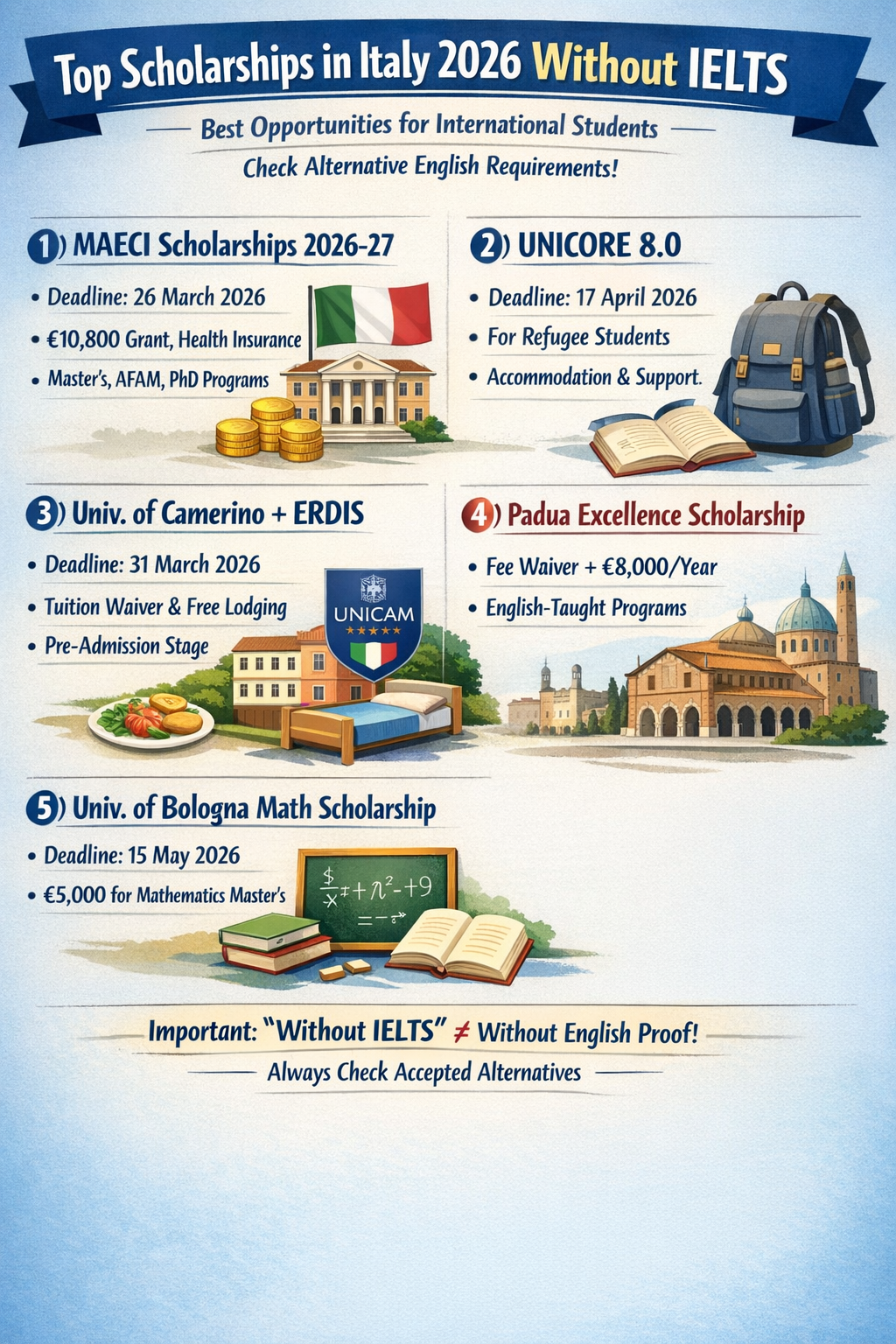
Other options: 100 fee-waivers, departmental scholarships, MAECI, Invest Your Talent in Italy
Fully funded: ❌ Not fully funded (living costs not fully covered)
Application: automatic with degree application
Best strategy: apply in the first application period
Compared to universities like Bologna or Sapienza, Padua offers a more structured merit-based system with clearly separated scholarship routes. However, those universities may offer broader or more fully funded options. Padua is stronger in clarity and process, but weaker if your goal is full living-cost coverage.
If you are looking for stronger full funding, you should also compare fully funded scholarships in Italy 2026, as Padua’s main routes do not fully cover living costs.
For broader options, check Europe scholarships 2026 to compare multiple countries and funding levels.
University of Padua Scholarships 2026 (Quick Answer)
Main scholarship route: Padua International Excellence Scholarship
Other major routes: 100 fee-waivers, departmental scholarships, MAECI, Invest Your Talent in Italy, Regione Veneto
Padua International Excellence funding: €8,000 gross per year + tuition fee-waiver
Main Excellence/departmental call size: up to 69 Padua International Excellence Scholarships + up to 30 departmental scholarships
Fee-waivers: 100 full tuition fee-waivers
Best for: international students applying to English-taught Bachelor’s or Master’s degrees
Key tradeoff: Padua has strong funding routes, but not all of them are fully funded
Official sources: University of Padua scholarship pages and 2026/27 official call
You can also explore other universities in Italy offering scholarships, such as Bologna and Sapienza, which follow slightly different funding structures.
University of Padua Scholarships 2026 Overview
Scholarship route
Funding
Study level
Who it fits best
Key 2026/27 note
Padua International Excellence Scholarship
€8,000 gross per year + tuition fee-waiver
Bachelor’s / Master’s / some single-cycle English-taught programmes
high-achieving international students
up to 69 scholarships
Departmental scholarships
under the same 2026/27 call, scholarships include €8,000 gross + tuition fee-waiver per academic year
selected English-taught programmes
strong applicants in specific departments
up to 30 additional scholarships
Fee-waivers
exemption from the second and third tuition instalments; first instalment still payable
English-taught degree programmes
students who want cost reduction even without stipend support
100 full tuition fee-waivers
MAECI scholarships
external government scholarship
usually Master’s / higher study routes depending call
students eligible for Italian government funding
separate external process
Invest Your Talent in Italy
subsistence allowance + fee-waiver + internship support
selected English-taught Master’s fields
Engineering, IT, Management, Economics applicants
external national programme
Regione Veneto scholarships
support for low-income students; awarded partly in cash and partly in services
Bachelor’s / Master’s / PhD
income-based applicants
not a merit-first scholarship
What Makes University of Padua Scholarships 2026 Different
Padua is different because it does not rely on one vague “international scholarship” label. It offers a stack of scholarship paths that serve different applicant types.
This matters because many university scholarship pages are hard to use: they mix merit awards, regional aid, and external scholarships into one confusing list. Padua is stronger than many competitors here because the main routes are clearly separated:
merit route: Padua International Excellence
cost-reduction route: 100 fee-waivers
department-specific route: additional scholarships in selected programmes
low-income route: Regione Veneto
government-linked route: MAECI and Invest Your Talent
The tradeoff is that the page is broader than a single-scholarship article. That means students need to choose the right route instead of assuming every Padua scholarship works the same way.
Benefits of University of Padua Scholarship (With Real Meaning)
1. Padua International Excellence Scholarship
The official 2026/27 call states that the scholarship includes:
€8,000 gross per academic year
a tuition fee-waiver
payment in 2 instalments of €4,000 gross each year
This is important because it is more than a simple discount, but it is not fully funded in the strict sense. Travel, insurance, and other costs are not included.
2. Departmental Scholarships
The 2026/27 English-taught scholarships call also covers:
up to 30 additional scholarships from selected departments
The same call states the scholarship includes:
€8,000 gross per academic year
a tuition fee-waiver
This is better for students applying to specific departments, because it creates more seats beyond the main Excellence pool.
3. Fee-Waivers
Padua also offers:
100 full tuition fee-waivers for students enrolling in English-taught degree programmes
The official page says:
you still pay the first instalment
you are exempt from the second and third instalments
This is better for students who may not win a cash scholarship but still need a serious cost reduction.
4. External and Regional Routes
The university also lists:
MAECI
Invest Your Talent in Italy
Regione Veneto scholarships
This matters because University of Padua Scholarship is not just one scholarship competition. It gives students multiple funding angles:
merit
government
departmental
low-income
Core Eligibility for the Main Padua Excellence / Departmental Call
To be eligible under the 2026/27 call, applicants must:
hold a non-Italian upper secondary qualification for Bachelor’s / single-cycle entry, or a non-Italian Bachelor’s degree for Master’s entry
not have Italian citizenship, except dual citizenship including Italian
not already reside in Italy under the call rules
apply for one or more English-taught degree programmes at the University of Padua
apply within the programme deadlines
note that you can apply to up to 2 degree programmes
This matters because the main Padua Excellence route is tied directly to the degree application, not a separate scholarship form.
Core Eligibility for Fee-Waivers
The fee-waiver page states that applicants should:
be talented prospective international students
have obtained their previous degree outside Italy
wish to enrol in an English-taught degree programme at Padua
not possess Italian citizenship, except dual citizenship including Italian
not reside in Italy
apply to an eligible English-taught programme
Who should NOT treat University of Padua Scholarship as the right first target?
This guide is not ideal if:
you only want a fully funded scholarship with living costs fully covered
you are applying only to non-English programmes
you already reside in Italy and do not meet the non-resident condition for the main merit routes
you want one scholarship application form separate from admission
The tradeoff is clear: Padua is strong, but the best-known routes are mainly for international students outside Italy entering English-taught programmes.
Required Documents for University of Padua Scholarship
For the main Padua merit-based routes, the official call is clear:
there is no separate scholarship application form
there are no extra scholarship documents beyond what is required for the selected degree programme
In practice, that means your main document burden comes from the degree application itself, such as:
prior academic qualification
transcripts
degree-specific admission documents
language-related proof if required by the programme
passport / identity documents used for admission
For external routes like MAECI or Invest Your Talent, requirements are separate and follow their own official calls.
Step-by-Step Application Process of University of Padua Scholarship
Step 1: Choose the right Padua route
Do not start by thinking “Padua scholarship” as one thing. First choose whether you are targeting:
Padua International Excellence
departmental scholarships
fee-waivers
MAECI
Invest Your Talent
Regione Veneto
For most international students, the first practical target is Excellence + fee-waiver consideration.
Step 2: Apply for an eligible degree programme
For the main Padua Excellence and fee-waiver routes, you must apply to an English-taught degree programme.
This matters because scholarship consideration is attached to admission.
Step 3: Watch the application period that applies to your programme
The 2026/27 call says scholarship results depend on programme type and admission period.
For the main Excellence / departmental call:
unlimited access programmes, 1st period: 2 November 2025 to 2 February 2026
limited access programmes, 1st period: 7 January 2026 to 7 March 2026
limited access programmes, 2nd period where needed: 10 March 2026 to 10 April 2026
unlimited access programmes, 2nd period where needed: 2 March 2026 to 2 May 2026
Step 4: Understand that selection is automatic
If you meet the requirements, you are automatically considered.
no separate scholarship form
no additional scholarship documents for the main call
This is better for applicants who want a simpler workflow.
Step 5: Check results on the official schedule
The 2026/27 call says scholarship selection results are published:
from 11 March 2026 for unlimited access degree programmes in the first period
from 10 April 2026 for limited access programmes in the first period
from 7 May 2026 for limited access programmes where scholarships were not awarded in the first period
from 4 June 2026 for unlimited access programmes where scholarships were not awarded in the first period
after entry test results for the relevant Medicine programmes
Step 6: Accept the offer and complete enrolment
If selected, you must:
accept the admission and scholarship offer
pay the admission fee by the deadline
not benefit from other incompatible scholarships
complete enrolment properly
meet visa conditions if applicable
Strategy Section: How to Increase Your Chances to get University of Padua Scholarship
1. Prioritize the first application period
The official call says scholarships are mainly reserved for candidates applying in the first application period.
This matters because waiting for the second period reduces your chances unless scholarships remain unassigned.
2. Apply to the right English-taught programme, not just any programme
This is better for students who are choosing carefully. Padua’s scholarship routes are not generic cash awards — they are tied to specific English-taught degree options and, in some cases, specific departments.
3. Treat academic strength as the main lever
Padua explicitly selects on:
academic excellence
quality
records from prior learning
The tradeoff is that broad motivation alone is unlikely to be enough. This is a merit-heavy route.
4. Use fee-waivers as the backup route
If you miss the Excellence Scholarship, the 100 fee-waivers still matter. This is important because many applicants focus only on cash awards and ignore major tuition relief.
5. Be realistic about cost coverage
Even the stronger Padua merit routes are not a full living-cost package. If you need full support, compare Padua with broader fully funded scholarships 2026 or other Italy scholarships 2026 routes.
Applying in the second application period significantly reduces your chances, because the official call states that most scholarships are allocated during the first period. Many applicants miss this and apply too late, which is one of the main reasons strong candidates fail to secure funding at Padua.
Who Should Apply to University of Padua Scholarship?
This guide is better for:
international students targeting English-taught Bachelor’s or Master’s programmes
strong academic applicants
students comfortable with merit-based competition
applicants who want automatic scholarship consideration through admission
students comparing scholarship routes in Italy and Europe
Who Should NOT Apply to University of Padua Scholarship?
This is not ideal for:
students who need a guaranteed full living-cost package
applicants focused only on non-English degree programmes
students who want one separate scholarship application process
applicants who already reside in Italy and may not fit the non-resident rule for the main merit routes
Is University of Padua Scholarship 2026 Fully Funded?
Not in the strict sense.
For the main Excellence and departmental call, the official benefit is:
€8,000 gross per year
tuition fee-waiver
But the call also says:
travel costs are not included
insurance and other expenses are not covered
So this is a strong merit scholarship, but it is not the same as a full stipend-plus-accommodation package.
Can You Apply Without a Separate Scholarship Application?
Yes, for the main Padua Excellence and fee-waiver routes.
This is one of University of Padua biggest advantages. The official pages say you are automatically considered if you meet the scholarship conditions and apply to the eligible degree programme.
This matters because it reduces friction compared with scholarships that require a separate portal, essays, and another deadline.
Does University of Padua Scholarship Cover Living Costs in Italy?
Partly, but not fully.
The €8,000 annual scholarship helps, but Padua’s own call says travel, insurance, and other costs are not included. That makes this better than a fee-only discount, but weaker than a true full-support scholarship.
Common Mistakes to avoid while applying to University of Padua Scholarship
treating University of Padua scholarship 2026 as one single award
ignoring the difference between Excellence, fee-waivers, and Regione Veneto
applying in the second period without understanding scholarships are mainly reserved for the first period
assuming €8,000 + fee-waiver means all living costs are covered
focusing only on the cash scholarship and ignoring the 100 fee-waivers
missing the fact that the main merit routes are tied to English-taught programmes
FAQ about University of Padua Scholarship
Does University of Padua offer scholarships in 2026?
Yes. The official university scholarship pages and the 2026/27 call confirm scholarship routes including Padua International Excellence Scholarships, departmental scholarships, and 100 fee-waivers.
How much is the Padua International Excellence Scholarship?
The official call states it includes:
€8,000 gross per academic year
a tuition fee-waiver
Is there a separate application for Padua International Excellence Scholarship?
No. The official call says eligible applicants are automatically considered when applying for the chosen degree programme.
How many Padua International Excellence Scholarships are there in 2026/27?
The official 2026/27 call states there are up to 69 Padua International Excellence Scholarships.
Does University of Padua also offer fee-waivers?
Yes. The official page states Padua offers 100 full tuition fee-waivers for students enrolling in English-taught degree programmes.
Conclusion
The correct way to approach University of Padua Scholarships 2026 is to treat it as a system, not a single opportunity. If you apply without understanding the different routes, you will likely target the wrong option or apply too late.
If you are a strong applicant aiming for an English-taught degree, University of Padua Scholarship offers one of the most structured scholarship systems in Italy. However, it is not fully funded in the strict sense, so it should be combined with other Italy scholarships 2026 or fully funded scholarships 2026 options if you need full financial support.
If you identify the right route early and apply in the first period, Padua becomes a strong and realistic scholarship option. If not, it becomes easy to miss.
The Goldsmiths Sanctuary Scholarship’s 2026 application round is closed. The previously published deadline was May 25, 2026, at midnight BST. Goldsmiths has not announced a confirmed 2027 application window. Applicants interested in a future round should monitor the official Goldsmiths scholarship page.
The Goldsmiths Sanctuary Scholarship 2026 offered substantial financial support to eligible students with refugee status or an active asylum application in the United Kingdom. Its funding package combined a full tuition fee waiver, a £8,825 allowance, and accommodation support.
Unlike general international scholarships, this award was designed for a specific group of applicants seeking access to higher education in the UK. It covered eligible undergraduate and taught postgraduate programmes at Goldsmiths, University of London.
Although applications for 2026 entry have closed, this guide explains the published eligibility rules, funding arrangements, documents, selection criteria, and previous application process so prospective applicants can understand the scholarship and prepare for any future announcement.
The Sanctuary Scholarship is a targeted financial-support programme at Goldsmiths, University of London.
The university’s published 2026 award structure provided up to four scholarships:
Two undergraduate awards for eligible students entering bachelor’s-level programmes.
Two taught postgraduate awards for eligible students entering postgraduate taught programmes.
Both groups were offered the same published funding package, subject to the university’s scholarship regulations.
This is not a general scholarship for international students applying from any country. Applicants needed to satisfy particular UK immigration-status requirements, hold an eligible Goldsmiths study offer, and meet the relevant academic and scholarship conditions.
The published 2026 application period has ended. A new application round, its eligibility rules, and its financial benefits should only be treated as confirmed once Goldsmiths publishes them.
What Makes the Goldsmiths Sanctuary Scholarship Different?
Many university scholarships primarily reduce tuition fees. The Sanctuary Scholarship’s 2026 package addressed several major study expenses simultaneously.
It included:
Full tuition fee support.
An allowance of £8,825.
Support towards accommodation in Goldsmiths halls of residence.
This combination can be particularly valuable for applicants who face financial and practical barriers to entering higher education.
However, its eligibility is considerably narrower than general merit-based or international scholarships. Immigration status and the requirement for an eligible Goldsmiths offer are central to the award.
Applicants who do not meet those conditions should look at other UK scholarships that match their circumstances rather than assume this opportunity is available to all overseas students.
Goldsmiths Sanctuary Scholarship 2026 Benefits
Full Tuition Fee Waiver
The published 2026 scholarship included a full tuition fee waiver for each year of study.
This could remove a major financial barrier for students undertaking an eligible degree at Goldsmiths.
The waiver was tied to the scholarship’s conditions and should not be interpreted as a guarantee for future application cycles.
£8,825 Allowance
Goldsmiths also listed a £8,825 allowance for successful scholarship recipients.
This was additional financial assistance beyond the tuition waiver.
The official award description does not establish that the same allowance will necessarily apply to a future cycle, so applicants should confirm the current award terms whenever applications reopen.
Accommodation Support
The 2026 scholarship included support for the accommodation fee of a single study bedroom in Goldsmiths halls of residence, up to £200 per week.
Students wishing to use Goldsmiths accommodation were instructed to submit a separate accommodation application.
Accommodation support does not necessarily eliminate every possible housing-related expense. Students should review their individual accommodation arrangements and other living costs.
Undergraduate and Postgraduate Support
Goldsmiths allocated up to two awards to undergraduate students and two to taught postgraduate students.
The scholarship was therefore relevant to both groups, provided they met the admission and immigration-status requirements.
It was not presented as a scholarship for online degree programmes or postgraduate research degrees.
Goldsmiths Sanctuary Scholarship 2026 Eligibility
According to the official 2026 criteria, applicants needed to meet Goldsmiths’ general scholarship regulations and several specific conditions.
Immigration-Status Requirements
Applicants needed to have either:
Refugee status in the United Kingdom; or
An active application for asylum in the United Kingdom.
Supporting documents demonstrating their status were required.
Goldsmiths also stated that applications from Ukrainian applicants seeking refuge in the UK under the relevant special Home Office arrangement would be considered.
Eligibility should not be determined from nationality alone. The specific status and documentation requirements are important.
University Admission Requirements
Applicants also needed to:
Hold an offer of study for an undergraduate or taught postgraduate programme at Goldsmiths.
Enrol in a programme delivered in person.
Be eligible to study in the UK.
Meet any applicable immigration conditions.
Students on Immigration Bail could not have conditions prohibiting them from studying.
Online programmes were not eligible under the published scholarship rules.
Who Was Not Eligible?
Applicants could not assume eligibility if they:
Were general international applicants without qualifying refugee or asylum-related status.
Did not meet the university’s relevant admission conditions.
Applied for an online programme.
Were subject to immigration conditions preventing study in the UK.
Anyone considering a future application should check the official regulations again because scholarship criteria can change between entry years.
The published requirements identified several important pieces of information and supporting evidence.
Immigration-Status Documentation
Applicants needed documentation demonstrating their refugee status in the UK or active asylum application.
Goldsmiths instructed applicants to upload supporting documents through their MyGoldsmiths account.
University Offer
Applicants needed an offer for an eligible undergraduate or taught postgraduate course.
An expression of interest in studying at the university was not equivalent to meeting this requirement.
Scholarship Application Form
Applicants also needed to complete the official scholarship application form and provide the information requested by the university.
Specific questions and document requests should always be checked against the live form for the relevant application round.
Accommodation Application
Students seeking Goldsmiths accommodation were instructed to make a separate accommodation application.
The university’s 2026 instructions asked applicants to mention the International Response Scholarship in the notes section.
This is the former name of the Sanctuary Scholarship.
How the Goldsmiths Sanctuary Scholarship 2026 Application Process Worked
The steps below describe the previous 2026 process. They are not instructions for submitting an application to a currently open round.
Step 1: Apply for an Eligible Degree
Applicants first needed to apply for an undergraduate or taught postgraduate programme at Goldsmiths.
The programme had to be delivered in person and meet the scholarship requirements.
Step 2: Obtain a Study Offer
The scholarship required applicants to hold an offer of study from Goldsmiths.
Prospective applicants therefore needed to understand the admission requirements for their chosen programme as well as the separate scholarship rules.
Step 3: Prepare Immigration-Status Evidence
Applicants needed to provide documents supporting their qualifying UK refugee or asylum-related status.
Goldsmiths directed them to submit the evidence through MyGoldsmiths.
Step 4: Submit the Scholarship Form
The previously published 2026 application window ran from February 16 to May 25, 2026.
Applications were submitted through the university’s scholarship form.
That application period has closed. Goldsmiths has not published a confirmed 2027 Sanctuary Scholarship application period.
Step 5: Complete Accommodation Arrangements
Applicants wishing to live in Goldsmiths halls also needed to follow the university’s accommodation application procedure.
The accommodation application was separate from the scholarship application.
Step 6: Await the Selection Decision
Eligible applications were considered through the university’s selection process.
Goldsmiths described initial eligibility screening followed by an awarding panel that assessed the applications and selected recipients and reserve candidates.
How Were Goldsmiths Sanctuary Scholarship Applicants Selected?
The scholarship was competitive, with up to four awards available for 2026 entry.
Goldsmiths described a two-stage process.
First, applications were reviewed against the eligibility requirements. Applicants who met the criteria then progressed to consideration by an awarding panel.
According to the official selection guidance, the panel considered:
Academic records.
Responses to the application questions.
The relevance and substance of applicants’ answers.
Applicants’ different skills, experiences, and circumstances.
Goldsmiths emphasized that the content and relevance of answers mattered, rather than polished writing style alone.
This is useful information for anyone interested in a future application. Applicants should explain their circumstances accurately and respond directly to the questions asked.
However, meeting the eligibility requirements did not guarantee an award.
Was the Goldsmiths Sanctuary Scholarship Easier to Obtain Than Other UK Scholarships?
There is no reliable basis for claiming that this scholarship was easier to win than other UK awards.
The eligible applicant population was narrower, but Goldsmiths offered only up to four awards in the 2026 round.
A restricted eligibility pool does not establish a higher acceptance rate.
What can be said is that this scholarship was designed for a specific group of students and assessed applicants using published eligibility and selection criteria.
Prospective applicants should focus on meeting those criteria rather than assuming their likelihood of success is higher.
Could Applicants Apply Without IELTS?
The Sanctuary Scholarship’s published eligibility section did not establish a separate IELTS requirement specifically for the award.
However, admission to a Goldsmiths degree may involve English-language requirements.
Those requirements depend on the chosen programme and the applicant’s circumstances.
Applicants should therefore check their programme’s admissions guidance rather than assume that scholarship eligibility removes English-language requirements.
Did the Scholarship Cover All Living Costs in London?
Not necessarily.
The 2026 package included a full tuition fee waiver, an £8,825 allowance, and accommodation support up to £200 per week.
These were substantial benefits, but the university’s published funding description did not guarantee that every personal expense would be covered.
Costs such as food, travel, personal expenses, and any accommodation costs beyond the support provided could still be relevant.
Students should evaluate their financial needs against the specific award terms rather than relying only on the description fully funded.
Common Mistakes Applicants Should Avoid in a Future Round
If Goldsmiths announces another application cycle, prospective applicants should avoid several common problems:
Assuming applications are already open. Confirm the new application window on the official university page.
Assuming all international students qualify. The scholarship has specific refugee and asylum-related eligibility requirements.
Applying without the required study offer. The published 2026 rules required an eligible Goldsmiths offer.
Overlooking in-person study requirements. Online programmes were excluded.
Failing to prepare immigration-status evidence. Relevant documentation formed part of the eligibility checks.
Confusing the scholarship form with the accommodation application. These were separate processes.
Treating an offer of admission as an automatic scholarship award. Recipients were selected competitively.
Reusing old application dates. The May 25, 2026 deadline should not be presented as a future deadline.
Goldsmiths Sanctuary Scholarship 2027: Is a New Round Confirmed?
As of October 25, 2026, Goldsmiths’ official Sanctuary Scholarship page continues to identify 2026 as the year of entry and states that applications are closed.
It does not publish a confirmed 2027 opening date or application deadline.
That means applicants should not assume that the previous February-to-May application window will automatically be repeated.
The scholarship may be offered again, but a future round, its funding, and its eligibility rules require an official announcement.
Is the Goldsmiths Sanctuary Scholarship still open in 2026?
No. Applications for 2026 entry are closed.
The previously published application deadline was May 25, 2026, at midnight BST.
When will the Goldsmiths Sanctuary Scholarship open for 2027?
Goldsmiths has not announced a confirmed 2027 application opening date on its official Sanctuary Scholarship page as of October 25, 2026.
Applicants should check the provider’s website for an announcement rather than rely on predicted dates.
Is the Goldsmiths Sanctuary Scholarship fully funded?
Its published 2026 package included a full tuition fee waiver, a £8,825 allowance, and accommodation support for a single room in Goldsmiths halls of residence up to £200 per week.
This was a substantial funding package, although it did not necessarily guarantee coverage of every personal living expense.
Can international students apply?
Not simply by being international students.
Applicants needed qualifying refugee or asylum-related status in the UK and had to satisfy the university’s additional eligibility criteria.
Do applicants need a Goldsmiths offer?
Yes. The published 2026 eligibility rules required an offer of study for an eligible undergraduate or taught postgraduate programme at Goldsmiths.
Are online programmes eligible?
No. The scholarship’s published criteria excluded online programmes.
How many Goldsmiths Sanctuary Scholarships were available?
Up to four awards were listed for 2026 entry: two undergraduate and two taught postgraduate.
Was IELTS required?
The scholarship’s published criteria did not specify a separate IELTS requirement. Applicants still needed to satisfy the English-language and admission requirements of their chosen Goldsmiths programme.
Can applicants use the old 2026 application form for 2027?
A 2027 application round has not been confirmed. Applicants should not assume that the old form, dates, or procedures will apply to any future cycle.
More Scholarships on Scholarships Central
Applicants looking for additional opportunities can explore:
Remember that eligibility, funding, and deadlines differ between scholarship programmes. Always check the official provider before treating an award as currently open.
Conclusion: Goldsmiths Sanctuary Scholarship 2026
The Goldsmiths Sanctuary Scholarship 2026 offered a substantial support package to qualifying students with UK refugee or asylum-related status. Its benefits included a full tuition fee waiver, a £8,825 allowance, and accommodation assistance for eligible undergraduate and taught postgraduate students.
The 2026 application round is now closed. The historical deadline was May 25, 2026, and Goldsmiths has not announced a confirmed 2027 application window.
For applicants considering a future round, the most useful preparation is to understand the published eligibility requirements, check the admission conditions for an appropriate Goldsmiths programme, and follow official announcements.
Do not submit an application based on an expired deadline or assume that previous funding arrangements will remain unchanged.
The UCL Global Undergraduate Scholarship is one of the most valuable funding opportunities for international students from lower-income families who want to study in the United Kingdom.
Offered by University College London (UCL), the scholarship helps students pursue full-time bachelor’s degrees by covering tuition fees. Some recipients also receive financial support for living expenses and additional costs.
For the 2026/27 academic year, UCL offered up to 33 scholarships, including 10 awards covering full tuition fees, maintenance support and an additional allowance.
Important update for 2027 applicants: The 2026/27 scholarship round closed on April 27, 2026. As of November 15, 2026, UCL has not yet published the application deadline or confirmed award allocation for the 2027/28 Global Undergraduate Scholarship.
However, applications for undergraduate admission starting in September 2027 are open.
Students interested in the next scholarship round can begin preparing their university admission application and financial documents now.
This guide explains the latest confirmed scholarship benefits, eligibility, household income requirements and application process. We also explain what families should prepare for the next round and how to avoid mistakes that could affect selection.
UCL Global Undergraduate Scholarship 2027: Quick Overview
Scholarship details
Information
University
University College London
Country
United Kingdom
Scholarship
UCL Global Undergraduate Scholarship
Degree level
Bachelor’s / Undergraduate
Funding
Full tuition; some awards include maintenance and additional costs
Latest confirmed number of awards
Up to 33 for 2026/27
Eligible applicants
International students from lower-income backgrounds
Main selection criterion
Financial need
Eligible courses
All full-time undergraduate degrees under the latest published scheme
The UCL Global Undergraduate Scholarship supports international students who have the academic qualifications to study at UCL but face financial barriers.
Unlike scholarships that primarily reward academic achievements or leadership, this scholarship is awarded on the basis of financial need.
This distinction is important.
A student may have excellent examination results but still need to provide detailed evidence showing that their family cannot reasonably cover the cost of studying in London.
UCL examines household income, available savings, other funding sources and relevant personal circumstances.
The scholarship is intended to make undergraduate education more accessible to students whose financial circumstances might otherwise prevent them from attending.
How Much Funding Does the UCL Global Undergraduate Scholarship Provide?
For the latest confirmed 2026/27 round, UCL offered up to 33 scholarships.
The awards were divided into three categories.
Scholarship category
Number of awards
Benefits
Full tuition + maintenance
10
Full tuition fees, maintenance allowance and fixed allowance for additional costs
Full tuition only
20
Full tuition fees
India-specific full tuition
3
Full tuition fees for eligible students from India
Total
33
Different funding packages
These are the confirmed 2026/27 figures.
The 2027/28 number of awards and benefits have not yet been published.
1. Full Tuition, Maintenance and Additional Costs
In the 2026/27 round, 10 scholarships covered:
Full undergraduate tuition fees.
A maintenance allowance to help with living expenses.
A fixed allowance for additional costs, such as visa fees and the Immigration Health Surcharge.
The scholarship was valid for the standard duration of the undergraduate degree.
UCL stated that the exact maintenance and additional allowance amounts would be confirmed separately.
This was the most comprehensive funding category in the published scheme.
2. Full Tuition Scholarships
Another 20 awards covered the full cost of tuition fees.
These awards did not automatically include living expenses.
A student receiving this category would still need to arrange funding for accommodation, meals, transportation and other personal expenses.
For a student whose family has limited income, full tuition support can make a major difference.
However, London is an expensive city. Families should calculate the remaining costs before accepting a university place.
3. Scholarships for Students from India
The 2026/27 scheme also included three additional full-tuition awards specifically for eligible students from India.
These awards followed the scheme’s financial-need requirements.
Students from Pakistan, Bangladesh, Nepal, Nigeria and other eligible countries could still compete for the main international scholarship categories.
The India-specific awards were not the only awards available to Indian applicants.
UCL has not yet confirmed whether the same country-specific allocation will apply in 2027/28.
Is the UCL Global Undergraduate Scholarship Fully Funded?
Some awards provide extensive funding, but not every award covers living expenses.
The 2026/27 scholarship included both tuition-only awards and awards covering tuition with additional financial support.
A full-tuition scholarship does not automatically pay for your accommodation, food, transport and personal expenses.
Even students awarded a maintenance allowance should review the exact value and payment conditions before assuming all expenses will be covered.
How Expensive Is Studying at UCL?
UCL has published tuition fees for September 2027 entry.
For example, the BA English programme lists an international tuition fee of £33,300 per year for the 2027/28 intake.
UCL’s published 2026/27 accommodation guide also gives an average rent of approximately £320 per week for an undergraduate student in self-catered university accommodation.
This equals approximately £12,480 for a 39-week academic year.
Consider the following illustration:
Expense
Example cost
First-year tuition: BA English, 2027/28
£33,300
Accommodation: 39 weeks at £320
£12,480
Total before food and other expenses
£45,780
The tuition figure is course-specific, while the rent figure is an average from the previous accommodation year. Actual 2027/28 housing prices and individual expenses may differ.
If a student receives a full-tuition-only scholarship, the £33,300 tuition cost in this example would be covered, but accommodation and other living expenses would still need funding.
This is why families should distinguish between full tuition funding and full-cost funding.
Who Is Eligible for the UCL Global Undergraduate Scholarship?
Under the latest confirmed 2026/27 rules, applicants had to meet three principal conditions:
Be eligible to pay UCL’s overseas tuition-fee rate.
Come from a low-income background.
Have submitted an admission application for a full-time undergraduate degree at UCL.
The scholarship covered all undergraduate degree programmes under that published scheme.
Applicants did not need to have received an admission offer before applying for the scholarship.
However, UCL Admissions had to confirm their overseas fee status before they could access the funding application.
These requirements are useful for preparing for 2027, but students must check the next published scholarship call for any changes.
Is There a Minimum GPA?
The Global Undergraduate Scholarship does not publish one universal GPA or percentage that guarantees selection.
Applicants must satisfy the academic requirements for their chosen UCL degree.
Once eligible, the scholarship itself is awarded primarily according to financial need.
For example, a student with excellent grades but substantial family resources may not have the same financial-need case as a similarly qualified student whose family cannot afford international university fees.
The scholarship does not remove the need to qualify for UCL admission.
What Does UCL Mean by a Low-Income Family?
This is one of the most important questions for applicants.
UCL’s general funding guidance describes:
Low income: Usually £25,000 or less in annual household income.
Lower income: Usually £42,875 or less in annual household income.
The Global Undergraduate Scholarship’s published 2026/27 page uses £42,875 as a guide.
However, this is not an absolute exclusion threshold.
UCL states that applicants may still be considered when household income exceeds the guide figure because other financial circumstances are assessed.
What If Your Family Earns More Than £42,875?
You should not automatically assume you are ineligible.
Consider the following situations:
Several family members depend on the same income.
The household has significant unavoidable expenses.
A parent recently lost their employment.
Family business income has declined.
A household member requires substantial ongoing financial support.
Exchange-rate fluctuations affect the family’s ability to afford overseas tuition.
These factors may be relevant to the financial assessment.
However, having additional expenses does not guarantee selection.
You must explain your actual circumstances accurately and provide evidence if requested.
How Does UCL Calculate Household Income?
UCL’s 2026/27 application guidance asks students to report the income used to support their household.
The form distinguishes between employment income, business income, savings and other financial resources.
Example: A Family with Salaried Employment
Suppose a student’s household receives:
Income source
Annual amount, illustrative
Parent’s salary
£9,000
Second household earner
£4,000
Rental income
£1,500
Total annual household income
£14,500
This is a fictional example to demonstrate the calculation, not an official UCL eligibility assessment.
The applicant would report the relevant income using UCL’s instructions.
Income figures must be consistent with supporting records.
What If Your Parents Run a Small Business?
UCL’s published guidance distinguishes business profit from total business sales.
For example, suppose a shop receives £20,000 in annual sales but has £16,000 in allowable operating expenses.
Its annual business profit would be £4,000.
The student’s family should not simply report £20,000 as business income if UCL’s form asks for the profit contributing to household support.
Likewise, a family with agricultural or irregular cash-based income may need to estimate earnings carefully and explain how those figures were calculated.
If you are uncertain, use the official application guidance or contact UCL’s Student Funding Office.
What If Your Family Has No Formal Income Certificate?
Some families earn money through small businesses, farming, informal employment or other activities without a conventional monthly payslip.
UCL’s 2026/27 guidance discusses alternative supporting evidence, including tax records, accountant-certified statements, bank statements and other relevant documentation.
It also allows applicants to explain situations where conventional records are unavailable.
Do not create false documents or invent income figures.
Describe the real circumstances and ask UCL which evidence would be acceptable.
What Documents Should You Prepare?
The next scholarship’s exact documentation requirements have not yet been published.
However, UCL’s latest application guidance indicates that the following information may be important.
Information or document
Purpose
UCL undergraduate admission application
Establishes admission application status
Confirmed overseas fee status
Scholarship eligibility
Household income figures
Financial assessment
Parent or household employment details
Income verification
Payslips or employment statements
Supporting salary evidence
Tax returns or business profit records
Business-income evidence
Bank statements
Evidence of income or available savings
Information about dependants
Household financial assessment
Details of other scholarships or loans
Calculates available study funding
Relevant exceptional expenses
Explains financial circumstances
You may not need to upload every document at the initial scholarship application stage.
For the 2026/27 scheme, UCL stated that shortlisted students would normally be asked for financial evidence later in the selection process.
Important Advice for Parents
Begin organizing legitimate financial records early.
If different family members contribute to household expenses, make a clear record of those contributions.
If household income changes significantly, keep documentation that explains what changed.
Do not assume that a single bank statement tells UCL everything about your family’s circumstances.
UCL Global Undergraduate Scholarship 2027: Important Dates
The following table separates confirmed admission dates from scholarship dates that remain unannounced.
Application stage
Date or status
UCL undergraduate admission for 2027
Open
Medicine UCAS deadline
October 15, 2026 — passed
Most undergraduate UCAS deadlines
January 13, 2027
Global Undergraduate Scholarship 2027/28 opens
Not announced
Global Undergraduate Scholarship 2027/28 closes
Not announced
Previous scholarship deadline
April 27, 2026
Previous award decisions
By June 3, 2026
Undergraduate studies begin
September 2027
The April 2026 scholarship date should only be used as historical information, not as a confirmed prediction for the next round.
Students should check UCL’s official scholarship website regularly.
How to Apply for the UCL Global Undergraduate Scholarship
The following process reflects UCL’s latest published application instructions for 2026/27.
The university may update the system, questions or deadlines for 2027/28.
Step 1: Choose an Undergraduate Degree at UCL
Start by finding a course that matches your educational background and future plans.
UCL offers undergraduate degrees in areas including Computer Science, Engineering, Economics, Architecture, Psychology, Sciences, Arts and other fields.
Each programme has its own academic requirements.
Review the course details before submitting an application.
These instructions describe the previous cycle. Applicants should confirm the current process when UCL announces the 2027/28 scholarship.
Step 6: Complete Your Financial Information
The scholarship application requests financial details.
Under the latest guidance, these included:
Household income.
Employment information.
Household dependants.
Exceptional financial circumstances.
Available student and family savings.
Loans and other funding.
The expected cost of studying at UCL.
The estimated amount of money still needed.
Use accurate figures and follow the instructions for the required tax year and currency.
For the 2026/27 application, students were instructed to report financial amounts in British pounds.
UCL may revise the reference tax years in the next application form.
Step 7: Explain Exceptional Circumstances
The previous application form included optional fields where students could explain relevant details not obvious from the income figures.
These included financial changes, unusual expenses and household responsibilities.
For example, a family might need to explain that a primary income earner has recently become unemployed.
The explanation should be factual and relevant to the funding assessment.
Avoid exaggerating hardship.
Step 8: Submit the Application Before the Official Deadline
When the next scholarship cycle is announced, submit the form before its confirmed deadline.
UCL states that late and incomplete applications are not considered.
In the previous cycle, students could review their answers before final submission, but could not change them afterward.
Applicants received an automated email confirmation after submission.
Step 9: Prepare Financial Evidence if Shortlisted
UCL’s Student Funding Office assesses eligible applications and may request evidence from shortlisted applicants.
The evidence must support the income and funding details included in the form.
Respond carefully to any requests and follow the deadlines provided by UCL.
Step 10: Wait for the Scholarship Decision
Under the 2026/27 process, successful students were notified before the relevant UCAS offer-response deadline where possible.
The university also warned that scholarship outcomes might not be available before an applicant needed to respond to an earlier university offer.
Students should therefore plan on the basis that scholarship funding is not guaranteed.
Does UCL Require a Scholarship Essay?
The published Global Undergraduate Scholarship application is primarily a detailed financial assessment.
It is different from scholarships that require a long personal statement about leadership or academic achievements.
Under the latest published form, students were asked to explain household finances, sources of funding and circumstances relevant to financial need.
Some answers had short character limits.
Rather than prepare a generic motivational essay, students should organize clear and accurate information about their financial situation.
UCL may change the questions for 2027/28, so follow the instructions in the actual application.
How Can You Improve Your Chances of Selection?
The scholarship is awarded based on financial need.
There is no guaranteed technique for receiving an award.
However, you can make your application clearer and more complete.
Explain Your Financial Circumstances Accurately
Do not simply say that studying in London is expensive.
Use the official form to explain the household income, available resources and financial shortfall.
Be Consistent
If your household has a particular annual income, the information in your application should be consistent with your supporting documents.
Where figures differ because circumstances have changed, explain the reason.
Report All Relevant Funding
UCL asks students to declare other financial support.
This can include scholarships, savings, loans and family contributions, depending on the form.
Hiding financial resources could affect the accuracy of your application.
Apply Early Enough to Resolve Access Problems
During the previous cycle, some applicants could not access the scholarship form because their overseas fee status had not yet been confirmed.
UCL advised eligible students to contact the Student Funding Office before the deadline if the form remained unavailable.
Applying for university admission early can reduce this risk.
What If Your Family Cannot Afford Any Living Expenses?
This is a serious consideration.
If you receive a full-tuition-only award, you may still need to pay for accommodation and living costs in London.
Under the previous application process, UCL asked students to identify funding sources and estimate the remaining shortfall over their degree.
Applicants with no family financial support could explain that situation in the relevant form fields.
However, UCL does not promise that every student with financial need will receive a tuition-plus-maintenance scholarship.
Before accepting an offer, understand whether you could realistically attend with the award you receive.
What If You Apply to More Than One UCL Degree?
Under UCL’s latest guidance, the scholarship application was specific to the undergraduate programme.
Students who applied to multiple programmes had to submit a separate scholarship application for each programme for which they wanted funding consideration.
Submitting multiple applications did not automatically increase their chances of winning.
UCL also instructed applicants to contact the Student Funding Office before changing their programme to protect scholarship eligibility.
Applicants should confirm whether these rules remain unchanged for 2027/28.
What If You Do Not Receive the Scholarship?
Not receiving funding does not necessarily mean your university admission application has been unsuccessful.
Admission and scholarship decisions are separate.
If you cannot afford UCL without substantial financial assistance, compare other universities before making a final decision.
These alternatives have different eligibility conditions. They should not be assumed to provide the same level of funding as UCL’s full-tuition scholarships.
What About UCL Master’s Scholarships?
The Global Undergraduate Scholarship is not the same as the UCL Global Master’s Scholarship.
That scheme has separate award amounts, eligibility requirements and deadlines. Its previously published 2026/27 round has closed.
Frequently Asked Questions
Is the UCL Global Undergraduate Scholarship 2027 open?
As of November 15, 2026, UCL has not announced the 2027/28 scholarship application deadline. The official page still displays the previous cycle, which closed in April 2026.
Can I apply to UCL for September 2027 now?
Yes. UCL’s 2027 undergraduate admissions process is open through UCAS.
What is the scholarship’s 2027 deadline?
The 2027/28 scholarship deadline has not yet been confirmed. The April 27, 2026 deadline applies only to the previous cycle.
Is the scholarship fully funded?
The previous scheme included 10 awards with full tuition, maintenance support and an additional allowance. Other awards covered tuition only.
How many scholarships are available?
UCL offered up to 33 awards for 2026/27. The 2027/28 allocation has not yet been confirmed.
Can Pakistani students apply?
Under the previous rules, students from countries outside the UK could apply if they had overseas fee status, met the financial-need conditions and had submitted an eligible UCL undergraduate application.
Pakistani applicants should check the next published eligibility rules before applying.
Can Indian students apply?
Yes, under the previous international eligibility conditions. The 2026/27 scheme also included three India-specific tuition awards. The 2027/28 country-specific allocation remains unconfirmed.
Is IELTS required?
The scholarship does not publish one universal IELTS requirement. Students must satisfy the admission and English-language conditions for their chosen UCL degree.
Is there a minimum GPA for the scholarship?
No universal scholarship GPA cutoff is published. Students must meet their programme’s academic requirements, while the scholarship selection is based on financial need.
What household income qualifies?
UCL generally uses £42,875 or less as a guide for lower-income households, but this is not an absolute cutoff. Other financial circumstances may be considered.
Can I apply with household income above £42,875?
Potentially. UCL says applications may still be considered above the guideline amount.
Do I need an admission offer before applying?
Under the previous scheme, no. You needed to have submitted an admission application and have your overseas fee status confirmed.
Do I need recommendation letters?
The previous scholarship guidance drew personal and academic details from the UCAS application and focused on financial information. Follow the next application form for any updated evidence requirements.
Do I need to upload income documents immediately?
Not necessarily. In the 2026/27 scheme, shortlisted applicants were asked to provide financial evidence later.
Can I apply for two different UCL programmes?
Yes, but the previous scholarship process required separate scholarship applications for each programme.
Is the scholarship for Master’s students?
No. The Global Undergraduate Scholarship is for bachelor’s degree study. UCL has a separate Global Master’s Scholarship.
Can I apply after the scholarship deadline?
UCL’s previous policy did not allow late or incomplete applications, including where admission offers arrived after the deadline.
What if my family’s income changes?
The published application guidance allows applicants to explain changes in household income and employment circumstances. Accurate supporting information may be requested.
How long does the scholarship last?
The previous scholarship was valid for the standard duration of the undergraduate programme. The next cycle’s rules should be checked when announced.
Final Advice: Should You Prepare for the UCL Global Undergraduate Scholarship 2027?
If you have the academic qualifications to study at UCL but your family cannot reasonably afford the tuition and living expenses, the Global Undergraduate Scholarship is worth monitoring.
It is particularly valuable because the previous scholarship scheme included awards covering all tuition fees, with some students receiving additional financial support.
However, it is important not to confuse the open 2027 university admissions process with a scholarship application round that has not yet been announced.
Start by reviewing the academic requirements for your chosen undergraduate degree.
Then discuss the likely costs with your family and organize accurate financial records that can support a future scholarship application.
Finally, monitor the official UCL scholarship website for the 2027/28 application opening, award values and deadline.
Your next practical step is to prepare your UCL undergraduate admission application, while waiting for UCL to publish the confirmed scholarship instructions.
ScholarshipsCentral editorial verification: November 15, 2026. Scholarship award figures, selection criteria and application instructions are from the last confirmed 2026/27 cycle. September 2027 admission information and tuition examples are based on UCL’s current 2027/28 admissions and fee pages.
The University of Bristol Think Big Scholarships 2027 are now open for international students who want to study in the United Kingdom.
For September 2027 entry, the University of Bristol offers undergraduate scholarships worth £6,500 or £13,000 per year, and postgraduate scholarships worth up to £26,000.
Students applying for an eligible master’s by research programme can also compete for 10 dedicated Think Big about Research awards.
The scholarship application deadline is 19 March 2027 at 1:00 PM UK time.
There is one important condition that students often misunderstand: you must apply for admission to Bristol before completing the scholarship form, but you do not need to have received an admission offer yet.
However, Bristol must issue your university offer before 8 April 2027 for your scholarship application to remain eligible.
Think Big is a valuable opportunity, but it is not a fully funded scholarship. The main awards reduce tuition fees, so students and their families must still plan for other education and living expenses.
This guide explains the funding, eligibility, application process, scholarship questions and selection requirements.
University of Bristol Think Big Scholarship 2027: Quick Overview
Is the University of Bristol Think Big Scholarship 2027 Open?
Yes. The University of Bristol confirms that applications opened on 27 October 2026.
The scholarship application period closes on Friday, 19 March 2027, at 1:00 PM UK time.
The university has also published the following selection timeline:
Stage
Date
Scholarship applications open
27 October 2026
Scholarship applications close
19 March 2027
University admission offer required by
8 April 2027
Scholarship outcomes announced
Early May 2027
Deadline to accept scholarship offer
End of May 2027
Formal award letters issued
July 2027
Study begins
September 2027
The scholarship deadline is separate from your chosen degree’s admission deadline.
If your programme closes applications earlier, you must follow that earlier university admission deadline.
Our advice: Submit your university application well before March 19. This allows time to receive your application ID and prepare your scholarship responses.
What Are the Bristol Think Big Scholarships?
Think Big is the University of Bristol’s main international scholarship programme.
For 2027, Bristol has announced an investment of up to £5 million in Think Big scholarships to help international students study at the university.
The programme includes funding for eligible undergraduate students, taught master’s students and master’s by research applicants.
Some additional scholarships are provided through university departments, donors and external partners.
One useful feature is that students can use one international scholarship application form to be considered for the participating scholarships for which they qualify.
This does not guarantee that every applicant qualifies for every award.
1. Think Big Undergraduate Scholarship 2027
The undergraduate scholarship supports eligible international students starting bachelor’s degrees at Bristol in September 2027.
Scholarship Benefits
There are two main award values:
£6,500 per year.
£13,000 per year.
The tuition discount may continue for up to four years, subject to the scholarship conditions.
For example:
Undergraduate award
Maximum value over four years
£6,500 per year
£26,000
£13,000 per year
£52,000
These totals assume the student qualifies for all four years of payments and the relevant tuition fees are payable.
Students on shorter courses will not automatically receive four years of funding.
Undergraduate Eligibility
You must:
Apply for an eligible full-time undergraduate degree delivered in person.
Be classified as an overseas student for tuition-fee purposes.
Apply for September 2027 entry.
Submit the Think Big scholarship application by March 19, 2027.
Receive an admission offer before April 8, 2027.
Meet the entry conditions in your formal UCAS offer by August 31, 2027.
Confirm Bristol as your firm UCAS choice.
The official 2027 scholarship guidance describes eligible in-person undergraduate study for up to four years.
Because course eligibility and programme structures can differ, check your intended degree against the current university guidance rather than relying on an older scholarship list.
Can Undergraduate Students Keep the Scholarship?
Yes, subject to academic progress.
Bristol’s 2027 terms state that undergraduate recipients must maintain satisfactory academic progress, defined as an average mark above 50% each year, for annual renewal.
Funding during placement or study-abroad years is subject to the amount of tuition charged. The discount cannot exceed the tuition fee for that year.
These conditions matter when calculating the total value of an award.
2. Think Big Postgraduate Scholarship 2027
The Think Big Postgraduate Scholarship supports eligible international students applying for master’s programmes at Bristol.
Postgraduate Scholarship Benefits
For September 2027 entry, the university lists four award amounts:
Award amount
Coverage
£3,000
First-year tuition discount
£6,500
First-year tuition discount
£13,000
First-year tuition discount
£26,000
First-year tuition discount
Unlike undergraduate funding, postgraduate Think Big funding is applied for a maximum of one year.
The award is not a monthly stipend, and it is not paid to students as cash.
Postgraduate Eligibility
You must:
Have applied for an eligible full-time master’s programme delivered in person.
Be an overseas fee-paying student.
Be applying for September 2027 entry.
Complete the scholarship application by March 19, 2027.
Receive an admission offer before April 8, 2027.
Meet the admission requirements for your chosen master’s programme.
The current Think Big guidance covers eligible one-year postgraduate taught and master’s by research programmes.
Are PhD students eligible?
The main Think Big scholarships described here are not a general PhD funding programme. Doctoral applicants should investigate research studentships and doctoral scholarships separately.
If you are considering several UK master’s funding opportunities, compare the University of Exeter Excellence Scholarships 2027/28, which provide competitive £15,000 tuition awards under different application rules.
3. Think Big about Research Scholarship 2027
The University of Bristol also offers a dedicated scholarship for students pursuing a master’s by research.
This is especially relevant to applicants interested in academic research, laboratory work or preparing for future doctoral study.
Research Scholarship Benefits
For September 2027, Bristol confirms 10 awards:
Number of awards
Value
5 scholarships
£13,000 each
5 scholarships
£6,500 each
Total
10 scholarships
These awards reduce the tuition fees for the first year of study.
They do not provide a guaranteed monthly stipend or full research expenses.
Who Can Apply?
Applicants must:
Have applied to a full-time master’s by research programme delivered in person at Bristol.
Have overseas tuition-fee status.
Meet the relevant admission requirements.
Submit the international scholarship application by the deadline.
Satisfy the offer and other conditions in the official 2027 scholarship terms.
Do Research Applicants Need an Admission Offer First?
Not when submitting the scholarship application.
You must already have applied to Bristol and received your application ID.
However, you must receive an admission offer before 8 April 2027 for your scholarship application to remain eligible.
Is the University of Bristol Think Big Scholarship Fully Funded?
No. The main Think Big awards are tuition-fee scholarships.
They reduce the amount of tuition you must pay, but they do not automatically cover accommodation, food, travel, visa expenses or other living costs.
How Much Will You Need to Pay After the Scholarship?
The remaining cost depends on your degree.
Suppose an eligible master’s course costs £30,000 in tuition fees. This is a hypothetical example, not a quoted fee for a specific Bristol programme.
Scholarship awarded
Remaining tuition
£3,000
£27,000
£6,500
£23,500
£13,000
£17,000
£26,000
£4,000
You must also budget for living expenses and other university-related costs.
For context, Bristol’s published undergraduate cost guidance reports average monthly living expenses of approximately £1,401 in 2025/26. This is historical information, not a guaranteed living-cost estimate for 2027.
Your actual expenses may be higher or lower.
International tuition fees vary by course and can increase over time.
Use the tuition fee displayed on your intended course page before making a financial decision.
Can Think Big Be Combined with Another Scholarship?
There are important restrictions.
Under the 2027 terms:
Students generally cannot combine Think Big with other University of Bristol tuition-fee discounts.
Bristol normally applies the higher-value eligible award instead.
The university’s Alumni Discount is an exception.
Eligible living-cost bursaries or stipends may be held alongside Think Big.
External tuition funding may be permitted, provided total tuition funding does not exceed tuition fees.
If another scholarship already covers your entire tuition, you cannot also receive a Think Big tuition award.
Always inform the university about other funding you receive.
Can Pakistani, Indian, Bangladeshi and Nigerian Students Apply?
Yes. Think Big is available to eligible international students with overseas tuition-fee status, rather than being limited to a single country.
Students from Pakistan, India, Bangladesh, Nigeria and other countries may apply if they meet the university’s admission and scholarship requirements.
However, the admission requirements are not identical for every country or qualification.
For example, a Pakistani student completing FSc or ICS may need a different admission assessment from an applicant studying A-Levels or the International Baccalaureate.
A student applying for a master’s degree must also demonstrate that their previous qualification meets the entry requirements for the intended postgraduate programme.
What Should International Applicants Check First?
Before applying, check:
Whether your school or university qualification is accepted for the degree.
Whether you meet any required subject prerequisites.
Whether you satisfy the programme’s English-language requirements.
Whether you qualify as an overseas fee-paying student.
Whether you can afford the remaining tuition and living expenses.
Do not assume scholarship eligibility guarantees university admission.
Can You Apply Without IELTS?
Possibly.
The Think Big scholarship does not publish one universal IELTS score for all applicants.
Instead, students must meet the English-language requirements of their chosen degree.
Bristol uses different English-language profiles for different courses and accepts several forms of recognised English proficiency evidence.
Some applicants may qualify through an accepted educational background or alternative qualification.
However, studying in an English-medium school or university does not automatically guarantee an exemption.
Check your course’s admission page and English-language profile before deciding whether to take IELTS or another accepted test.
How to Apply for the University of Bristol Think Big Scholarship 2027
The application process has two separate parts: university admission and the scholarship application.
Step 1: Choose Your Degree
Begin by identifying an eligible undergraduate or master’s programme at Bristol.
Review its academic requirements, tuition fees, English requirements and application deadline.
This directs you to the university’s international scholarship application form.
One application can be used to consider you for the participating international scholarship awards for which you are eligible.
Step 5: Complete Your Personal Details
Use the same personal information as in your university admission application.
The scholarship form has three main sections:
Personal details.
Application questions.
Terms and conditions.
Ensure your identifying information and application ID are accurate.
Mistakes may prevent the university from matching your scholarship application with your degree application.
Step 6: Prepare Your Three Scholarship Answers
Bristol uses three questions to assess scholarship applicants.
Each question has a maximum of 1,000 characters, including spaces.
This is a character limit, not a 1,000-word limit.
The questions examine achievements, ambassadorial potential and study plans.
The next section explains what each theme means.
Step 7: Review the Application Carefully
Before submitting:
Check that every required section is complete.
Check each response against the character limit.
Confirm that your application ID is correct.
Ensure your answers are truthful and personally written.
Read the scholarship terms and academic integrity statement.
Bristol says you cannot edit your scholarship application after submitting it.
You can save your application and return before the final submission.
Step 8: Submit Before March 19, 2027
The scholarship deadline is Friday, 19 March 2027 at 1:00 PM UK time.
Do not assume the application remains open until midnight.
After submission, Bristol sends an email confirming receipt.
If you do not receive the confirmation, check your spam or junk folder.
Step 9: Receive Your University Admission Offer by April 8
This stage is essential.
Even though you can submit the scholarship application without an admission offer, Bristol’s 2027 terms require an offer before Thursday, 8 April 2027.
If you do not receive one by then, your scholarship application will be withdrawn.
If you have multiple Bristol study offers, make sure the university knows which programme you are choosing for scholarship consideration.
Undergraduate applicants must also confirm Bristol as their firm UCAS choice.
Step 10: Check Your Scholarship Result
The university plans to communicate scholarship outcomes in May 2027.
Successful students should follow the instructions in their scholarship offer and complete the acceptance process by the stated deadline.
Formal award letters are expected in July 2027.
Receiving a scholarship award does not remove the need to satisfy your university admission and enrolment conditions.
How to Answer the Three Think Big Scholarship Questions
This section is particularly important because Bristol uses these questions to assess applications.
The university’s guidance identifies three themes.
Question 1: Achievements Beyond Academic Studies
Bristol wants to understand your achievements, skills, ambition and contributions outside the classroom.
You might reflect on:
Volunteering or community involvement.
Leadership in a school or university activity.
A project you developed or organised.
Creative achievements.
Meaningful responsibilities you have taken on.
The important part is explaining what you actually did and the difference it made.
You do not necessarily need a national award or an impressive job title.
A genuine contribution to your school or community can be meaningful when explained clearly.
Question 2: Ambassadorial Potential
This question examines how you might benefit your community and how you develop relationships with other people.
Bristol expects scholarship recipients to represent the university positively.
Reflect on experiences that demonstrate communication, teamwork, responsibility and contribution.
For example, you might consider whether you have helped bring people together, supported others in learning or contributed to a community activity.
Focus on real experiences instead of making general claims about being a good leader.
Question 3: Why Bristol and Your Future Plans
The third question concerns your reasons for choosing the University of Bristol and your career ambitions.
Before answering, research your intended degree.
Consider the academic content of the programme, how it connects to your interests and what you hope to achieve after graduation.
The question is not simply asking why you want to live in the United Kingdom.
It is asking why this educational opportunity makes sense for your own goals.
Important Academic Integrity Rule: Can You Use AI to Write Your Scholarship Answers?
Bristol’s 2027 scholarship rules restrict the use of AI and translation tools.
The university considers their use in scholarship applications a form of cheating, apart from narrow exceptions such as checking basic grammar and spelling or generating an occasional short phrase within a sentence.
Using AI to write full answers or translate complete scholarship responses could make your application ineligible.
Prepare your answers yourself, using your genuine experiences and your own language.
You can review the published questions to understand what information is being requested, but the actual application responses must comply with Bristol’s academic integrity rules.
How Competitive Is the University of Bristol Think Big Scholarship?
Think Big is a competitive international scholarship.
Bristol does not publish one universal selection percentage or guaranteed academic score for receiving an award.
The scholarship questions are an important assessment component, but applicants must also satisfy the university’s degree admission and scholarship conditions.
What Makes an Application Stronger?
Students should focus on explaining genuine achievements and a clear connection between their previous experiences and future plans.
An effective application should make it easy for the reviewer to understand the student’s contribution, motivation and potential.
It should also demonstrate why Bristol is a suitable academic choice.
No particular type of extracurricular achievement guarantees selection.
Which Think Big Scholarship Is Hardest to Win?
There is no verified acceptance-rate comparison proving that the undergraduate, postgraduate or research route is the most competitive.
The research master’s category has a published total of 10 awards for 2027.
For the main undergraduate and postgraduate awards, students should not assume that the largest award is necessarily the easiest or hardest to obtain.
The better approach is to apply for the category that matches your actual degree level and eligibility.
Important Mistakes to Avoid
Students should be especially careful about the following problems:
Confusing the university admission deadline with the Think Big scholarship deadline.
Assuming an admission offer is needed before submitting the scholarship form.
Missing the separate April 8 admission-offer requirement.
Using the wrong university application ID.
Writing more than 1,000 characters in a response.
Submitting generic answers that do not explain personal experiences.
Using prohibited AI-generated or translated scholarship responses.
Assuming Think Big pays for accommodation and all living expenses.
Assuming the scholarship can automatically be transferred to a later intake.
Bristol’s 2027 terms state that scholarships are valid for September 2027 entry only.
If you defer to a later academic year, the scholarship cannot simply be carried forward. You would need to apply again for funding for the relevant intake.
What If You Need a Fully Funded Scholarship Instead?
Think Big is suitable for students who can finance the remaining costs after a tuition discount.
If your family cannot afford those costs, it is worth comparing scholarships that provide both tuition and living support.
For eligible students from participating Commonwealth countries, the Commonwealth Shared Scholarships 2027/28 offer a different funding model, including approved tuition fees, living support and other specified benefits.
For those planning further ahead, the Chevening Scholarship application guide explains a separate UK government master’s scholarship programme. The 2027/28 Chevening application window has already closed, so it should not be treated as a currently open alternative.
The best scholarship is not necessarily the one advertising the largest award. It is the one for which you are eligible and whose remaining costs you can realistically manage.
Frequently Asked Questions
Is the University of Bristol Think Big Scholarship 2027 open?
Yes. Applications opened on 27 October 2026 for students planning to begin eligible degrees in September 2027.
What is the Think Big Scholarship 2027 deadline?
The deadline is 19 March 2027 at 1:00 PM UK time.
How much is the undergraduate Think Big Scholarship?
The main undergraduate awards are worth £6,500 or £13,000 per year for up to four years, subject to the university’s conditions.
How much is the postgraduate Think Big Scholarship?
Postgraduate awards are worth £3,000, £6,500, £13,000 or £26,000 toward the first year’s tuition fees.
Is the Bristol Think Big Scholarship fully funded?
No. The main Think Big awards reduce tuition fees but do not automatically cover accommodation, food, flights or other living expenses.
Can Pakistani students apply?
Yes, if they satisfy the international fee-status, admission and scholarship eligibility requirements.
Can I apply without IELTS?
Possibly. The scholarship does not impose one IELTS requirement for all courses. Your chosen degree has its own English-language requirements and accepted evidence routes.
Do I need an admission offer before applying?
No. You must first submit an application to study at Bristol and receive your application ID.
However, an admission offer must be received before 8 April 2027.
Can I apply before applying to the University of Bristol?
No. You must submit your university admission application first.
What is the minimum GPA for Think Big?
Bristol does not publish one universal GPA cutoff for the Think Big awards. Students must meet the admission requirements for their intended programme and satisfy the scholarship conditions.
Are Master’s by Research students eligible?
Yes. Bristol has announced 10 Think Big about Research scholarships for eligible students beginning in September 2027.
Can PhD students apply?
The Think Big awards described in this guide are not general doctoral scholarships. PhD applicants should investigate separate research funding.
Are online or part-time courses eligible?
No. The official 2027 programme guidance excludes online, distance-learning and part-time courses.
Is a scholarship essay required?
The application includes three short-answer questions covering achievements, ambassadorial potential and future study plans.
Each response is limited to 1,000 characters, including spaces.
Can I use ChatGPT or another AI tool to write my answers?
Bristol restricts AI and translation-tool use in scholarship applications. Narrow exceptions include basic grammar and spelling checks and occasional short phrases. Applicants should write their own substantive responses.
How many scholarships can I apply for through the Bristol form?
Bristol operates one international scholarship application form covering participating schemes for which the applicant is eligible. You do not need a separate Think Big application for every participating award.
When will Think Big Scholarship results be announced?
The university plans to communicate outcomes in May 2027.
Can I combine Think Big with another scholarship?
Some combinations are permitted, but Think Big generally cannot be combined with another Bristol-funded tuition discount. External funding and living-cost bursaries are governed by the conditions in the official terms.
What happens if I defer my admission?
Think Big awards for September 2027 cannot be automatically transferred to a later intake. You would need to apply for scholarship funding for the new entry year.
Official University of Bristol Scholarship Links
Before applying, use the following official resources:
Final Advice: Should You Apply for Think Big 2027?
The University of Bristol Think Big Scholarship 2027 is a valuable opportunity for international students seeking financial support for undergraduate or master’s study in the United Kingdom.
The awards can substantially reduce tuition fees, and students do not need to wait for a university admission offer before submitting the scholarship application.
However, they must first apply for their degree, obtain the relevant application ID and complete the scholarship form by March 19, 2027.
The university must also issue an admission offer before April 8, 2027.
Before applying, make sure you understand the tuition fees, remaining living expenses and scholarship conditions.
Prepare your application using your own genuine experiences and follow Bristol’s academic integrity requirements.
If you meet the eligibility conditions and can realistically finance the remaining costs, Think Big is worth considering.
Editorial verification: November 15, 2026. This guide was updated using Bristol’s published 2027/28 scholarship guidance and terms. Check the official university website for changes before submitting your application.
The scholarships in Italy landscape for 2026 includes several strong opportunities for international students who want to study in Italy without relying only on IELTS. As of March 23, 2026, some Italian universities and scholarship-linked admission routes accept alternatives such as previous education in English, programme-level language checks, or other officially accepted proof of proficiency.
In this article, we cover the top scholarships in Italy 2026 without IELTS, focusing on officially verifiable options and current 2026 deadlines where applicable. You will find details on scholarship benefits, eligibility criteria, English-language alternatives, required documents, and how to apply before the deadline.
Don’t Know How to Apply and Join the University? Join our WhatsApp channel for verified opportunities, deadline reminders, and new scholarship alerts: Scholarships Central
Quick Overview Table of Scholarships in Italy
Scholarship
University / Provider
Funding
2026 Status
IELTS Alternative Route
MAECI Scholarships 2026-27
Italian Government
€10,800, insurance, possible tuition exemption
Open until 26 March 2026
English-taught applicants can use a B2 English document; an entirely English-taught bachelor’s degree is accepted
UNICORE 8.0
Multiple Italian universities
Tuition support, accommodation, meals, health insurance, study support
Open until 17 April 2026
Official FAQ says an English certificate is generally not required; English may be assessed during interview
University of Camerino + ERDIS Marche
University of Camerino
Tuition waiver, free food and lodging, possible extra cash support
Pre-admission open until 31 March 2026; ERDIS call follows later
For English-taught courses, Cambridge/IELTS/TOEFL upload is listed as not mandatory
Padua International Excellence Scholarship 2026-27
University of Padua
Fee waiver + €8,000 gross per academic year
2026/27 call available from March 2026; degree deadlines vary
Padua exempts applicants who completed previous education entirely in English
University of Bologna Mathematics Scholarship 2026-27
University of Bologna
2 scholarships worth €5,000 each
Open until 15 May 2026, 18:00
Bologna accepts several routes, including previous university study in English or a free CLA online test
1. MAECI Scholarships 2026-27
Benefits
The MAECI scholarship is one of the strongest government-backed scholarships in Italy for international students in 2026. The official 2026-27 call provides:
total grant of €10,800
payment in 3 instalments
collective health insurance
possible tuition fee exemption depending on the institution
funding for study, research, or higher education routes in Italy
Eligibility
Open to foreign students and Italian citizens living abroad from eligible countries listed on the Study in Italy portal.
Applicants can apply through only one beneficiary country.
The most relevant routes here are mainly Master’s, AFAM, PhD, and research programmes. Standard bachelor’s degrees are generally not covered, except limited special cases stated in the call.
Applicants must hold the qualification required for the chosen programme.
Age limits in the official call apply:
up to 28 for Master’s and AFAM
up to 30 for PhD
up to 40 for research projects
For English-taught programmes, applicants need B2 English, but IELTS is not the only route. An entirely English-taught bachelor’s degree can be used as proof, and applicants from countries where English is an official language may use a self-declaration.
For programmes entirely taught in English, Italian language proof is not required.
Required Documents
Valid passport or identity document
Academic qualification required for the chosen programme
English-language proof for English-taught programmes, which can be:
a B2 English certificate
a document confirming the bachelor’s degree was taught entirely in English
a self-declaration where the call allows it
For PhD applicants:
PhD admission letter, or
supervisor invitation first, with admission letter uploaded later if requested
For research applicants:
supervisor invitation letter
research project
Any supplementary documents later requested through the Study in Italy portal
How to Apply
Go to the official Study in Italy portal.
Register an account using an email address you check regularly.
Choose the eligible study route, usually Master’s, AFAM, PhD, or research.
Upload the required identity, academic, and language documents.
If your programme is English-taught, upload an accepted B2 English document or the alternative proof allowed by the call instead of relying only on IELTS.
Submit the application online by 26 March 2026 at 14:00 Italian time.
If you are shortlisted and the portal enables it, upload any supplementary documents later by the official follow-up deadline.
Selection Criteria
The official call shows a multi-stage process:
comparative evaluation of applications
interview for applicants who pass the first stage
publication of the merit ranking
possible upload of supplementary documents if requested
acceptance or decline of the award
Why It Ranks High
This is one of the strongest scholarships in Italy because it is a live national government call with a clear deadline, a strong grant amount, and official English-proof alternatives beyond IELTS.
2. UNICORE 8.0 (Scholarships in Italy)
Benefits
UNICORE 8.0 is one of the best currently open Italy-based scholarship routes for refugee students. The official UNICORE FAQ lists benefits such as:
accommodation
meals
residence-permit related support
health insurance
study materials
legal, social, and psychological support
Eligibility
Open only to applicants recognized as refugees in the eligible countries listed by the official UNICORE call.
Applicants must hold a qualification valid for admission to a Second Cycle Degree Programme.
Minimum required GPA is 3.0 or equivalent.
The degree must normally have been obtained in or after 2021, unless the individual university call states otherwise.
Applicants must meet the admission requirements of the selected programme.
Applicants must not have previously enrolled at a partner university in the UNICORE network.
English proficiency is required, but the process may assess English during the interview rather than relying only on IELTS.
Applicants can apply to a maximum of 2 universities.
Required Documents
Refugee ID card or proof of refugee registration
Certificate confirming the qualification required for admission
Transcripts of exams passed and grades
GPA documentation
Curriculum vitae
Motivation letter
Any additional document required by the specific university or programme
How to Apply
Visit the official UNICORE platform and review the available participating universities and courses.
Read the general admission criteria and then check the specific university call for your chosen programme.
Create an individual account on the UNICORE platform.
Select up to 2 universities.
Upload all required documents directly on the platform.
Submit by 17 April 2026 at 12:00 noon (UTC+2).
If one of the participating universities requires an additional admission-platform step, complete that extra submission as instructed by the university.
Selection Criteria
UNICORE has one of the clearest selection systems in this list:
Step 1: document evaluation
Step 2: online interview
The official criteria include:
academic background and GPA: 0–20
CV, professional experience, and personal skills: 0–10
coherence between previous studies and the chosen programme: 0–10
Applicants scoring below 25 do not move to the interview stage. The interview then evaluates:
technical skills
subject knowledge
English level
Why It Ranks High
This is one of the strongest scholarships in Italy for eligible refugee students because it combines university access with practical settlement support and does not depend only on IELTS.
3. University of Camerino + ERDIS Marche (Scholarships in Italy)
Benefits
The University of Camerino scholarship route becomes powerful when combined with ERDIS Marche. Official university pages state that the scholarship can offer:
university tuition fee waiver
free food
free lodging in student residences and canteens
possible additional cash assistance
Eligibility
Applicants must first complete the UNICAM pre-admission procedure for an eligible programme.
Programme requirements can vary depending on the degree and country of qualification.
For English-taught courses, Cambridge, IELTS, or TOEFL can be uploaded, but the university states these are not mandatory at pre-admission stage.
MOI certificates should not be uploaded.
If even one mandatory document is missing, the pre-admission application is rejected.
The later ERDIS Marche scholarship stage is based on both merit and certified family economic situation.
The pre-admission result does not automatically mean scholarship award or final enrolment.
Required Documents
Passport
High school diploma for bachelor’s entry
Bachelor’s documents as well, if applying for a master’s programme
Programme-specific academic documents
All attachments uploaded in .pdf format
Payment confirmation of the €20 pre-admission fee
For the later ERDIS scholarship stage:
certified family income documents
certified family asset/property documents
any additional economic documents required by the annual ERDIS notice
How to Apply
Start with the official UNICAM pre-admission route for academic year 2026/27.
Register in the university database and open the Domanda di Valutazione Preventiva procedure.
Check programme-specific and country-based document rules before uploading files.
Upload the mandatory documents in .pdf format.
For English-taught programmes, upload an English certificate only if you have one; the university says this is not mandatory at pre-admission stage.
Submit the application and pay the €20 fee.
Complete the pre-admission application by 31 March 2026.
If you receive a positive evaluation, follow the next instructions for Universitaly pre-enrolment and then prepare separately for the later ERDIS Marche scholarship call.
Selection Criteria
This route works in two layers:
UNICAM pre-admission first
ERDIS Marche scholarship evaluation later
From the official pages:
UNICAM pre-admission is rejected if mandatory documents are missing or payment is not finalized
ERDIS awards are based on merit and certified family economic situation
Why It Ranks High
This is one of the more practical scholarships in Italy for students who want a realistic lower-cost route and can manage both academic and financial-document requirements.
4. Padua International Excellence Scholarship 2026-27 (Scholarships in Italy)
Benefits
The Padua International Excellence Scholarship remains one of the strongest merit-based scholarships in Italy for international students. Official University of Padua pages show:
fee waiver
€8,000 gross per academic year
support for English-taught bachelor’s and master’s programmes
a maximum duration of 2 years for master’s and 3 years for bachelor’s or single-cycle degrees
Eligibility
Open to highly talented international applicants seeking admission to English-taught bachelor’s or master’s programmes at the University of Padua.
Applicants must meet the public scholarship conditions published by Padua, including:
holding a non-Italian foreign qualification valid for admission
not residing in Italy
applying to one or more eligible English-taught degree programmes
There is no separate scholarship application. Eligible applicants are considered automatically when they apply for admission.
For the English requirement, Padua accepts exemptions. Applicants do not need an English certificate if their previous education was completed entirely in English, or if they meet one of the other official exemption routes.
Required Documents
Because Padua uses automatic scholarship consideration, the required documents are the same as the degree-application documents. Based on the official Padua application guidance, applicants should prepare:
Valid passport or ID
Academic transcript or marksheet
Academic qualification, if already obtained
CV
Motivation letter
English-language certificate, unless exempt
Any programme-specific documents requested by the chosen degree
Official translations into English or Italian where required
How to Apply
Apply for one or more eligible English-taught bachelor’s or master’s programmes at the University of Padua.
Submit the normal degree application with the required admission documents.
Use one of Padua’s accepted English-proof routes if you are exempt from IELTS.
There is no separate scholarship application.
If you meet the scholarship conditions, you are considered automatically.
Apply in the first application period if possible, because the official page states scholarships are reserved for first-period candidates, with only exceptional second-period consideration.
Wait for the selection results published according to the official 2026/27 call timeline.
Selection Criteria
Padua is highly selective but structurally simple:
there is no separate scholarship application
eligible students are automatically considered
each Academic Committee shortlists candidates
awards go to the most deserving candidates based on academic excellence, quality, and prior records
Why It Ranks High
This is one of the most attractive scholarships in Italy for high-performing students because it combines strong merit funding with clear English-proof alternatives to IELTS.
5. University of Bologna Mathematics Scholarship 2026-27 (Scholarships in Italy)
Benefits
The University of Bologna Mathematics scholarship is a narrower award, but it is still a real and active 2026/27 scholarship option in Italy. The official call provides:
2 scholarships
value of €5,000 each
funding for first-year international students in the two-year master’s in Mathematics
Eligibility
Open to international students enrolling in the first year of the two-year master’s degree in Mathematics.
Applicants need a suitable academic background in Mathematics, Physics, or an equivalent foreign qualification considered suitable by the university.
If the degree title is different, applicants must still meet the required credit background stated by the programme.
English proficiency is required at B2, but IELTS is not the only route. Bologna also accepts:
a previous degree taught entirely in English
a previous university English exam at B2 level
native-speaker status
a free online test offered by the University Language Center (CLA)
Non-EU applicants also need to satisfy the Italian-language rule required for enrolment in the programme.
Required Documents
Based on the official programme admission page, applicants should be ready to upload:
Academic qualification documents
Transcript or academic curriculum
English-language proof through one of the accepted routes
Application documents in .pdf format through Studenti Online
Original foreign qualification documents later for enrolment verification, if admitted
How to Apply
First apply for admission to the Mathematics master’s programme through Studenti Online.
Upload the required admission documents in .pdf format.
Meet the programme’s Intake 1 application deadline of 13 April 2026 if you want to compete in the first scholarship call.
If needed, complete the academic-preparation interview stage.
After or alongside the admission route, apply for the scholarship in Studenti Online under the call titled First call for scholarships for international students – Second cycle degree/Two-year master in Mathematics – A.Y. 2026/2027.
Upload the required scholarship documents, including Annex A and a valid passport copy.
Submit the scholarship application by 15 May 2026 at 18:00 CET.
Selection Criteria
The Bologna Mathematics scholarship uses a specific scoring model:
academic curriculum: max 25 points
curriculum vitae: max 5 points
To be eligible, applicants must:
apply for the master’s admission by the Intake 1 deadline
obtain a positive evaluation (green status) from the Admission Board
be under 30
Why It Ranks High
This is one of the clearest programme-based scholarships in Italy because the scoring model, deadline, and English alternatives are all published clearly.
All official links can be found in the end.
Financial Note Regarding scholarships in Italy
These scholarships in Italy are not equal in cost coverage:
MAECI gives a fixed national grant of €10,800, but tuition exemption depends on the institution and regional fees still apply.
UNICORE is stronger on practical arrival support because it can include accommodation, meals, health support, and related integration assistance.
UNICAM + ERDIS can become one of the most practical low-cost Italy routes because it combines tuition waiver with food and lodging support.
Padua is strong for merit students because it combines fee waiver with €8,000 gross per year.
Bologna Mathematics is narrower and smaller at €5,000, so it works better as a programme-specific opportunity than a full living-cost solution.
Who Should Apply for Scholarships in Italy
Best fit for MAECI
students targeting Master’s, AFAM, PhD, or research in Italy
applicants who want a national government scholarship route
students who can handle a competitive merit ranking and interview process
Best fit for UNICORE
refugee students in the eligible countries
applicants with good GPA, relevant academic background, and a strong interview profile
students needing structured support beyond tuition
Best fit for University of Camerino + ERDIS Marche
students who want a practical Italy route with lower living-cost pressure
applicants who can prepare strong family economic documents
students comfortable with a step-by-step admission first, scholarship second process
Best fit for Padua International Excellence
high-achieving applicants to English-taught bachelor’s or master’s programmes
students with very strong previous academic records
candidates who want merit-based selection without a separate scholarship form
Best fit for Bologna Mathematics
international applicants specifically targeting the Mathematics master’s
students with a strong academic curriculum in mathematics or physics
candidates who want a transparent programme-based scholarship competition
How Competitive Are These Scholarships in Italy?
Most Competitive Scholarships in Italy
Padua International Excellence Scholarship
MAECI Scholarships
UNICORE 8.0
Reason:
all three combine strong funding with high visibility
all three attract international demand
all three filter candidates beyond basic eligibility
Competitive but More Route-Specific
University of Bologna Mathematics Scholarship
University of Camerino + ERDIS Marche
Reason:
narrower applicant pool
more programme-specific or documentation-specific filters
lower overall visibility than national awards, but still selective
Real Chances Analysis of Scholarships in Italy
Best Chance for Government Funding
MAECI is the strongest national government route in this list, but only if your profile matches its eligible study categories and you can compete on merit.
Best Chance for Full Practical Support
UNICORE 8.0 is the strongest support package for eligible refugee applicants because the value is not just monetary. It also covers practical settlement support.
Best Chance for Merit Students
Padua International Excellence is strongest for students with top academic records applying to English-taught degrees. If your academics are average, your chances are lower here than in more profile-based routes.
Best Chance for Lower-Cost Study in Italy
University of Camerino + ERDIS Marche is one of the more practical routes if your family-income documents are strong and you want a realistic living-support model.
Best Programme-Specific Chance
University of Bologna Mathematics Scholarship is strongest if you are already a serious Mathematics applicant and can secure a strong academic evaluation by the department.
Tips to Win Scholarships in Italy
Match the scholarship to your actual profile instead of chasing the biggest funding label.
For MAECI, check programme type carefully before applying because standard bachelor’s coverage is very limited.
For UNICORE, prepare both documents and interview performance.
For UNICAM + ERDIS, start financial-document preparation early.
For Padua, apply in the first application period if possible.
For Bologna, do not miss the Intake 1 admission deadline because the scholarship depends on it.
For all five Scholarships in Italy, do not assume “without IELTS” means “without English proof.”
Common Mistakes while Applying to Scholarships in Italy
assuming all scholarships in Italy accept the same English-proof route
applying to MAECI for an ineligible degree type
missing programme admission deadlines while focusing only on the scholarship
ignoring the separate economic-document burden in the ERDIS route
treating Padua as an easy scholarship because there is no separate application
applying to Bologna scholarship without first securing the required admission status
confusing “without IELTS” with “no language requirement at all”
FAQ about Scholarships in Italy
Are there really scholarships in Italy without IELTS in 2026?
Yes, but the correct meaning is that some scholarships in Italy or their linked university admissions routes accept alternatives to IELTS. These can include:
a previous degree taught entirely in English
another accepted English certificate
an internal university language test
programme-specific language assessment during interview
It does not mean there is no English requirement at all.
Which scholarship in Italy is fully funded without IELTS?
For eligible applicants, UNICORE 8.0 is the strongest support package in this article because it can include accommodation, meals, health support, and study-related assistance, while not relying only on IELTS as the English route.
Is MAECI a scholarship in Italy without IELTS?
MAECI can fit that category for English-taught programmes because the official call accepts a B2 English document and also allows an entirely English-taught bachelor’s degree as an accepted route. IELTS is not the only option.
Can I study in Italy with MOI only?
Sometimes, but not universally. Some universities may accept previous education in English, while others want a specific certificate, transcript proof, internal test, or direct assessment. MOI should never be assumed to work everywhere.
Which scholarships in Italy is easiest to get?
There is no universal easiest option. Structurally:
MAECI is broad but competitive
UNICORE is highly specific and interview-based
Padua is very merit-focused
UNICAM + ERDIS is practical but documentation-heavy
Bologna Mathematics is narrow but targeted
The easiest option is the one that fits your profile best.
Which scholarships in Italy are still open right now?
As of 23 March 2026, the routes covered in this article are still active in some form:
MAECI Scholarships 2026-27 — open until 26 March 2026
UNICORE 8.0 — open until 17 April 2026
University of Camerino pre-admission — open until 31 March 2026
Padua International Excellence Scholarship 2026-27 — active with 2026/27 call timing and programme deadlines
University of Bologna Mathematics Scholarship 2026-27 — open until 15 May 2026
Do all scholarships in Italy have the same deadline?
No. Some Scholarships in Italy have fixed scholarship deadlines, like MAECI, UNICORE, and Bologna Mathematics, while others depend first on university admission windows, like Padua and UNICAM.
The scholarships in Italy listed in this article show that international students do have real 2026 options without relying only on IELTS. MAECI is the strongest government route, UNICORE 8.0 offers the most practical support for eligible refugee students, Padua is the strongest high-merit option, UNICAM + ERDIS is one of the most realistic lower-cost routes, and Bologna Mathematics is a strong programme-specific opportunity. The correct strategy is simple: verify the official English-proof route, match the Scholarships in Italy to your profile, and apply before the deadline closes.
Join our WhatsApp channel for verified opportunities, deadline reminders, and new scholarship alerts: Scholarships Central